

The three week summer break which provides an intermission in the current 2025 F1 season is finally nearing its close. The upcoming Dutch Grand Prix at Zandvoort will mark the resumption of F1 action with a race which is set to be the penultimate Dutch Grand Prix before Zandvoort’s contract expires at the end of 2026.
In its time on the F1 calendar, Zandvoort has provided some memorable races. From the debut victory of the Cosworth DFV engine in 1967, to James Hunt and John Watson’s tussle in 1976, action has never been far away in the Dutch dunes. This was also the case for the race we’ll be exploring today — the 1981 Dutch Grand Prix.
[adrotate banner=”10″]
Get 10% off all official F1 Merch at TheRaceWorks.com using code ‘EF1‘ at checkout.
A Strange Season
The 1981 season coming into the Dutch Grand Prix had been typified by a combination of unpredictability and controversy. New rules had been introduced that year, which aimed to curb increasing cornering speeds by mandating a 6cm ground clearance for all cars. However, several teams (led initially by Brabham) had been able to circumvent these rules using special hydraulic suspension. This gave Brabham and other teams who eventually introduced the system a significant pace advantage.
For much of the year, the title fight had looked a two horse race. Argentinean Williams driver Carlos Reutemann had opened up an early lead through a consistent finishing record. However, he was chased by Nelson Piquet, who had the advantage of Brabham’s head start in deploying hydraulic suspension. The gap between the pair going into the race at Zandvoort was 6 points in favour of Reutemann.

Image Credit: Revista Corsa (Public Domain)
.jpg)
In the races prior to the Dutch Grand Prix though, it was neither Reutemann or Piquet in the ascendancy. Instead, two other drivers had come from nowhere to stake their claims as title contenders. They were Frenchmen Alain Prost and Jacques Laffite, driving for Renault and Ligier respectively.
Prost in particular had looked the man to beat over the races preceding the 1981 Dutch Grand Prix. After winning his first grand prix in France, Renault had introduced a major rear wing upgrade which massively improved their performance. Prost drove the upgraded car to second in Germany, while reliability denied him further wins in Britain and Austria. Laffite meanwhile was beginning to reap the benefits of a consistent campaign. With his first victory of the season in Austria, the experienced Ligier driver was only 5 points behind Piquet.
The Cream Rises to the Top
With the status quo established coming into Zandvoort, eyes soon turned to the on track action. As it happened, qualifying provided little in the way of surprises, but that did not mean there was no reason to be excited.
Indeed, the grid could scarcely have been better arranged when it came to the title fight. All of the major championship players were right up the sharp end of the field. This meant the top drivers would all be eager for a strong result in order to avoid losing ground in the championship to their direct rivals. An exciting race therefore seemed likely.
Confirming his recent run of excellent form was Alain Prost. The young Frenchman used a new lightened RE30 chassis to great effect, pipping his teammate Rene Arnoux to pole position. Third on the grid meanwhile was Piquet, ahead of Reutemann’s reigning champion teammate Alan Jones in fourth, with Laffite behind Reutemann in sixth. Outside the top six, the main notable performances were Mario Andretti qualifying his Alfa Romeo “best of the rest” in 7th, and the Ferraris of Didier Pironi and Gilles Villeneuve managing only a disappointing 12th and 16th on the grid.
Mixed Fortunes
With the top drivers all clustered together, all eyes were on the front of the field at the race start. However, as it turned out the main action on lights out occurred further down the field.
Prost got away cleanly from pole, followed by teammate Arnoux, while Jones jumped Piquet and Laffite passed Reutemann. However, further down the order a torrid weekend for the Ferraris quickly became even worse. After a lightning start from 16th on the grid, lead driver Villeneuve was looking to progress up the field. However, as he approached turn 1 he found himself sandwiched between two cars who evidently hadn’t seen him. The resultant collision sent the Ferrari skidding into the dirt at turn 1 and out of the race.
Further round the first lap there were more tangles. Andretti attempted to pass Reutemann, only to have the Williams obstinately shut the door and mangle his front wing. Meanwhile, things went from bad to worse for Ferrari as Didier Pironi collided with the second Ligier of Patrick Tambay. The resultant damage would put the number 28 Ferrari out by lap 4 — a double retirement for the Prancing Horse inside of five laps.
[adrotate banner=”3″]
Get 10% off all official F1 Merch at TheRaceWorks.com using code ‘EF1‘ at checkout.
Trouble Brewing
Out in the lead, Prost was pulling away from the rest of the field at an impressive rate. His teammate Arnoux in second however was clearly struggling with what would later transpire to be an engine issue. At the start of lap 3 Jones was able to line the Renault up out of the final corner and simply charge past on the straight, despite the Renault theoretically having a much more powerful turbocharged engine. Arnoux’s problems were underscored when Jones’ move was emulated by Piquet on lap 4, and Laffite on lap 6. Soon Reutemann capitalised on the Frenchman’s misfortune too, meaning all of the the top five drivers in the championship were in the top 5 in the race.
At this stage of the race, the two Williams cars looked to be in strong form. Reutemann soon closed up on Laffite after passing Arnoux, and began tentatively looking for a way past the Ligier.
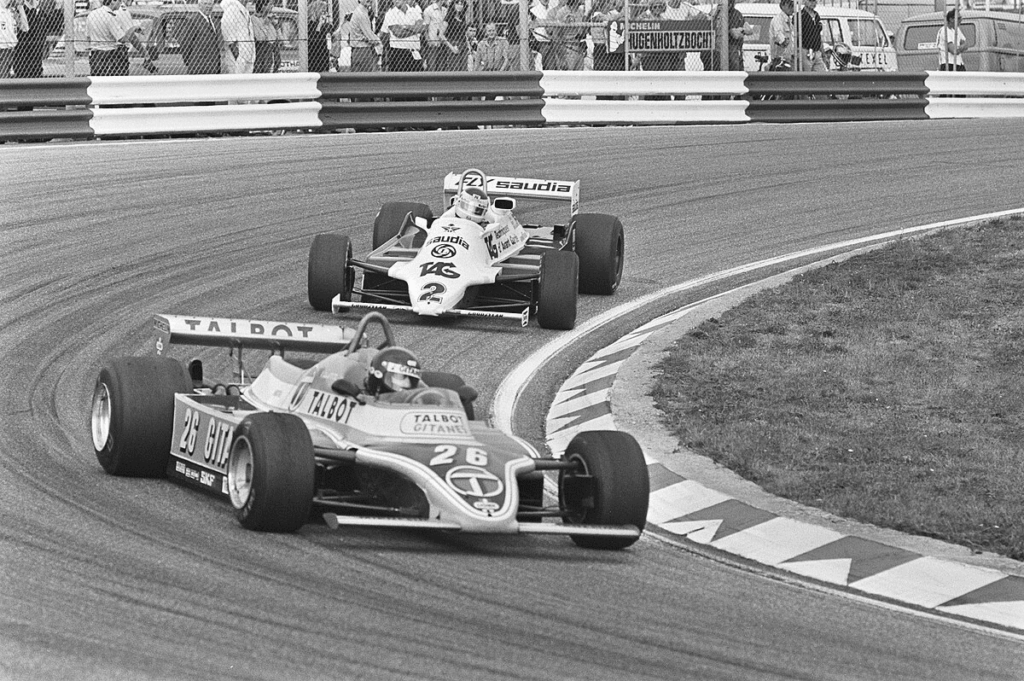
Image Credit: Hans van Dijk – Anefo, CC0 1.0, Link.
Jones’s Williams was running equally well, and the reigning champion was making full use of it. The Australian also had extra incentive as he sought to make up for an error at the previous year’s Dutch Grand Prix which had cost him the win. Jones therefore began to chip away at Prost’s lead, while simultaneously pulling away from Piquet in third. The duel for the lead was on.
Dual Duels
There were therefore two fights on the cards — each involving one of the two Williams machines.
By lap 15 Jones was right up behind Prost and looking for a way past. Unlike with Arnoux however, Prost’s Renault was on full song, and its power made life difficult for the Williams.
Nevertheless, at the start of lap 19 Jones seemed to have got a run on Prost. The young Frenchman showed a tactical nous which belied his age however, blocking Jones from taking the inside line into Tarzan corner. Jones nevertheless tried to hang on, attempting a truly spectacular overtake around the outside. Unfortunately for the Australian though, he simply ran out of grip and was forced to tuck back in behind Prost.
Almost immediately after this exchange, Reutemann and Laffite’s battle also flared up. In this case though the outcome was far more significant.
Like Jones, Reutemann opted to make his move at turn 1 — better known as “Tarzan”. However, unlike Jones, Reutemann opted for a late dive to the inside, looking to take Laffite by surprise.
The move had its desired effect in that Laffite was indeed caught completely unaware. However, this meant that by the time Reutemann was up the inside, the Ligier was already turning into the corner. While Reutemann mounted the kerb in an attempt to avoid an accident, a collision was inevitable, and the consequences were huge. Both Laffite and Reutemann were out of the race on the spot. This meant no points for the championship leader, and a bitter blow to Laffite’s title hopes too.
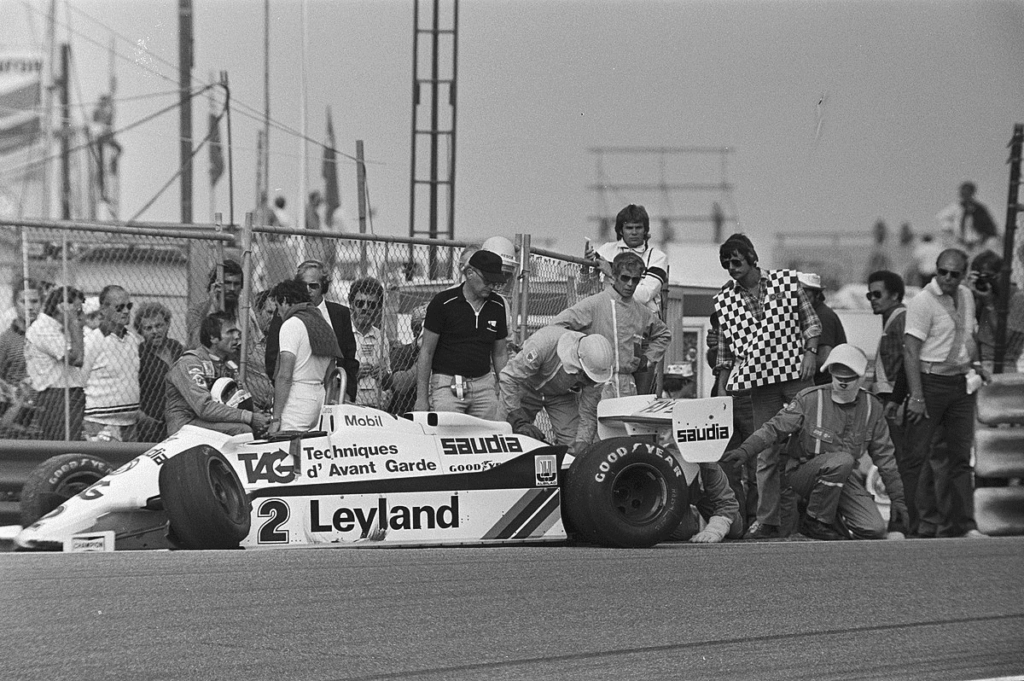
Image Credit: Hans van Dijk – Anefo, CC BY-SA 3.0 NL, Link.
The Action Continues
Despite Reutemann and Laffite’s demise and Prost having fended off Jones’ first challenge, the action continued unabated. As if to underline this, the beginning of lap 20 was signalled by the sight of Bruno Giacomelli’s red and white Alfa Romeo spearing into the barriers at turn 5. Attention soon turned back to the battle for the lead though, because Prost and Jones were now lapping backmarkers. If Jones were to get past Prost, it seemed like this could be his best opportunity.
Prost initially managed to get through much of the traffic unhindered, but when he came up to the Tyrrell of his future 1985 title rival Michele Alboreto, he had problems. Jones didn’t need a second invitation, and pulled off an incredible audacious move to pass Prost on the short straight before the final corner. As they crossed the line on lap 23. Jones held the lead.
Prost was not done fighting however, and he tucked in Jones’ slipstream as the pair went down the pit straight. Then into turn 1 he pulled out and dived to the inside. Jones again tried to hang on around the outside to maintain his hard-won lead, but Prost was not to be denied. The lead was his once more.
Championship Implications
Jones initially stuck with the Renault, hoping to find another opportunity to overtake and this time hold the lead. However, it rapidly became apparent that all the hard fighting had taken the best out of the Williams’ tyres. Jones had started on a soft compound in hopes of taking the fight to the turbocharged cars, but they simply could not stand up to the abuse of battling for the lead any longer.
Prost therefore rapidly pulled away from Jones, who began to slip back into the clutches of Piquet. The Williams had held a huge lead over the Brabham, who was driving a relatively anonymous race, but with a large chunk of laps still to go Jones’ tyre situation would only get worse.
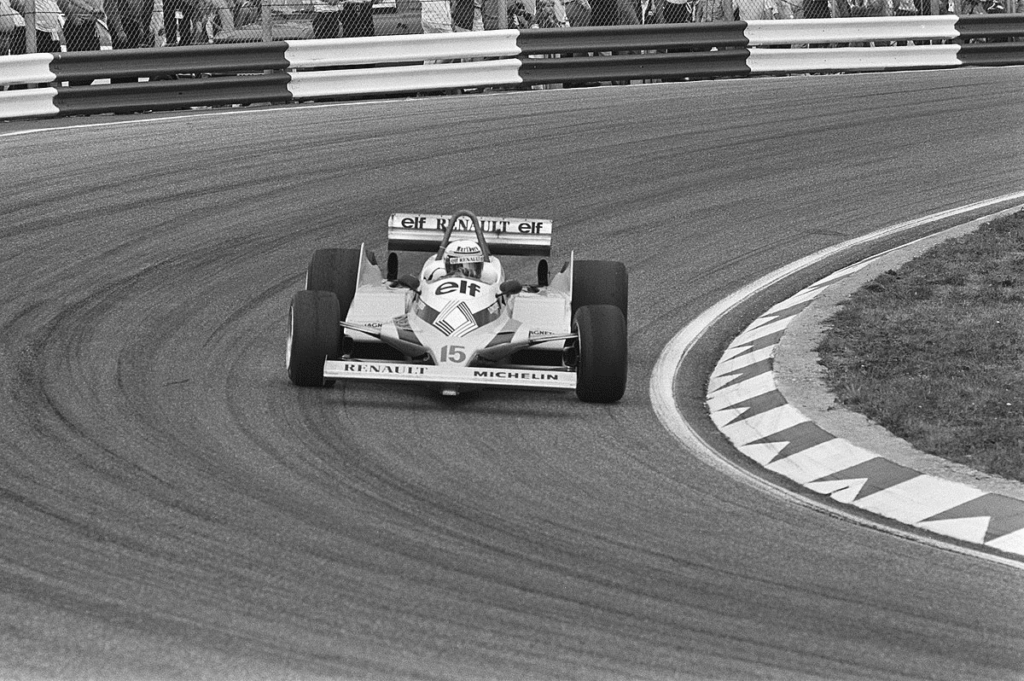
Image Credit: Hans van Dijk – Anefo, CC BY-SA 3.0 NL, Link
After such an action-packed first half of the race, the second half proved a rather more quiet affair. Indeed the main action in the closing laps was a series of retirements. These notably included the McLaren of British Grand Prix winner John Watson, who had been running a solid fourth for most of the race. The brave Andretti — still nursing his tattered front wing — also crashed out with a tyre failure at the exact same point on the circuit that his teammate Giacomelli had crashed. This promoted Piquet’s pay-driver teammate Hector Rebaque to fourth, while behind him the final points positions were occupied by the Lotus of Elio de Angelis and the Ensign of Chilean Eliseo Salazar after a strong drive in a backmarking car.
As Prost ticked off a trouble-free final few laps, Piquet finally caught Jones. There was only 5 laps to go, but the condition of Jones’ tyres left him in no position to fight. Piquet therefore calmly cruised by to take 6 points from his title rival the season before. The result would leave him equal on points with championship leader Reutemann.
In the end though, nobody could touch Prost. The future four-time world champion had won his second grand prix in emphatic fashion, and shown that he could fight with the very best. In many ways, it was a drive which set the template for the era of F1 which was to follow…
[adrotate banner=”6″]
Get 10% off all official F1 Merch at TheRaceWorks.com using code ‘EF1’ at checkout.
Featured image credit: Hans van Dijk – Anefo, CC BY-SA 3.0 NL, Link.