

The Spa-Francorchamps circuit in Belgium has a long and storied history in grand prix racing. Indeed, even before the advent of Formula 1 the fearsome track hosted races in the pre-war European Grand Prix championship. Since then, it has become a mainstay of the Formula 1 calendar.
[adrotate banner=”10″]
Get 10% off all official F1 Merch at TheRaceWorks.com using code ‘EF1‘ at checkout.
The track’s history, combined with its iconic layout, have made Spa a favourite for many fans. However, as we draw near to the 2025 edition of the Belgian Grand Prix, Spa’s future on the F1 calendar is in doubt. The sport’s expansion into new markets has put classic circuits at threat, with Spa among them. Indeed, the latest contract signed with the track will see it only host F1 on a rotational basis until 2031. With other circuits signing longer-term deals, some fans are concerned that the track could depart the calendar for good after this period.
[adrotate banner=”10″]
Get 10% off all official F1 Merch at TheRaceWorks.com using code ‘EF1‘ at checkout.
Absence Makes the Heart Grow Fonder
Should Spa fall off the F1 calendar in the future, it would not be the first time it has done so. The track has already had one extended period of absence from Formula 1 which spanned over a decade.
This absence was prompted by safety concerns about the terrifying original 14 kilometre layout of the track. This layout used large sections of public road, and was scene of many huge high-speed accidents.
As a result of this continual bevy of crashes, F1 departed Spa following the 1970 race there. The Belgian Grand Prix remained on the calendar, but alternated between the unpopular pancake-flat Nivelles circuit and the tight Zolder circuit starting in 1972.
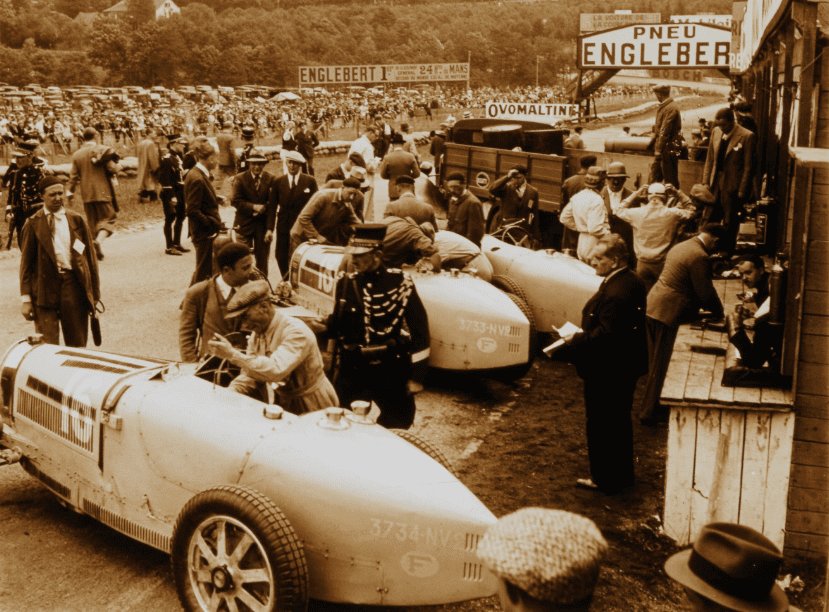
Image Credit: Bibliothèque Nationale du France (public domain)
F1 dropped Nivelles after 1974 and committed solely to Zolder. The Flemish track served Formula 1 well for a while, but eventually it too began to show severe problems. In 1981 a sombre race weekend saw one mechanic killed in practice and another injured after a bungled race start. When star driver Gilles Villeneuve died in practice at the track the following year, it became increasingly apparent that F1 had outgrown Zolder.
It is at this point that Spa re-entered the picture. While F1 had been diligently returning to Zolder year over year, the old Francorchamps circuit had been undergoing extensive renovations. Starting in 1979, a new layout was devised which took some of the most iconic sections of the old track and blended them into a new shorter 6 kilometre layout. This revised Spa circuit was continually tested and fettled over the following years, and by 1983 it was considered to be in a good enough state to host Formula 1.
Turbo Charge
The decision to race at Spa was still very much a last-minute one. As late as January 1983, it remained unclear whether F1 would return to Zolder or use the renovated Spa circuit. However, with Zolder’s issues and Spa long having been missed, a deal was eventually struck. The 1983 Belgian Grand Prix would return to the race’s traditional home for the first time since 1970.
When that long-awaited race weekend finally arrived, there was brief concern that the reprofiling work may have caused the circuit to lose some of the character that had made it so beloved. These fears soon dissipated when the cars hit the track for Friday practice however. Instead, drivers found the long straights and sweeping curves through the Belgian countryside a joy to drive.
Those aforementioned long straights and high-speed corners favoured cars with powerful engines and efficient aerodynamics. It was therefore no surprise to see turbocharged cars monopolising the top positions in qualifying.
Fastest of all though was Alain Prost in his Renault RE40. The car was proving well-suited to high speed circuits, and after winning at home in France a month earlier, Prost was in fine form once again. When the second day of qualifying was affected by rain, Prost’s Friday time of 2:04.615 was enough to secure pole. Meanwhile the fastest non turbo car — the Williams of reigning champion Keke Rosberg — found itself a hefty 3.3 seconds down.
Surprises in Store
On race day there was drama right from the start. Marc Surer, who had qualified well in his non-turbocharged Arrows, had a gearbox issue on the grid. This led to the start being aborted, but some drivers including Prost and the Alfa Romeo of the oft-maligned Andrea de Cesaris did not see the flags. De Cesaris therefore flew off into an early lead, only to have to come to a stop once he noticed the start had been aborted.
Unbelievably though, on the second start de Cesaris produced an even better getaway. From third on the grid he sprinted into the lead for an Alfa Romeo team which rarely enjoyed such competitiveness. All Prost could do initially was sit behind in second and fend off a challenge from Ferrari’s Patrick Tambay.
The early laps were defined by a gaggle of turbocharged cars pulling far ahead of the rest of the field. However, at the very back of that group and confounding expectations was Keke Rosberg in his non-turbocharged Williams. Despite his huge power deficit on such a high-speed track, he alone was finding a way to stick with the lead group.
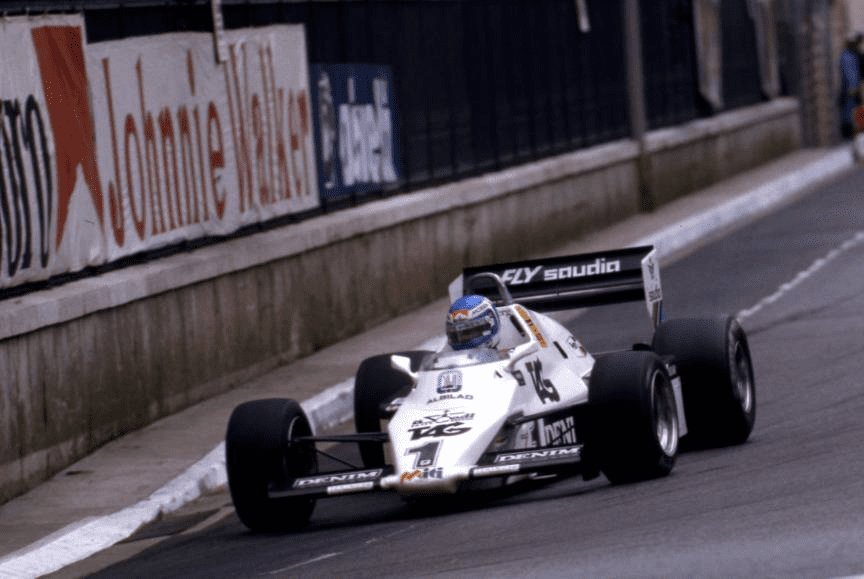
Image Credit: Williams F1
Meanwhile, de Cesaris began to stretch his legs at the front of the field. By lap 10 he had a lead of more than 5 seconds over Prost, who was beginning to drop back. The two Ferraris immediately behind Prost meanwhile were running line astern, with Tambay looking for a way past Prost, while Rene Arnoux in the second scarlet car held fourth.
Surprisingly though the first move in the lead group came from Rosberg. On lap 12 he managed to get past the BMW-engined ATS of Manfred Winkelhock while going up the hill through Raidillon. This promoted the hard-charging Williams driver into the points.
Pit Stop Panic
Seemingly inspired by Rosberg’s efforts, other drivers now began to get a move on. Particularly keen was championship leader Nelson Piquet in fifth, who began making a concerted effort to get past Arnoux’s Ferrari.
At least initially, Arnoux was able to use the Ferrari’s immense power to hold Piquet off, despite having cooked his tyres. This in turn allowed Rosberg to close right up on the two turbocharged runners. Eventually Piquet did finally get past into Eau Rouge on lap 17. The crafty Rosberg then attempted to follow him through, but his lack of power allowed Arnoux to fend him off.
As this battle was going on, the pit window opened. This began what would prove to be the pivotal phase of the race.
Race leader de Cesaris was the first of the lead group to come in on lap 20. After having dominated the first section of the race, hopes at Alfa Romeo were high for a clean stop.
Unfortunately for de Cesaris, his pit stop was a disaster. 1983 was the first season since the 1950s to see widespread use of refuelling stops following Brabham’s reintroduction of the concept a year earlier. Many teams therefore lacked practice in their execution, and Alfa Romeo were among them. The result was a plodding 25 second pit stop.
Prost came in for his stop three laps later, but not before more drama occurred when Winkelhock’s ATS shed a wheel at high speed after his pitstop, and Arnoux retired with a blown engine. De Cesaris’ shambolic stop and Winkelhock’s accident both served to underline the teams’ lack of pit stop experience.
Prost’s stop on the other hand was drama free, with Renault’s mechanics delivering a searingly quick turnaround for the time. It took just 14 seconds for Prost to have his tyres changed and his fuel topped up, which enabled him to emerge from the pits ahead of an incensed de Cesaris. Only time would tell if the young Alfa driver could regain his lead…
Prost Perfection
While de Cesaris was keen to regain his lost lead, Prost had other ideas. Renault had introduced a major upgrade package for the previous race at Monaco which equipped their car with F1’s first ever exhaust-blown diffuser — a technology later used to great effect by Red Bull in the 2010s. With clean air now ahead of him, Prost was able to use his upgraded car to full effect to pull clear of the Alfa Romeo.
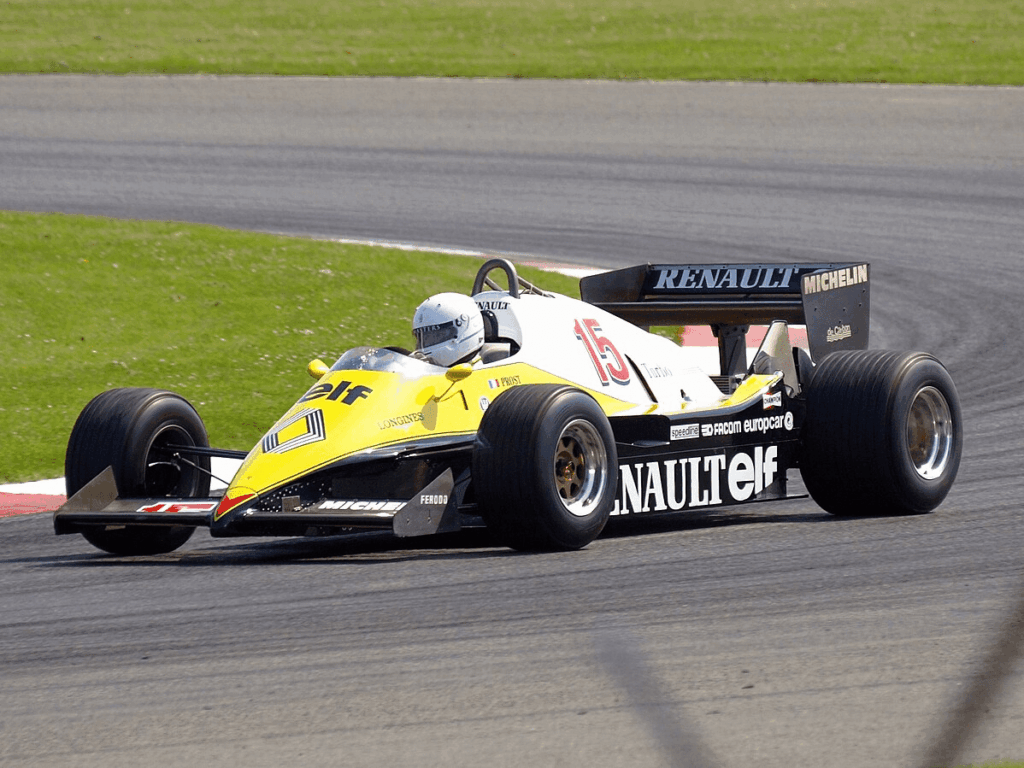
Image Credit: Darren Tee – Own Work, CC BY 2.0, Link.

Worse was yet to come for de Cesaris however, as on lap 25 his Alfa ground to an agonising halt. His engine’s fuel injection had failed. De Cesaris often received criticism for his wild driving, but this time he had done everything right only to be let down by his team and his car. Quite understandably the young Italian could only sit disappointedly next to his stricken car and wonder what might have been.
The race was now entering its closing stages, and Prost held a comfortable lead. The Frenchman therefore made sure to manage his pace to avoid suffering the same fate as de Cesaris.
To the Victor go the Spoils
While Prost had sufficient gap to cruise home, other drivers did not have this luxury. Among them was championship leader Piquet. He had the Ferrari of Tambay right behind after jumping him in the pit stops, and was forced to maintain maximum pace to try to keep him behind.
This pressure from Tambay eventually had the desired effect, and Piquet was hit with a gearbox issue. The Brazilian kept going, but a loss of top gear meant he was a sitting duck on the straights. This duly allowed the Ferrari up into second. Before long the second Renault of Prost’s teammate Eddie Cheever was also past and into the podium places. With Prost taking a well-earned victory ahead of Tambay, it was a great day for the Renault team.
Piquet did however manage to cling on to fourth ahead of Rosberg. The Williams driver and his teammate Jacques Laffite therefore rounded out the points placings.
With that, F1’s first race back at Spa came to an end, and it had been a suitably entertaining event. While not flush with overtakes, the track had provided notable underdog performances from the likes of de Cesaris, and a display of calm perfection from Prost. Rosberg had also proven that even after its changes, Spa was still very much a circuit where a determined driver could make a difference.
It’s small wonder the track has been a fixture of the F1 calendar ever since.
[adrotate banner=”6″]
Get 10% off all official F1 Merch at TheRaceWorks.com using code ‘EF1’ at checkout.
Featured Image Credit: Planet Labs Inc – Own Work, CC BY-SA 4.0, Link.
.jpg)