

Easily one of the most challenging tracks on the race calendar, the Circuit de Spa-Francorchamps remains a classic.

[adrotate banner=”10″]
Get 10% off all official F1 Merch at TheRaceWorks.com using code ‘EF1‘ at checkout.
Circuit Stats
| Track Length | 7.004 km |
| Number of Laps | 44 |
| Race Lap Record | 1:48.286 (Valtteri Bottas – 2018) |
| Qualifying Lap Record | 1:41.252 (Lewis Hamilton – 2020) *Modern layout 1:09.820 (Clay Regazzoni – 1974) *Old layout |
| First Grand Prix | 1950 |
| First Race Winner | Juan Manuel Fangio |
| 2023 Race Winner | Max Verstappen |
Circuit History
The Circuit de Spa-Francorchamps has been a part of Formula 1 since the World Championship began in 1950. One of just 7 circuits that have been used since Formula 1 began, it’s a challenging combination of high-speed straights, sweeping curves and tight hairpins. Throw in a steep incline and you’ve got yourself one hair-raising ride.

In 1921, Jules de Thier and Henri Langlois van Ophem designed a triangular-shaped track that used public roads between Francorchamps, Malmedy and Stavelot. The result was a 14.9km circuit that swept through the hills and forests of the Ardennes region.
The track crossed the former Belgian-German Empire border. This lay at Eau Rouge creek, which runs under the track at the foot of the Raidillon and between the paddocks and the entrance to Blanchimont.
The track was originally due to host its inaugural motorsports race in 1921, but this was cancelled when only one driver entered. In 1922, the first car race was held, and in 1924 the 24 Hours of Francorchamps took place at the circuit.
In 1950, Formula 1 arrived on the scene. At the time, Spa-Francorchamps was the fastest road circuit in Europe. Since then, it has hosted a Formula 1 race every year except for 2003 and 2006. Spa-Francorchamps is currently contracted to host Formula 1 until the end 2025.
Layout Changes
There have been many layout changes in the long history of the Circuit de Spa-Francorchamps, most notably in 1979. A major redevelopment of the circuit saw its length cut in half. Spa-Francorchamps currently sits at 7.004km, and is still the longest circuit on the current Formula 1 calendar.


Go back to 1930, and the Malmedy chicane was bypassed to make the course faster. However, in 1935, the chicane was reinstalled with a minor change. 1939 saw the birth of the iconic Eau Rouge/Raidillon curve, as the Virage de l’Acienne Douane was eliminated.
In 1947, the Malmedy chicane was cut from the circuit once more, becoming part of the Masta straight. Holowell’s slight right-hander was also altered, and a shortcut was added to bypass the town of Stavelot. This meant that drivers no longer entered the town itself.
[adrotate banner=”10″]
Get 10% off all official F1 Merch at TheRaceWorks.com using code ‘EF1‘ at checkout.
Major Redevelopment
1979’s huge overhaul of the circuit saw the start-finish line move to the straight ahead of the La Source hairpin. The circuit was halved in length, but remained incredibly fast and challenging. In 1994, following the deaths of Ayrton Senna and Roland Ratzenberger, chicanes were introduced that were constructed of stacked tyres. Eau Rouge also found itself the subject of alteration in 2002.
The final Bus Stop chicane was reprofiled in 2004, adding an extra sweep to the right. In 2007, the Bus Stop chicane was moved back, and the La Source hairpin got moved forward to allow more space for the new pit lane and to extend the start-finish straight.
Ahead of the 2010 Formula 1 Grand Prix, asphalt runoff was added to the inner and outer sections of Les Combes. 2013 saw drainage grooves being cut into the start-finish straight, underneath the first 11 grid slots.
Criticism around the Raidillon tyre barrier and runoff area (known for bouncing crashed cars back onto the track rather than stopping them) spurred changes in 2020. Gravel traps were placed at La Source, Raidillon, Blanchimont, Les Combes and Stavelot. There were also expansions of the runoff areas at multiple corners, including Raidillon.
Racing In The Rain
The Ardennes region is famous for its unpredictable weather. It’s not unusual for drivers to face blazing sunshine on one section of the track, whilst fighting for grip in heavy rain elsewhere on the lap. The Belgian Grand Prix and wet conditions has to be one of the most iconic pairings in Formula 1. Approximately 29% of races in the history of the Circuit de Spa-Francorchamps have taken place in the rain.
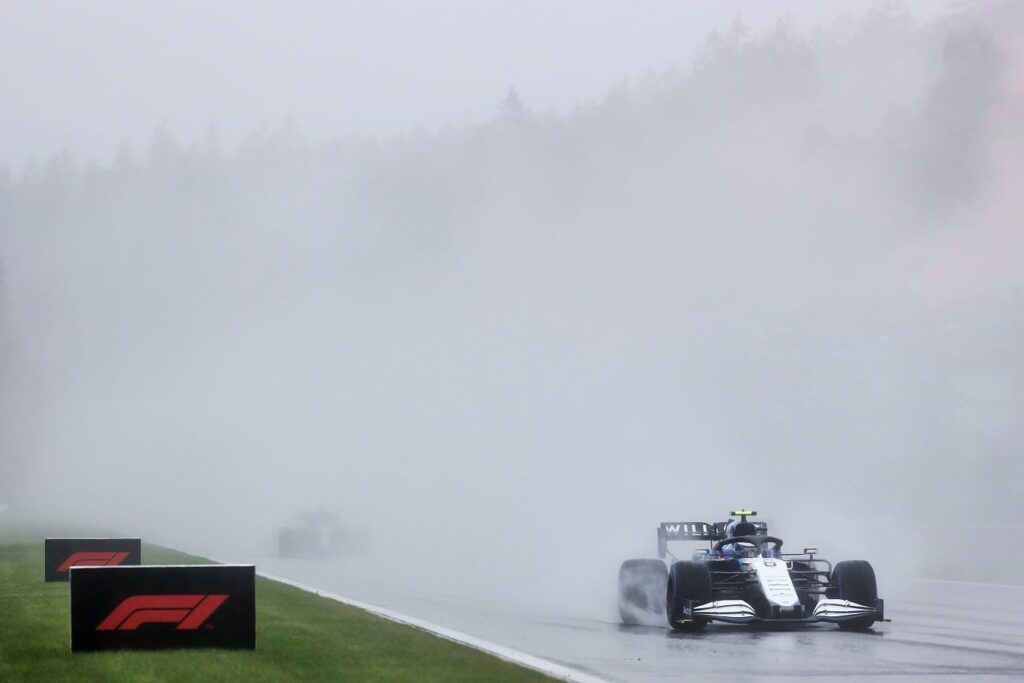
Conditions were so bad in 2021, that Sergio Perez slid his Red Bull into the barrier as he made his way to the grid. The race start was delayed by a whopping 3 hours, but eventually the Safety Car was allowed to lead the pack out of the pit lane. The track surface was so wet, that pole-sitter Max Verstappen had to pull out to the side behind the Safety Car in order to see. Huge plumes of spray made visibility incredibly low for the drivers. On lap 3, with every lap so far being run behind the Safety Car, the race was red-flagged. The decision was made not to restart the race, and half points were awarded.
[adrotate banner=”10″]
Get 10% off all official F1 Merch at TheRaceWorks.com using code ‘EF1‘ at checkout.
Safety Concerns
Safety has always been a hot topic of debate throughout the history of the Circuit de Spa-Francorchamps. Sadly, the circuit has seen multiple fatalities and a number of horrific crashes.
During the Formula 2 feature race in 2019, there was a serious collision involving Anthoine Hubert and Juan Manuel Correa. Giuliano Alesi lost control of his car at Raidillon, causing a chain reaction that saw Hubert clip Ralph Boschung’s right rear tyre, hit the barrier and get deflected sideways into the path of Correa. Hubert’s car was snapped in two, resulting in his death and causing serious injury to Correa.
The 2021 W Series qualifying session was affected by rain, causing a serious incident that saw 6 cars crash into one another. The incident left damaged cars strewn all over the runoff area and the track. Sarah Moore, Abbie Eaton, Beitske Visser, Ayla Agren, Belén García and Fabienne Wohlwend were all checked as a precaution. Visser and Agren then went to hospital for further checks and x-rays. Thankfully, all drivers escaped without injury, and were cleared by medics.
Just one day after the W Series incident, Formula 1 also saw qualifying hit by heavy rain. In the third session, multiple drivers were reporting that conditions were not safe, calling for a delay or red flag. Lando Norris then experienced a sudden snap of oversteer, but managed to correct the car. However, he aquaplaned into the tyre barrier at Raidillon before spinning back across the track. Norris was taken to hospital for x-rays, but was thankfully cleared to race the following day.
Eau Rouge’s Evolution
Following the W Series and Formula 1 incidents in 2021, drivers from all racing series were calling for changes. Their target area? The Eau Rouge/Raidillon curve. Jack Aitken said “Everyone has gotten the picture of what needs changing”. Zhou Guanyu said that “Eau Rouge corner in Spa need to make a change”, and Pietro Fittipaldi stated “They need to do something to Eau Rouge to make it safer”. Jake Hughes, Daniel Ricciardo and Toto Wolff all agreed that changes had to be made immediately in the interest of safety. The result was a major facility and safety facility redevelopment ahead of the 2022 Grand Prix. 20 variations of Eau Rouge were evaluated, with the final selection being made with the help of former Formula 1 drivers Thierry Boutsen and Emanuele Pirro.
Iconic Moment
Schumacher vs Häkkinen will forever be remembered as one of the greatest rivalries in F1, and their fight for the win at the 2000 Belgian Grand Prix was a defining chapter in their epic battle.
Häkkinen was on the charge to try and win his 3rd championship in a row, whilst Schumacher was fighting to bring home Ferrari’s first championship in 21 years. Whilst the race started off wet, the track really started drying out in the later stages of the race. Schumacher had the lead, with Häkkinen chasing the Ferrari and trying to find a way past Schumacher’s impeccable defence.
With just 3 laps remaining, Häkkinen finally got the run he had been looking for. In a stroke of racing ingenuity, the Finn used the lapped car of Ricardo Zonta to slingshot himself past Schumacher and ultimately take the race win.
What’s your iconic Belgian Grand Prix moment? Let us know in the comments!
[adrotate banner=”10″]
Get 10% off all official F1 Merch at TheRaceWorks.com using code ‘EF1‘ at checkout.