

[adrotate banner=”10″]
Get 10% off all official F1 Merch at TheRaceWorks.com using code ‘EF1‘ at checkout.
As many will doubtless know, Silverstone played host to the very first Formula 1 World Championship race back in 1950. In the intervening 75 years the track has witnessed some of the sport’s most memorable races and moments. From Williams’ first victory to Lewis Hamilton’s 2008 wet-weather masterclass, it’s no surprise that Silverstone stands out as one of F1’s most beloved and iconic circuits.
Among the many races at Silverstone, one of the most enjoyable for the devoted legion of home fans who flock to the circuit every year was the 1977 British Grand Prix.
That race saw James Hunt — already the darling of British F1 fans — score the first victory of his title-defending season. In doing so, he avenged a controversial disqualification the previous year, and became the first Englishman to win a championship grand prix in England since 1958.
[adrotate banner=”10″]
Get 10% off all official F1 Merch at TheRaceWorks.com using code ‘EF1‘ at checkout.
Scores to Settle
By the time the 1977 British Grand Prix came around, that year’s title contenders seemed firmly established. Niki Lauda was well in contention thanks to a consistent campaign following his horrendous accident at the Nürburgring the previous year. His main rivals were Mario Andretti at a resurgent Lotus team, and Jody Scheckter driving for the new Wolf outfit. Going into the race at Silverstone, just one point separated the trio in the championship.
For reigning champion James Hunt meanwhile, prospects were significantly less rosy. Despite taking pole at the first three races, Hunt claimed just three points finishes in the season’s first nine rounds. This was partially down to McLaren’s M23 chassis, which had been introduced in 1973, losing competitiveness. However, even the arrival of a new M26 chassis did not seem to provide the hoped-for improvement in form initially.
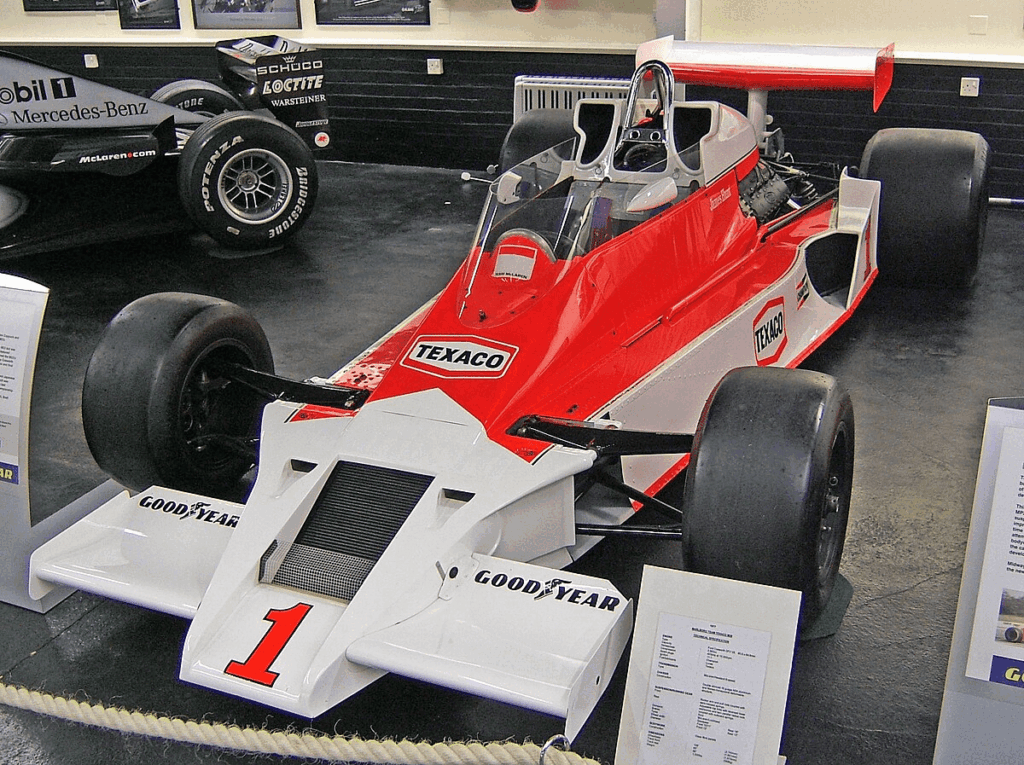
Image Credit: John Chapman / Pyrope – Own Work, CC BY-SA 2.0, Link.

Hunt and his teammate Jochen Mass knuckled down to develop the new car though, and by the French Grand Prix their efforts were starting to bear fruit. This progress happened just in time to set Hunt up for a potential strong showing at his home event.
Hunt was also hungry for a result for other reasons. The previous year’s British Grand Prix at Brands Hatch had seen the Briton seemingly secure a memorable home win following a red flag and subsequent restart. This soon turned sour however, as after the race Hunt was disqualified. It was judged that he should not have been allowed to take the restart after being involved in the crash that bought out the red flag, and failing to complete the first lap. With Hunt viewing the disqualification as being down to Ferrari’s political manoeuvring, 1977 presented a chance for vengeance.
A Groundbreaking Debut
Hunt’s quest for home race redemption was not the only major storyline of the 1977 British Grand Prix, however. The race also provided intrigue on the technical side of the sport.
That intrigue came in the form of the arrival of a new team with a particularly radical car — Renault.
The French giant’s RS01 chassis itself was nothing to write home about. However, in the back the car sported Formula 1’s first ever turbocharged engine — a 1.5 litre V6. While regulations restricted it to half the displacement of conventional engines, Renault nevertheless proudly claimed an output of 510 horsepower. This compared very favourably with the approximately 475 horsepower produced by the Cosworth DFV engines which most rival teams used.

Image Credit: Ian McWilliams – Own Work, CC BY 2.0, Link.
Renault’s arrival was met with a combination of excitement and suspicion by the F1 fraternity. Some within the paddock were thrilled by the debut of a genuinely radical new technology. Others meanwhile sneered at what they saw as a developmental dead-end.
What the critics did not realise however was just how much scope for development turbocharging had. While Renault experienced horrendous reliability initially (earning the RS01 the nickname “The Yellow Teapot) Silverstone was merely a starting point. Combined with the ground effect aerodynamics which Lotus had introduced earlier in 1977, turbocharging would eventually go on to become one of the defining technologies of the next two Formula 1 eras.
A Battle for the Ages
Unsurprisingly given the early state of its development, the Renault didn’t feature in the top grid positions for the race. For the home Silverstone crowd on the other hand, qualifying couldn’t have gone much better.
Hunt claimed pole in his much-improved McLaren, while Ulsterman John Watson took second in his Brabham BT45B. Home drivers would therefore lock out the front row. With Lauda, Scheckter and the two Lotuses of Andretti and teammate Gunnar Nilsson also qualifying well, the grid looked ideally set for a brilliant race.
At the start the partisan crowd’s spirits were dampened somewhat by Hunt having one of his habitual poor getaways. Watson therefore took over in front ahead of Lauda and Scheckter as Hunt’s McLaren fell to fourth.
Early on the order remained relatively static, with the only major change being Andretti getting ahead of his teammate Nilsson. However as the fuel loads began to lighten and tyres began to wear certain drivers began to find their groove.
Hunt was among those on a charge. After seeing off a brief challenge from Andretti he set about making up for his poor start. An excellent move on Scheckter into the high-speed Stowe corner on lap 7 clearly announced the reigning champion’s intentions.
Hunt soon pulled up onto the back of the lead train comprised of Watson and Lauda. For the time being though the Brabham driver seemed unfazed, holding off the two champions imperiously. After losing the lead of the previous race in France on the final lap to fuel exhaustion, Watson was clearly in no mood to finish second again.
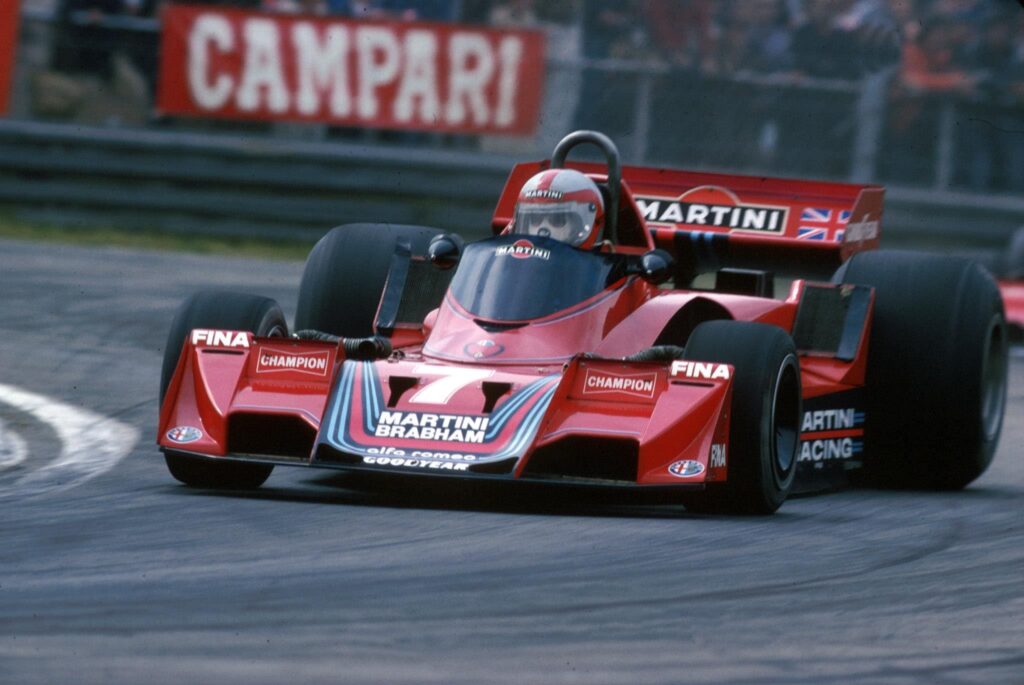
Image Credit: CrazyLenny2 – Own Work, CC BY-SA 2.0, Link.
Unlucky for Some
The demanding, high-speed nature of Silverstone soon started to take its toll however. One early casualty was the Renault, which dropped out on lap 16 with a broken turbocharger. The fact that the team would win a race less than two years later almost seems hard to believe.
Back up at the front Watson began to pull away from Lauda, while Hunt closed in further on the Austrian. Hunt was in no mood to hang around though, and on lap 23 he hurled his M26 past the Ferrari at the Woodcote chicane. It would now be a straight fight for the win between the two Britons.
Hunt quickly closed the gap to Watson, but the Englishman would soon get a reminder that catching and overtaking are two different things.
Lap after lap Watson held his ground, leveraging the grunt of his Brabham’s flat-12 Alfa Romeo engine to keep ahead. Hunt seemed quicker through the corners, and occasionally tried a desperate divebomb hoping to catch Watson unaware. The Ulsterman always had control of the situation though, and deftly held Hunt off. At the race approached its closing stages, it seemed that Brabham and Watson would finally secure their first win of 1977.
Just when the race seemed sewn up though, Watson’s challenge unravelled. On lap 50 of 78 the Brabham’s engine began to cough and splutter. With Hunt still close behind, this almost immediately cost Watson the lead into Chapel curve. Watson quickly entered the pits for a top-up of fuel, believing the issue to be a repeat of his fuel runout in France. However it soon transpired the problem was more terminal, and was down to the Brabham’s fuel lines themselves failing. The perennially unlucky Northern Irishman therefore retired from the second race in succession that he could have won.
A Late Charge
With Hunt secure in the lead following Watson’s untimely retirement, attention turned to the lower podium places. In this area much of the excitement came from Lotus’ second driver Gunnar Nilsson.
The Swede tended to fare well on high-speed circuits, and Silverstone proved no different. Despite the Lotus 78 suffering a straight line speed deficit, Nilsson and his car both started to come good as others wore down their tyres.
First Nilsson passed his team leader Andretti on lap 53 to claim fourth. He soon followed this by getting right up behind Scheckter for third too. Scheckter briefly resisted the Swede’s challenge, but his Wolf soon blew its Cosworth engine, promoting the Lotus to third. With Lauda a long way ahead in second, it seemed the podium was now set, but Nilsson continued to push hard regardless.
Meanwhile, Hunt was ticking down the laps to the chequered flag when he was met with the somewhat troubling news that McLaren believed he was marginal on fuel. Mindful of what happened to Watson, Hunt duly eased off — a luxury afforded by his huge gap to second place.
Despite this issue, Hunt was able to hold on, crossing the line 18 seconds ahead of Lauda. Nilsson meanwhile was just 1.3 seconds further back, having closed right up on Lauda during the final tour.
All three drivers on the podium were justifiably elated. Hunt, for having avenged his previous year’s disqualification and having got his season back on track. Lauda for having extended his championship lead by driving a canny, controlled race, and Nilsson for having shown charging spirit to claim his second podium of the year (which would sadly prove the last of a tragically short career curtailed by cancer).
Perhaps most thrilled of all though was the Silverstone crowd. Not only had “their man” won, but they had been treated to 68 laps of non-stop fantastic motor racing. It is testament to Silverstone’s quality as a race track that even 48 years later, it continues to provide similarly enthralling action.

Image Credit: Martin Lee – Own Work, CC BY-SA 2.0, Link.
[adrotate banner=”8″]
Get 10% off all official F1 Merch at TheRaceWorks.com using code ‘EF1‘ at checkout.
Featured Image Credit: McLaren F1