

[adrotate banner=”10″]
Get 10% off all official F1 Merch at TheRaceWorks.com using code ‘EF1‘ at checkout.
The changeable weather at Spa-Francorchamps always brings a challenge, but in 2021 it brought chaos and controversy.
About The Belgian Grand Prix
Since 1950, Formula 1 has raced at the Circuit de Spa-Francorchamps in Belgium. It’s just one of seven circuits that has been used since the Formula 1 World Championship began, and it’s a favourite amongst fans. A challenging combination of tight hairpins, sweeping curves and high-speed straights, the circuit also boasts a steep incline to make one rollercoaster of a race track.
The Ardennes region of Belgium is famous for its unpredictable weather. It’s not unusual for drivers to face blazing sunshine on one section of the track, whilst fighting for grip in heavy rain elsewhere on the lap. The Belgian Grand Prix and wet conditions has to be one of the most iconic pairings in Formula 1. Approximately 29% of Formula 1 races in Belgium have taken place in the rain.
Despite the circuit being halved in size in 1929, Spa-Francorchamps is still the longest circuit on the race calendar. Each lap is 7.004km, and the race lap record is now held by Sergio Pérez, who set a time of 1:44.701 on the final lap at the 2024 Belgian Grand Prix. Spa-Francorchamps extended its deal with Formula 1 in January 2025 and is currently set to host races in 2026, 2027, 2029 and 2030.
[adrotate banner=”10″]
Get 10% off all official F1 Merch at TheRaceWorks.com using code ‘EF1‘ at checkout.
The 2021 Belgian Grand Prix
It’s easy to remember a race for having non-stop action and daring moves. But it’s equally easy to remember races that are shrouded in controversy, and this is where the 2021 Belgian Grand Prix really stands out.
Rain never fails to spice up a grand prix. It’s caused spins, collisions and lengthy delays. Teams and drivers have gambled on strategies that have either proven to be a stroke of genius, or ended in heartbreak. The 2021 Belgian Grand Prix added drama to an already controversial season, with questionable decisions from the race directors throughout the weekend. To top it all off, the extreme rain helped to bring about the shortest ever race in Formula 1 history.
Free Practice
The first free practice session on Friday was a relatively normal affair. There were spins at La Source for Yuki Tsunoda and Kimi Räikkönen. Räikkönen’s session ended after he hit the inside pit wall, whilst Charles Leclerc ran wide at turn 7 before safely recovering. Nicolas Latifi impeded Lewis Hamilton, and the timing table was topped by Valtteri Bottas.
The second free practice session saw the red flags come out on two occasions. The first was due to Leclerc losing the rear end of his Ferrari as he came into Les Combes, crashing into the wall. The second red flag was the result of Max Verstappen crashing into the wall at Malmedy, having also lost control of the rear. Esteban Ocon also had a spin, but was able to recover and get back to the pits. Despite his crash, it was Verstappen at the top of the timings when the session finished.
The final free practice session on Saturday saw a damp start to the day. Rain had fallen non-stop overnight, making the track slick and slippery. Whilst there were no major incidents, there were plenty of slides. George Russell, Nikita Mazepin, Valtteri Bottas, Sebastian Vettel and Carlos Sainz all ran wide in the wet conditions. Räikkönen’s session ended early due to brake failure, and Pierre Gasly had a spin. At the end of the session, it was Verstappen at the top of the timesheets once more.
[adrotate banner=”10″]
Get 10% off all official F1 Merch at TheRaceWorks.com using code ‘EF1‘ at checkout.
Qualifying
The rain returned ahead of the qualifying session, causing race control to delay the start. As the cars eventually filtered out onto the track, everyone had opted for the full wet tyre…except for two. George Russell and Nicholas Latifi were rolling the dice and had opted for intermediate tyres. It seemed to be a gamble that paid off, with both drivers quickly finding themselves in first and second respectively. Teams hurried to switch from wets to inters, and at the end of Q1 it was Lando Norris who set the fastest time, followed by Verstappen and Hamilton.
Q2 was also run on intermediate tyres, and it was a fairly smooth session as drivers put their foot down to try and escape elimination. At the end of Q2, Norris was once again at the top of the timings. Hamilton was second fastest, with teammate Bottas third.
The heavens opened once again, with the rain worsening by the minute. Drivers went out to try and navigate the track, but immediately called for a delayed session or even a red flag due to the conditions. No sooner had Vettel been on the radio to complain about the dangerous conditions, the inevitable red flag incident occurred. Norris found himself aquaplaning at speed through Eau Rouge, slamming heavily into the barriers at Radillon. Vettel stopped his Aston Martin alongside the stricken McLaren, checking on Norris in a moment of pure sportsmanship and class. The session would not resume, and it was Verstappen on pole, Russell in second and Hamilton in third.
Race Start Delayed
Following the heavy crash during qualifying, Norris was cleared to race. The rain was still incredibly heavy, with the race start being delayed multiple times in the hopes that conditions would improve. Sergio Pérez didn’t even make it to the grid, crashing on the out lap. Due to the multiple race start delays that followed, the Red Bull mechanics managed to fix Pérez’s car. There was some initial confusion as to whether Pérez would be allowed to start the race, but he was eventually given the go-ahead by race officials.
25 minutes after the race was initially due to start, the first attempt was made at getting things underway. The Safety Car led the pack around on two formation laps, but it wasn’t to be. The starting procedure was suspended and the cars queued up in the pit lane. Just over one and a half hours later, the stewards invoked article 11.9.3 of the 2021 FIA International Sporting Code. This rare decision meant that they were able to suspend the race clock on grounds of force majeure (meaning the longest ever race still belonged to Canada).

Race Start...
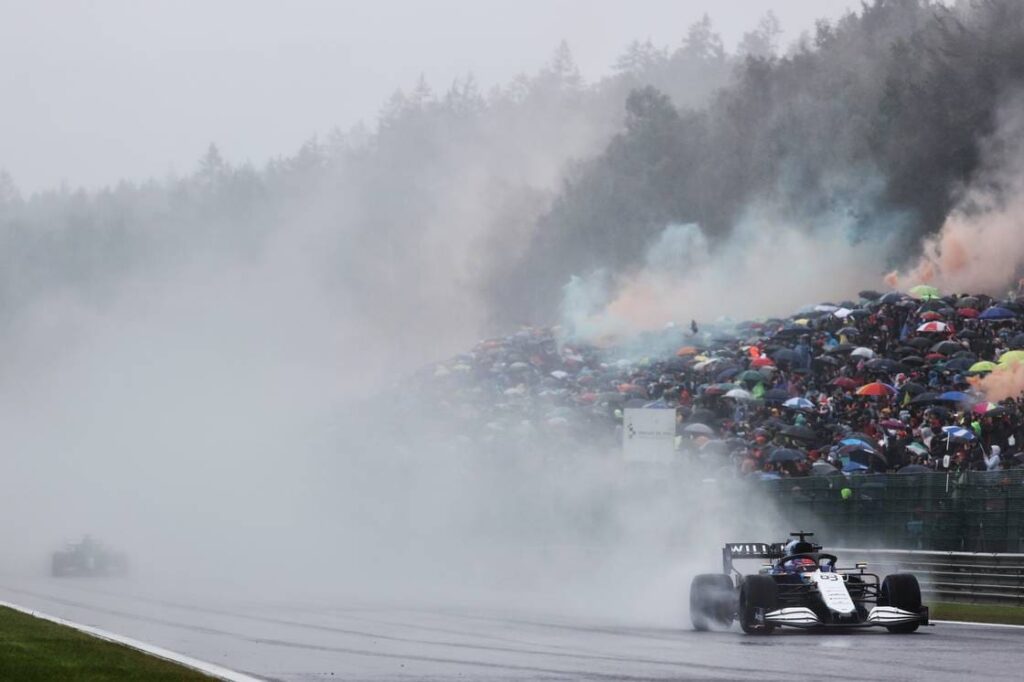
After over three hours of delays and suspended starts, the race finally got the green light, officially starting behind the Safety Car and from the pit lane. Bernd Mayländer once again led the pack around Spa-Francorchamps, with the cars creating a thick, white curtain as the spray was kicked up into the air.
As the race had officially started, all laps behind the Safety Car were counted as race laps. The cars trundled around the circuit for two laps, with no improvement in the weather. Then, half way through the third lap, the race was suspended yet again.
…And Race Finish
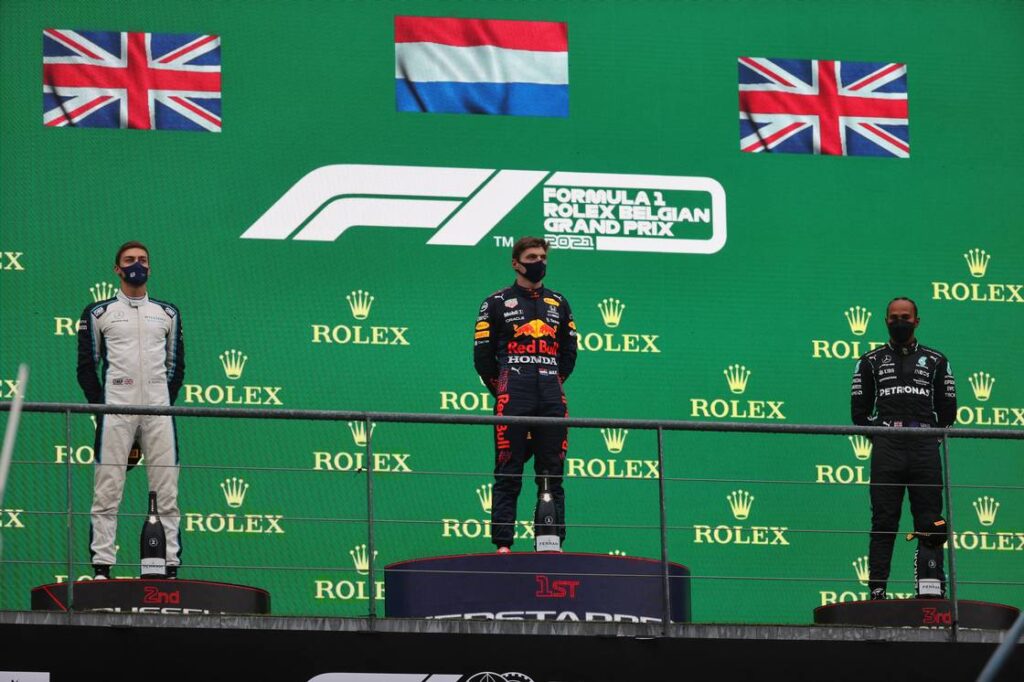
The message went out from Race Control that the race would not be resumed. Under 2021 regulations, the results could be classified and half points could be awarded. The result was taken after the first lap, as regulations required a two-lap countback should a race be suspended. As no overtaking could happen, Max Verstappen was declared the winner. George Russell came in second and claimed his first career podium, with Lewis Hamilton in third. Lance Stroll was handed a 10-second penalty for a rear wing change under parc fermé conditions, dropping him from 18th to 20th. Leclerc was also investigated for a tyre change during the delayed starts. As this change had been quickly reversed, he avoided any penalties.
With the final classification coming from just one lap, it was the shortest race in the history of F1. As it stands, it’s the only F1 World Championship Grand Prix where there is no officially recognised fastest lap and the only race to have never had green flag conditions. It was also only the sixth time half points had been awarded, the 11th time there had been no retirements during the race and the 12th time a race had finished under the Safety Car.
[adrotate banner=”10″]
Get 10% off all official F1 Merch at TheRaceWorks.com using code ‘EF1‘ at checkout.
Post-Race
As was the running theme throughout the 2021 season, Michael Masi came under fire for his decisions across the Belgian Grand Prix weekend. Masi stood by his argument that a genuine attempt to go racing had been made. Hamilton called the race “a farce”, and argued along with others that points should not have been awarded. Some drivers defended the choice to award half points, including Daniel Ricciardo and Sergio Pérez. Even Verstappen was quick to admit “it’s not the way you want to win”.
On top of the points debate, there was criticism from a commercial standpoint too. Some accused Formula One of prioritising profit over the interests of spectators and fans. There was no refund for the spectators that had battled the rain to witness just two slow Safety Car laps. Stefano Domenicali, Formula One Group CEO, rejected claims that the two laps had been run purely to satisfy commercial obligation.
In response to criticism about racing in extremely wet conditions, changes were made to the sporting regulations. From 2022, a race was required to run for a minimum of two laps under green flag conditions for points to be awarded. The design of the cars themselves was also reviewed in a bid to reduce the need for safety cars and red flags in wet conditions. In 2023, Pirelli introduced a new full-wet tyre that didn’t require the use of tyre blankets. “Spray guards” were also designed, although after initial tests it appears there could be a long wait before any introduction into the sport.
Summary
The 2021 Belgian Grand Prix was not one of Formula 1’s shining moments. However, it’s worthy of being a race to remember due to the important lessons that can be learned. We have many more races to come at Spa-Francorchamps, but there’ll likely (and hopefully) never be another Grand Prix quite like we saw in 2021.
Which Belgian Grand Prix do you think is a race to remember? Let us know in the comments!