

The Japanese Grand Prix is always a fan-favourite. We look back at the 2012 Japanese Grand Prix, and a very special race for Kamui Kobayashi.
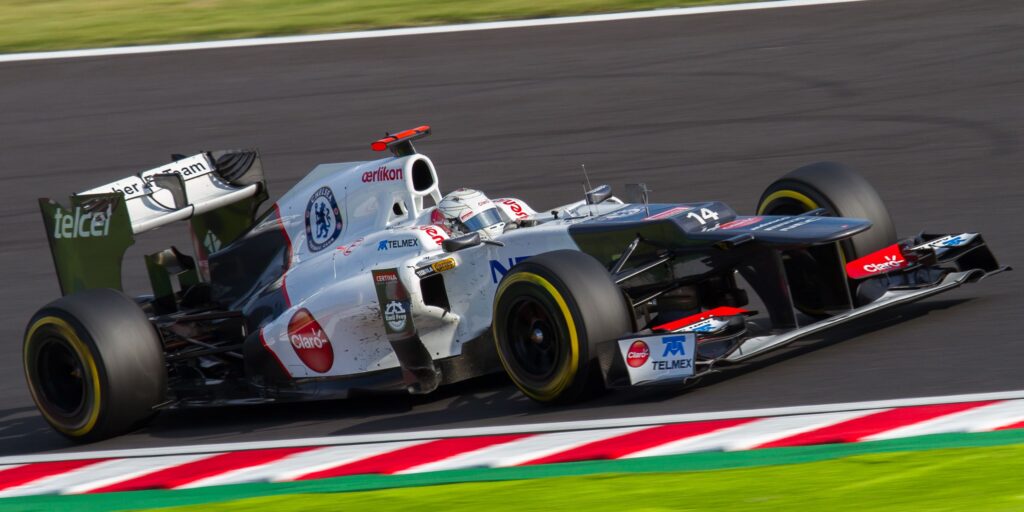
Image Credit: Morio – Own work, CC BY-SA 3.0, Link
[adrotate banner=”10″]
Get 10% off all official F1 Merch at TheRaceWorks.com using code ‘EF1‘ at checkout.
About The Japanese Grand Prix
The Japanese Grand Prix has been part of Formula 1 since 1976. For the first two years, it was held at the Fuji Speedway in Oyama. But in 1980, Japan was noticeably absent from the race calendar. Formula 1 didn’t return to Japan until 1987, when the brand-new Suzuka International Racing Course took over hosting duties. With the exception of the 2007 and 2008 Grands Prix (which were held at a newly refurbished Fuji Speedway), Suzuka has been the home of Formula 1 in Japan ever since. As far as Formula 1 tracks go, Suzuka has a unique combination of design features. The speedy crossover section, multiple tight hairpins and the famous “Esses” that make up Turns 3 to 6 are all things that make it such an iconic circuit.
Throughout the years, there have been 21 Japanese drivers in Formula 1. Of those, 18 took part in at least one race. There is just one Japanese driver on the grid in 2025 – Yuki Tsunoda. Yuki will be hoping to impress in front of his home crowd, especially as he will be making his debut as a Red Bull driver, following the team’s decision to swap him with Liam Lawson.
Only 2 Japanese drivers have ever stood on the Formula 1 podium in Japan. The first of those two was Aguri Suzuki, who took third place at the 1990 Japanese Grand Prix. The most recent occurrence was 13 years ago, when Kamui Kobayashi delighted the Japanese crowds with a third-place finish.
The 2012 Japanese Grand Prix
With the weather set to be a sunny and dry afternoon at Suzuka, it seemed like things would be able to get off to a relatively normal start. Almost everyone opted for the soft compound tyres, with only three drivers choosing to start on the hard compound. Kamui Kobayashi had managed to qualify fourth, but was starting the race from third on the grid thanks to Jenson Button’s five-place gearbox penalty.
Lights Out And Away We (Briefly) Go
As it would turn out, the start was absolute chaos. Sebastian Vettel led the pack away from pole. Kamui Kobayashi jumped Mark Webber off the line, splitting the Red Bulls. Behind them, Fernando Alonso was trying to close the door on Kimi Räikkönen into the first corner. Räikkönen’s front wing clipped Alonso’s rear left tyre, causing the Ferrari to spin off with a puncture and ultimately ending Alonso’s race. In the second Lotus, Romain Grosjean was putting full concentration into keeping ahead of Sergio Perez. With all his attention on the Sauber, Grosjean ran into the back of Webber, sending the Aussie spinning off at Turn 2.
The chain reaction had suddenly begun. Bruno Senna tried to avoid the collision ahead of him, but in doing so he made contact with Nico Rosberg. Rosberg was forced to retire from the race as a result of their collision, whilst Senna sustained damage to his front wing.
The Safety Car was deployed before the first lap had even reached the halfway point and Webber, Senna and Grosjean all came in to replace their front wings. The chaos had played into the hands of Jenson Button, who had now made up the five places he had lost from his penalty. Felipe Massa had also managed to move up six places as a result of some careful but speedy tiptoeing around the multiple crashes.
Race Restart
Lap 3 saw the Safety Car dive back into the pits and the race was underway once again. To absolutely no-one’s surprise, Vettel dashed away into the distance. Further down the order, Perez and Räikkönen squabbled over fifth place. Perez was forced to slot into seventh behind Lewis Hamilton. At Turn 6, he managed to slip back past the McLaren and resumed the hunt for Räikkönen.
Grosjean was handed a 10-second stop-go penalty for his opening lap clash with Webber, which saw the Frenchman rejoin the track at the very back of the running order.
[adrotate banner=”10″]
Get 10% off all official F1 Merch at TheRaceWorks.com using code ‘EF1‘ at checkout.
Middle Stint
Button was the first of the scheduled pit stops to come in on Lap 14, with Kimi Räikkönen and Nico Hülkenberg following not long after. Kamui Kobayashi came in for his pit stop on Lap 15, feeding back out onto the track in eight place and, crucially, ahead of Button. Vettel pitted from the lead on Lap 18, with Massa diving into the pit lane from second. Both drivers were comfortably able to rejoin ahead of Kobayashi and Button, who had now managed to get back up to third and fourth respectively. One lap later, the yellow flags came out at the Turn 11 hairpin as Perez, who had fallen behind Hamilton, tried to slip around the outside of the McLaren, only to find himself spinning off into the gravel.
Bruno Senna was given a drive-through penalty on Lap 21 for his collision with Nico Rosberg at the start of the race, which he promptly served on the following lap. By this time, Mark Webber had managed to fight his way back up to ninth, although he pitted again just a few laps later. Kobayashi also made his second and final scheduled pit stop on Lap 31. Narain Karthikeyan became the fourth retirement of the race on Lap 34, with the HRT mechanics wheeling him back into the garage due to vibrations in the car.
Closing Stages
Button came into the pits again on Lap 36 and managed to get back out in fourth. Massa followed suit on Lap 37, feeding back out and retaining second place. Vettel came in on Lap 38 and, with a 15 second lead before pitting, was comfortably back out on track in the number one spot. Charles Pic drove his Marussia back into the garage on Lap 41. Engine failure had claimed him as the fifth retiree of the race.
Things largely settled down over the course of the final 10 laps. Vitaly Petrov ran his Caterham wide at the famously fast 130r (Turn 15). Petrov was also later given a drive-through penalty for ignoring waved blue flags. Michael Schumacher battled with Daniel Ricciardo for 10th place, but couldn’t get past the Toro Rosso. Vettel lightly locked up through the chicane on Lap 49. But, with a 20 second cushion between him and Massa, it was hardly cause for any concern. Vettel took the chequered flag with ease, claiming his 24th career victory and his second “Grand Slam” (pole, fastest lap and leading every lap of the race). Massa came home in second and secured his first podium since the 2010 Korean Grand Prix. Button raced the socks off of his McLaren, but ultimately it wasn’t enough, with Kobayashi beating him to the final podium spot by just 0.5 seconds.
[adrotate banner=”10″]
Get 10% off all official F1 Merch at TheRaceWorks.com using code ‘EF1‘ at checkout.
Post-Race Proceedings
Vettel’s victory meant that the Red Bull driver had closed the gap in the championship, now finding himself just four points behind Alonso. Mark Webber made his feelings about the first lap incident perfectly clear. He branded Grosjean a “first-lap nutcase” and called for the Frenchman to be banned. Grosjean’s take was that he was trying to avoid contact, admitting “It didn’t work. It was a stupid crash.”
But nothing could take away from the elation of the Japanese fans to see their man Kamui Kobayashi take third place at Suzuka.
It was a stellar drive from the Sauber driver, and a well-deserved podium that must have felt even more special in front of his home crowd.
Which Japanese Grand Prix do you think is a race to remember? Let us know in the comments!