

Formula 1’s first ever night race was supposed to be a shining moment for the sport, but a shocking scandal overshadowed it all.
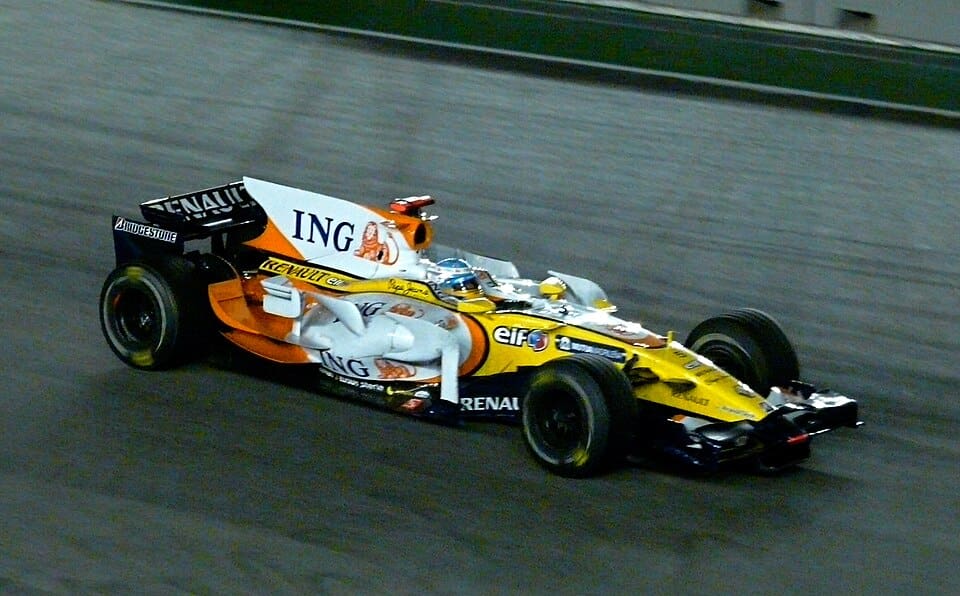
About The Singapore Grand Prix
Formula 1 stormed onto the streets of Singapore in 2008, with the race being held on the brand-new Marina Bay Street Circuit. It was first announced in 2007, with a five-year deal already lined up and good to go.
The harbourside location is reminiscent of Monaco and the old Valencia Street Circuit. Using public roads, the circuit is able to use an incredible artificial lighting system to replicate daylight conditions. This allowed Formula 1 to host its first ever night race, which meant the start time could be scheduled in line with European races.
Singapore certainly provides a challenge in the form of its weather. Humidity is rarely below 70%, and the risk of heavy rain is a persistent threat. Combined with a narrow street-track layout and a bumpy surface, and you’ve got one of the most physically demanding circuits on the calendar. Drivers experience an incredible amount of physical stress over the Singapore Grand Prix weekend. As a rough guideline, they can lose as much as three kilograms of body weight during the race!
In 2024, a legendary Singapore Grand Prix record was broken. From 2008-2023, every single Formula 1 race at the Marina Bay circuit had at least one Safety Car appearance. But in 2024, the 100% streak ended as the race went from start to finish with zero Safety Car deployments. Let’s see if normality resumes in 2025..
As it stands, Singapore is currently set to host Formula 1 until at least 2028.
The 2008 Singapore Grand Prix
The 2008 Singapore Grand Prix was set to become something special. Formula 1 cars racing at night? On a street circuit? The air was filled with the promise of something truly exciting, something truly unique and something spectacular. And oh boy, it lived up to the hype. There were tight battles, dramatic accidents, penalties…all of the things that really get people talking about Formula 1.
Just when you thought it couldn’t possibly generate more worldwide discussion, it threw in the ultimate conversation piece…a scandal.
Race Start
Before the race even began, there was drama. As the cars made their way around the circuit for the warm-up lap, Nelson Piquet Jr. spun out at Turn 23. Thankfully, he was able to recover immediately and took his position on the grid.
As the lights went out, Felipe Massa retained his lead off the line. Behind him were Lewis Hamilton and Kimi Räikkönen. All three made it through the first few corners with no incident. Squabbling over fourth and fifth were Robert Kubica and Heikki Kovalainen, who came together in Turn 3. Both drivers were able to continue, but the collision allowed Sebastian Vettel and Timo Glock to get past Kovalainen. At the front, Massa was pulling away from Hamilton. By lap 11, he was over three seconds ahead of his championship rival.
Fernando Alonso was the first driver to come into the pits. The Spaniard came in on lap 12, swapping his super-soft tyres for the soft compound. When he rejoined, he found himself at the back of the field. Two laps later, teammate Piquet Jr. lost control of his Renault, smashing into the wall at Turn 17. The Safety Car was deployed, handing Alonso a lifeline to help keep him in the fight.
Safety Car Pit Lane Chaos
Just before the Safety Car came out, Mark Webber, David Coulthard and Reubens Barrichello all managed to get into the pits before the pit lane was closed. Nico Rosberg and Robert Kubica were forced to pit whilst the pit lane closure was in force, but without the stop they both risked running out of fuel. Shortly after, Barichello’s Honda developed a mechanical failure that brought an end to his race.
Once all cars were behind the Safety Car, the pit lane re-opened and there was a mad rush as almost every driver came in for a stop. Amidst the frenzy, Ferrari had double-stacked their drivers. As Räikkönen patiently waited behind Massa, disaster struck. Ferrari prematurely released Massa from his pit box and into the path of Adrian Sutil. To make matters worse, the fuel hose was still attached to Massa’s car, sending mechanics flying and fuel spraying as he sped off. Massa went almost the entire length of the pit lane before coming to a stop just before the pit exit.
It was a painful wait as the Ferrari mechanics were busy servicing Räikkönen’s car, but eventually they came sprinting down the pit lane. The mechanics removed the remains of the fuel hose and sent Massa on his way once more. The Brazilian was now at the back of the field, with all those who had stopped before the Safety Car (or utilising one-stop strategies) now firmly ahead. Rosberg was the new race leader, with Jarno Trulli and Giancarlo Fisichella rounding out the top three. Hamilton was currently sat in eighth, and comfortably ahead of his main championship rival.
Middle Stint
As racing resumed, Rosberg quickly began to pull away from the heavily-fuelled cars behind him. The stewards handed Massa a drive-through penalty for an unsafe release in the pits, whilst simultaneously dishing out 10-second stop-go penalties to Rosberg and Kubica for pitting when the pit lane was closed.
After serving his penalty on lap 25, Massa came back out to resume last place. Kubica pitted from fourth, served his stop-go penalty and came out behind Massa. Up at the front, Rosberg had now built up a gap in excess of 15 seconds over Trulli. This meant that when he served his penalty on lap 29, he only lost three places. Trulli inherited the race lead, whilst Fisichella then pitted from second. This promoted Alonso and Rosberg to second and third respectively.
On lap 30, disaster struck for Red Bull as Webber’s car developed a gearbox issue going into Turn 13. The gearbox was trying to select two gears at once – something Red Bull claimed was the result of an electrical surge from the tramline that runs under a section of the circuit. Trulli led for a further four laps before pitting, handing the lead to Alonso. One lap later, Alonso made his final stop of the race, retaining his lead ahead of Coulthard and Hamilton.
Final Push
On lap 41, Hamilton got past Coulthard as they went into Turn 7, although both drivers pitted at the end of the lap. In the sprint to get back out ahead, Coulthard almost ended up repeating Massa’s earlier pit-lane fiasco, as the Red Bull almost left the pit box with the fuel hose still attached. On lap 45, Alonso was leading from Glock by a comfortable six seconds. Rosberg was a further 11 seconds down the road. When Glock came into the pits on lap 47, he promoted Rosberg to second and Hamilton to third.
Four laps later, Trulli suffered a mechanical failure and retired from the race. As this was happening, Räikkönen made his final stop, coming back out in fifth. Massa spun on lap 52 as he went through Turn 18. Thankfully, his Ferrari only made light contact with the tyre wall and any major damage was avoided. The same could not be said for Sutil, who almost immediately went off in the same spot. The Force India suffered severe damage to the front suspension, forcing Sutil to retire. This brought out the Safety Car for a second time in the race.
With just nine laps to go, the Safety Car came back into the pit lane and Alonso immediately pulled away from Rosberg and Hamilton. Rosberg found himself under instant pressure from the McLaren, as Hamilton looked to capitalise on Massa’s misfortunes and gain crucial ground in the championship fight. Räikkönen crashed into the barriers and out of the race with four laps to go after bouncing off the controversial Turn 10 kerbs. As the chequered flag waved, it was Alonso who crossed the line first to win the 2008 Singapore Grand Prix. Rosberg managed to hang on to second place ahead of Hamilton in third.
“Crashgate” Emerges
At the time of his crash, Piquet Jr. laid the blame on how difficult the car was to drive when heavy with fuel. After his departure from the Renault F1 team in 2009, the story changed. In a shock statement, Piquet Jr, alleged that he had been instructed to deliberately crash in order to give an advantage to Alonso. He continued on to claim that team principal, Flavio Briatore, and engineer Pat Symonds had been the ones to orchestrate the crash and issue the order.
Naturally, the FIA were quick to react to such a shocking allegation. In what became known around the world as “Crashgate”, Renault were charged with conspiracy and race fixing. They were summoned to face the FIA World Motorsports Council in Paris on 21st September 2009. Max Mosley, then FIA president, confirmed that Piquet Jr. would face no action after providing his statements, even if the case was found in Renault’s favour.
Flavio Briatore and Renault both initially stated they were to take legal action against Piquet Jr. and his father, claiming that they had made false allegations. However, before the FIA hearing in September, Renault publicly announced that they would not contest the charges. It was also announced that Briatore and Symonds had both left the Renault F1 team.
Harsh Punishments
Renault’s main sponsors, ING and Mutua Madrileña, both ended their deals with the team as a result of the scandal. The FIA World Motorsports Council imposed a disqualification on Renault F1, suspended for two years – had they not forced Briatore and Symonds to resign, the ban would have been instant. They were warned that if another similar incident happened before 2011, then the team would be banned from the sport.
Briatore, who fervently denied any wrongdoing, was banned indefinitely from any FIA-sanctioned event. He was also banned from managing drivers and informed that super licences would not be issued or renewed to any driver associated with him in the future. Symonds, who had expressed “eternal regret and shame” at his role in the scandal, was given a five-year ban.
Summary
The 2008 Singapore Grand Prix was exciting enough when we all innocently thought it was business as usual. However, the revelation of a scandal was something else entirely. It did cast a bit of a dark cloud on what should have been a glitzy new race, but it was a real eye-opener. I remember being in utter disbelief when the news broke. Sure, there had been claims of cheating in the past, but this seemed like something much more cold, scheming and almost criminal.
People wonder if we should look back on incidents like this as things to remember. Personally, I believe that whilst it wasn’t something to look back proudly on, it was something to learn from and provides a reminder that actions have consequences. And whilst we may not admit as much, let’s face it…we all love to gossip about a scandal from time to time.
Which Singapore Grand Prix do you think is a race to remember? Let us know in the comments!
Feature image credit – By chensiyuan; ptttf – chensiyuan, CC BY-SA 4.0, Link