

Home of Formula 1’s first night race, the Marina Bay Street Circuit in Singapore never fails to provide an eventful race.
[adrotate banner=”10″]
Get 10% off all official F1 Merch at TheRaceWorks.com using code ‘EF1‘ at checkout.
Circuit Stats
| Track Length | 4.94 km |
| Number of Laps | 62 |
| Race Lap Record | 1:35.867 (Lewis Hamilton – 2023) |
| Qualifying Lap Record | 1:30.984 (Carlos Sainz – 2023) |
| First Grand Prix | 2008 |
| First Race Winner | Fernando Alonso |
| 2023 Race Winner | Carlos Sainz |
Circuit History
Formula 1 stormed onto the streets of Singapore in 2008, with the creation of one of the most physically demanding tracks on the calendar. The Marina Bay Street Circuit hosted the first ever night race in Formula 1 history, and is run entirely under artificial lighting.
It’s no surprise that the legendary Hermann Tilke designed the initial circuit plans, with its breathtaking backdrop and iconic skyline. The designs were refined by KBR Inc, and the Marina Bay Street Circuit was born.

The race was first announced in 2007. Bernie Ecclestone, entrepreneur Mr Ong Beng Seng, and the Singapore Tourism Board, all came to an agreement for a five-year deal. With the first race held in 2008, the Singapore Grand Prix quickly became a standout event.
The harbourside location is reminiscent of Monaco and the old Valencia Street Circuit. Using public roads, the circuit is able to use an incredible artificial lighting system to replicate daylight conditions. This allowed Formula 1 to host its first ever night race, which allowed the start time to be scheduled in line with European races. This, in turn, made for favourable viewing for TV audiences worldwide.
In 2022, it was announced that the race contract would be extended. Singapore is currently set to host Formula 1 at the Marina Bay Street Circuit until at least 2028.
Challenges
The circuit’s initial layout boasted an incredible 23 corners. This was reduced to 19 by 2023, but it still provides plenty of tough challenges for drivers.
The track surface is quite bumpy, and drivers have to carefully navigate their way around the high-speed lap. Street circuits are usually narrow, and the Marina Bay Street Circuit is no exception. Stray too far from the racing line, and you can find yourself in the wall.
Singapore also provides a challenge in the form of its weather. Humidity is rarely below 70%, and the risk of heavy rain is a persistent threat. Combine this with the track layout and the bumpy surface, and you have one of the most physically demanding circuits on the calendar. Drivers will experience so much physical stress over the Singapore Grand Prix weekend, that they can lose as much as three kilograms of body weight during the race.
[adrotate banner=”10″]
Get 10% off all official F1 Merch at TheRaceWorks.com using code ‘EF1‘ at checkout.
Layout Changes
In 2009, the pit lane exit was modified to feed out at the run up to Turn Two. The first corner was also made tighter in order to try and boost overtaking opportunities.
The “Singapore Sling” at Turn 10 previously had high kerbs, leading to fears that cars could become airborne. The kerbs were lowered multiple times over the course of the 2008 race weekend. The following year, they were repositioned to allow for a more gradual entry. Unfortunately, the changes saw the corner being dubbed “the worst corner in Formula 1”, and the chicane was scrapped altogether for the 2013 Grand Prix. A single-apex left-hand bend replaced the chicane.
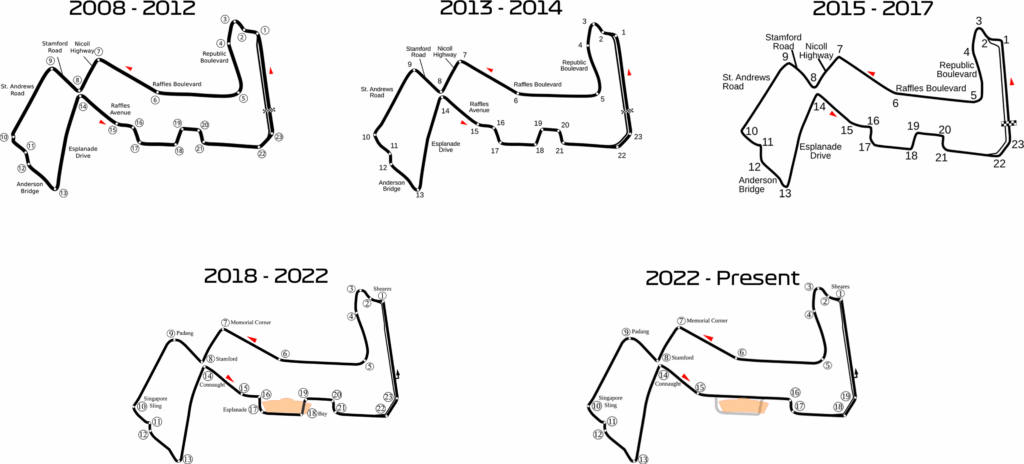
In 2015, there were changes made to Turns 11, 12 and 13. Turn 11 was tightened for slower cornering speed. Turn 12 was modified to change how drivers approached the Turn 13 hairpin. This itself was widened by a metre to allow more overtaking opportunities.
2023 saw the Bay Grandstand section removed due to renovation works in that part of the circuit. Turns 16 and 19 have been linked by a new straight, eliminating Turns 17 and 18. The revised layout meant that the number of corners was reduced to 19 overall, and the track length shortened to 4.928km (3.060 miles). In order to compensate for this, the race distance was increased by two laps. The renovation work is expected to be completed in 2026, with the previous track layout and Bay Grandstand set to return for the 2027 Grand Prix.
Shifting Towards Sustainability
Running so many high-powered lights takes an incredible amount of energy. Formula 1 and the Marina Bay Street Circuit have been making changes to help with sustainability.
In 2023, the existing lighting around the track was replaced with energy-efficient LED lights. This has reduced energy consumption by around 30%, whilst still providing the light levels needed to run the race at night.
There are also 1,396 solar panels fitted to the pit building. In their first year after installation, a colossal 923,000kwh of energy was generated, which helped power the event. To give you an idea of just how much energy that is, all 20 Formula 1 cars would need to complete the race almost 4.5 times. That’s the equivalent of nearly 279 laps!
The event provides huge support for the local economy too. Almost 700 Singapore-based companies are brought in to work over the course of the weekend. This includes many of the food and drinks stalls at the circuit, leaving a positive impact on the local community.
A Unique Record
If you’re looking for an easy bet to win at the Singapore Grand Prix, then you should bet on there being a Safety Car.
The Marina Bay Circuit holds a unique record when it comes to Safety Car appearances. Bernd Mayländer has had the privilege of leading the pack in every single Singapore Grand Prix. No other race in Formula 1 history has had a 100% record when it comes to Safety Car deployment.
Over 14 years in Singapore, the Safety Car has been used a grand total of 24 times. That’s an average of 1.71 deployments per race.

[adrotate banner=”10″]
Get 10% off all official F1 Merch at TheRaceWorks.com using code ‘EF1‘ at checkout.
Iconic (But Infamous) Moment
There have been many controversies in Formula 1’s history, but perhaps one of the more infamous and high-profile scandals happened at the Marina Bay Street Circuit in 2008. The inaugural Singapore Grand Prix got underway with little drama, and the laps ticked by. On lap 12, Renault’s Fernando Alonso was the first of the drivers to pit, sending him to the back of the field. Just two laps later, Nelson Piquet Jr. lost the rear of his car. He slammed into the wall at Turn 17, prompting a Safety Car and a flurry of pit lane activity.
Alonso now found himself leading the pack. He managed a faultless drive over the remaining laps and crossed the line to take the win. It seemed that luck had very much been on Alonso’s side.
Nelson Piquet Jr. described the crash as a “simple mistake” and pinning the blame on the car being difficult to drive. However, after Renault dropped him part-way through the 2009 season, he made an astonishing claim. Piquet Jr. told media sources that he had been instructed to crash deliberately in order to help Alonso’s race.
The claim sparked an FIA investigation into Renault F1 for alleged race fixing, and charged the team with conspiracy on 4th September. Renault F1 announced that they would not contest the charges. On 21st September 2009, it was announced that Renault F1 were disqualified from Formula 1 (although this was suspended for two years and subsequently overturned by a French court).
Nicknamed “Crashgate” by fans, it’s a shocking moment for the sport that will surely be remembered for many more years to come.
What’s your iconic Singapore Grand Prix moment? Let us know in the comments!