

The 2025 F1 season is entering its closing stanza, with the upcoming US Grand Prix being round 19 of 24. It seems that the nearer we get to the finale, the more things are heating up, both figuratively and literally.
Last race in Singapore was notably declared F1’s first ever “heat hazard” weekend due to high temperatures. This necessitated the use of active driver cooling vests for the first time since the FIA added provision for them to the regulations at the start of this year. With tempers flaring as title rivals Norris and Piastri came together on lap 1, many are wondering if this week’s race in Texas could see tensions finally boil over.
It therefore seems fitting to look back this week on the 1984 Dallas Grand Prix — The race which first took F1 to the Lone Star State and which, much like Singapore, had many in the paddock somewhat hot under the collar.
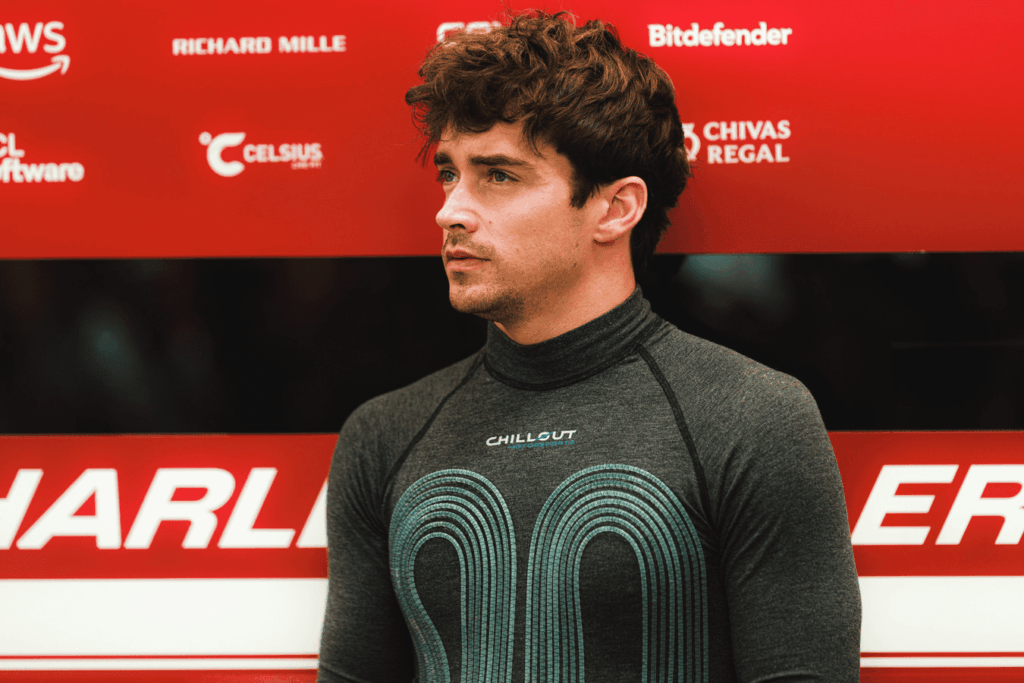
Image Credit: Scuderia Ferrari
The American Dream
Plans for a race in Dallas, Texas first materialised in 1983 amid wave of other US street races. Then as now F1 was looking to break into the US market, and bringing the sport to American streets seemed a good way of doing so. The plan for Dallas was to organise a race through the city’s Fair Park complex, and by September 1983 the race’s place on the F1 calendar was confirmed, with a provisional date in July 1984.
The plan seemed mutually beneficial. Dallas would benefit from the prestige of F1, and Formula 1 could continue building its foothold in the US market. The venue also seemed fitting for the rapidly-growing F1. Dallas was the financial nerve-centre of the US’s biggest state, and was deemed a suitably glamorous backdrop for Formula 1. The ongoing success of the Dallas TV series at the time also certainly didn’t hurt publicity.
One thing stood in the way of making the Dallas race happen though. Typically a new track needed to host a lower category of motorsport to prove its viability before hosting F1. With the planned July 1984 date, there would be no time for such a race. As a result, with all parties eager to capitalise on the hype they had created for the race, F1 quietly waived the stipulation following assurances that there would be no issues. This is worth remembering in light of later events…
The Best-Laid Plans…
Despite the whole plan for the race being something of a rush-job, to the organiser’s credit the circuit appeared ready by the time race weekend came around. Pundits also praised the layout of the track itself, considering it more interesting than many rival street tracks.
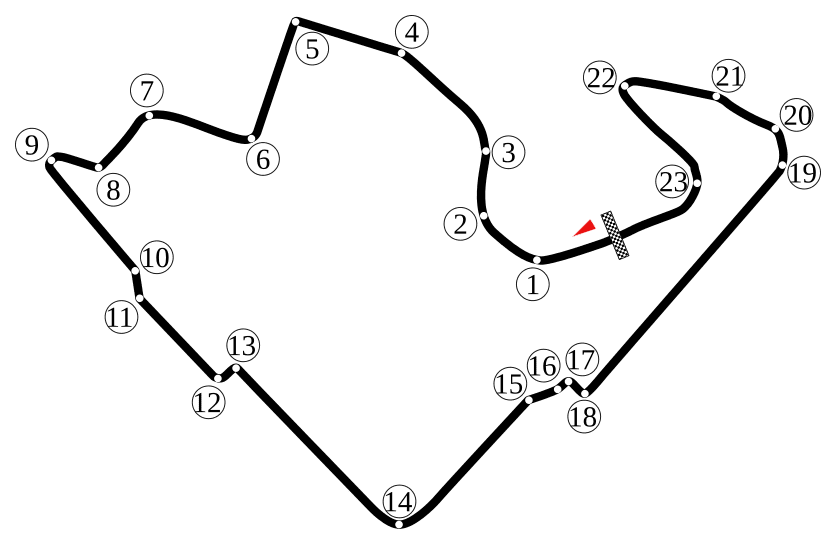
Image Credit: Xander89 – Own Work, CC BY-SA 3.0, Link.

However, things rapidly started to go wrong almost the instant the cars hit the track.
The chief issue was the heat. With the race being held at the height of the Texas summer, temperatures quickly reached upwards of 40°C (105°F). Some teams were better prepared for such temperatures than others, with the Williams team notably bringing water-cooled skull caps designed by Dennis Carlson for both of their drivers. Even with such measures though, the race would certainly be an ordeal.
Worse though was the effect the heat had on the track itself. Mere minutes into the first practice session of the weekend, the combination of the heat and the stresses of near 1000bhp Formula 1 cars pounding around the circuit began to break up the track surface. The result was something resembling a rutted gravel road, which unsurprisingly was not particularly conducive to quick lap times.
Hot Laps
As a result of the continually worsening track surface, most of the fastest times occurred during the Friday qualifying session. The unusual conditions did shake up the usual order somewhat though. For the first time in his career, hard-trying Lotus number 2 Nigel Mansell claimed pole position. The Hethel-based team’s happiness was then further bolstered when Mansell’s teammate Elio de Angelis made it a Lotus front-row lockout.
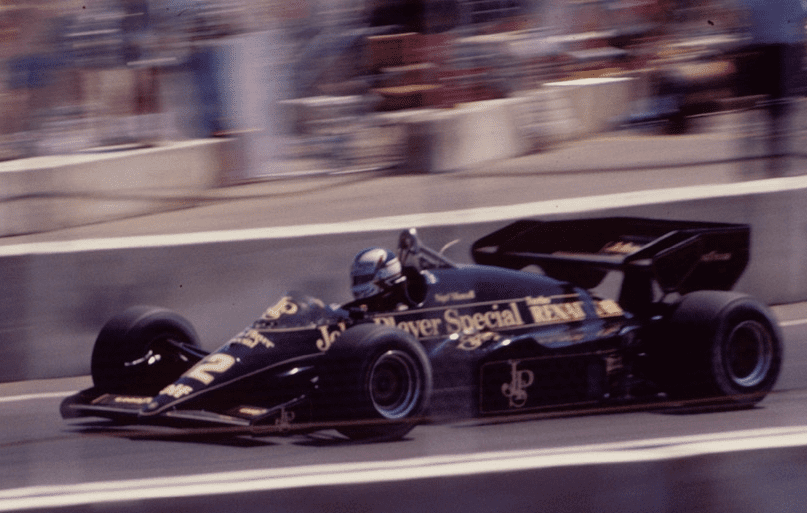
Image Credit: Tom Margie – Own Work, CC BY-SA 2.0, Link.
Renault were also in high spirts. Not only did they supply the engines to Lotus, but their works driver Derek Warwick took third on the grid, and was the only one to improve his time in Saturday’s qualifying session. With the circuit only getting worse, Warwick seemed well-placed for a good race.
By comparison, some of the anticipated top runners were struggling. The dominant McLarens of Niki Lauda and Alain Prost managed only 5th and 7th respectively, split by the Toleman of future McLaren legend Ayrton Senna. Things were even worse for Nelson Piquet, who had won the previous two races. He could only manage a lowly 12th on the grid.
Drama from the Start
On race day, the track situation got even worse following damage in one of the support races. This necessitated emergency repairs using quick-drying cement to patch the holes in the asphalt. Calls for a boycott were again raised, but again they came to nothing.
Even before the green flag on race day, drivers came to grief. These notably included fourth placed qualifier René Arnoux’s Ferrari, which had to start from the pit lane due to an electrical issue. This would be the prelude to an outstanding drive.
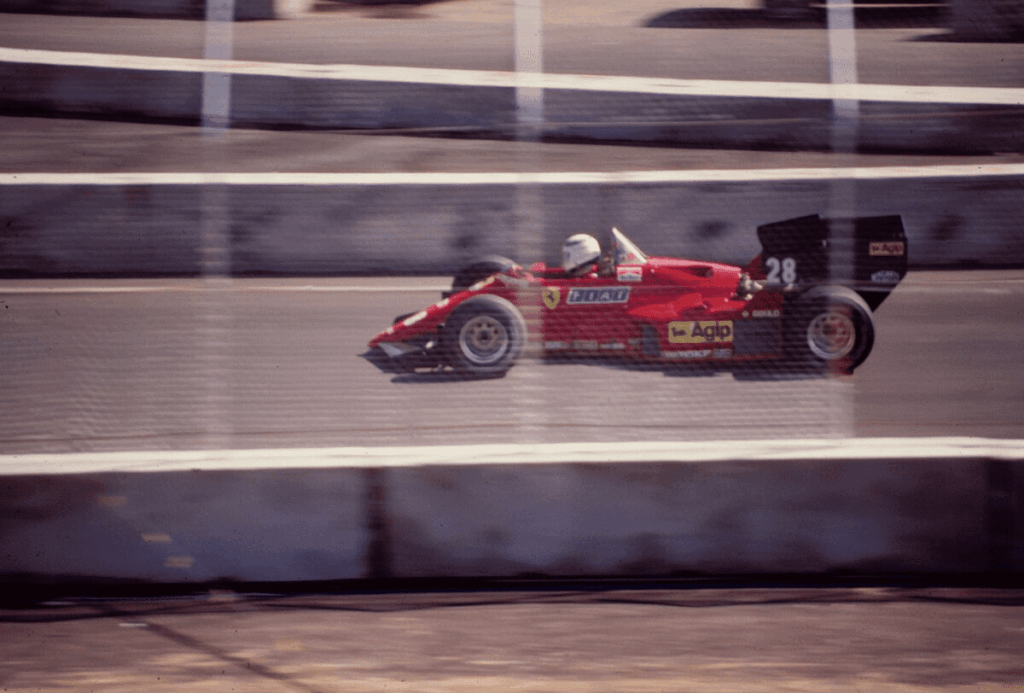
Image Credit: Tom Margie – Own Work, CC BY-SA 2.0, Link.
Nevertheless, the leaders got away cleanly on lights out, with Mansell, de Angelis and Warwick all holding position. The spellbinding Senna meanwhile jumped Lauda to run fourth.
Before long things started unravelling though. First to go was the Ligier of Francois Hesnault, who clattered into the barriers before the end of lap 1. Senna came to grief a lap later too, spinning 180 degrees after attempting to get past Warwick. The Brazilian somehow avoided the walls and got going again, but had dropped to last place.
Clashes and Crashes
Back up at the front of the field, Mansell was attempting to stamp his authority on the race. The Briton had prominently crashed out of the lead a few races prior in Monaco, and was eager to make amends. The Briton soon had a new sight in his mirrors though, as his former F3 rival Warwick demoted de Angelis, whose engine was misfiring, to third.
Warwick quickly closed up on Mansell, and it became increasingly apparent that the Lotus man had overworked his tyres on the abysmal surface in his efforts to pull out a lead. Indeed, the race seemed to be getting away from Lotus, as the canny Lauda got past de Angelis for third.
After lurking behind Mansell’s Lotus for several laps, Warwick thought he spied a gap at the turn 17 chicane. In his eagerness to get past though, the Renault man left his braking too late and got off line. With the circuit covered in gravel, there could only be one result — a Renault in the wall.
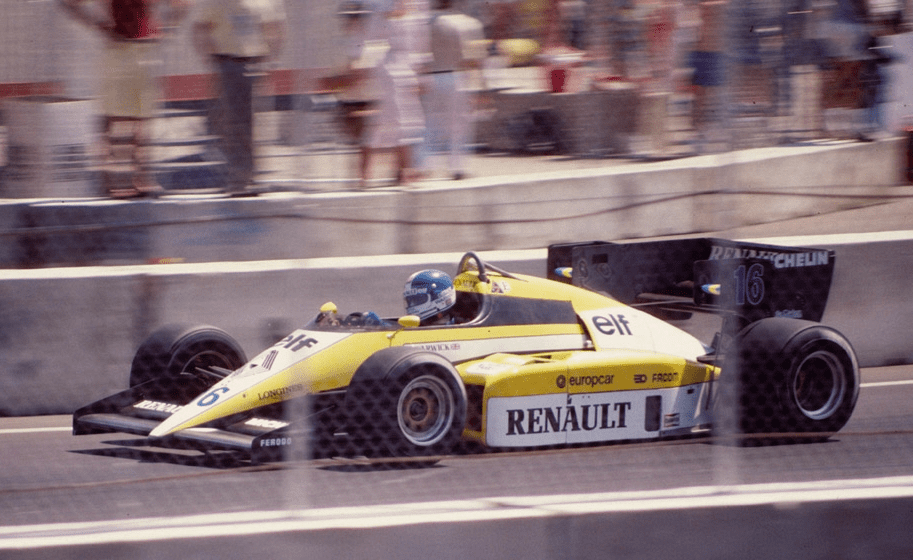
Image Credit: Tom Margie – Own Work, CC BY-SA 2.0, Link.
The good news for Lotus kept coming. After Warwick’s crash De Angelis’ engine suddenly started firing on all cylinders again, and he quickly got back past Lauda. The black and gold cars were 1-2 once more, but Mansell’s tyre issues were seemingly becoming more acute. His Italian teammate therefore easily cruised up behind him, but the Briton was not eager to relinquish the lead and defended for all he was worth.
Dropping Like Flies
With all the drama, it was easy to miss the progress of some other drivers. One of those who had stealthily made good progress was Keke Rosberg. It seemed that as the race wore on the benefits of Williams’ driver cooling system were becoming apparent. The cool-headed Finn underlined this by muscling his uncompetitive Williams past Lauda into third place. Prost then slipped past Lauda too, confirming a bad few laps for the 1975 and 77 champion.
For Rosberg though, things kept getting better. He was soon up to second after Mansell shut the door on another attempted move for the lead by de Angelis. The resultant loss of momentum allowed Rosberg past, and he was now able to start harassing Mansell for the lead.
While the battle for the lead was heating up, the attrition further down the field continued. The second Renault of Patrick Tambay soon retired after hitting the wall, as did the second Toleman of Johnny Cecotto. With the rate of retirements, it seemed there would scarcely be anyone left by the end of the race.
Attack from the Back
If Mansell and Rosberg kept at it the way they were going, they would be among the retirements list too. Time and again Rosberg would go for an ambitious move, only for Mansell to slam the door. Rosberg’s building anger grew further when Mansell locked up into the chicane, forcing the Finn to brake early and lose second place to Prost.
Prost’s residence of second place was only a brief one though. When the McLaren hesitated momentarily on exiting turn 13, Rosberg was back through in a flash.
Second soon became first when Mansell tagged the wall and stuttered momentarily. Rosberg didn’t need a second invitation and was through immediately. While a desperate Mansell tried to repass, this time it was Rosberg’s turn to slam the door in his face. Soon Mansell was sinking back through the order at a rate of knots, and after being passed by Prost, de Angelis and Lauda he was forced to accept defeat and pit for new tyres.
Attention then turned to a man who was evidently on a mission. After starting stone dead last, Rene Arnoux was putting in the drive of his life. While others around him were driving untidily and hitting the walls, the Ferrari man was seemingly unflurried. Soon, after the retirement of Nelson Piquet with a jammed throttle and a move on de Angelis, he was up to a staggering fourth place.
Winner Takes All
With Mansell no longer playing the role of the cork in the bottle, the action at the front of the field subsided somewhat. However, Prost did gradually begin to reel in Rosberg, and on lap 49 he passed the Williams with a simple move at the chicane. It seemed that the race would be yet another McLaren victory in one of their most dominant seasons ever.
In the space of a mere four laps though, McLaren’s race completely fell apart. Just 10 laps from the chequered flag, Prost whacked the wall. This broke his front right wheel rim, and ended his race on the spot. Worse still for McLaren, Prost’s teammate Lauda similarly retired from his newly inherited second place four laps later. In a stroke, McLaren had gone from a strong 1-3 to no points at all.
Rosberg, Arnoux and de Angelis were now the top three, and would remain that way to the flag. Rosberg finished as the worthy winner, and demonstrated the benefits of driver cooling. Arnoux meanwhile had entertained the crowd with perhaps his best ever performance from the very back of the grid.
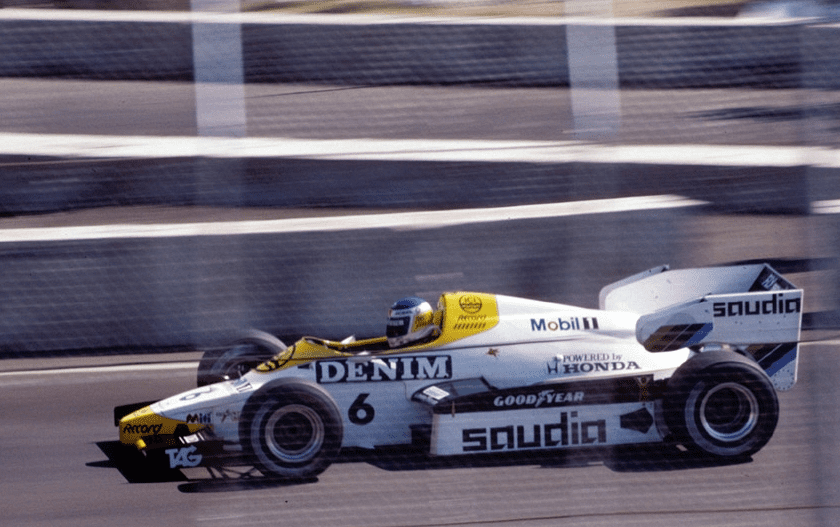
Image Credit: Tom Margie – Own Work, CC BY-SA 2.0, Link.
There was still a bit more drama to come though. As Rosberg’s teammate Jacques Laffite came home fourth, and the backmarking Osella of Piercarlo Ghinzani finished an excellent fifth, the crowd’s attention turned to the man in sixth place. It was Nigel Mansell — desperately trying to will his car home with a broken gearbox.
The Lotus fully let go mere metres from the line, but Mansell was determined to finish and claim the last point. He therefore began pushing his car to the line under the full force of the searing sun. It was a gallant effort, but eventually the temperature got the better of Mansell, and he collapsed from exhaustion.
It was, in a way, symbolic of the race itself. The drivers had given it their all against the odds, and in unimaginable conditions. While not all had made it to the flag, all had contributed to a truly memorable race.
Featured Image Credit: Tom Margie – Own Work, CC BY-SA 2.0, Link.