

Shell and Mahindra Racing have announced an innovative E-Fluid recycling project for Formula E, marking a groundbreaking move towards sustainability in motorsport. This project showcases their commitment to environmental responsibility. It also pushes the boundaries of lubricant technology in electric racing.
The Power of EV-Plus Transmission Fluid
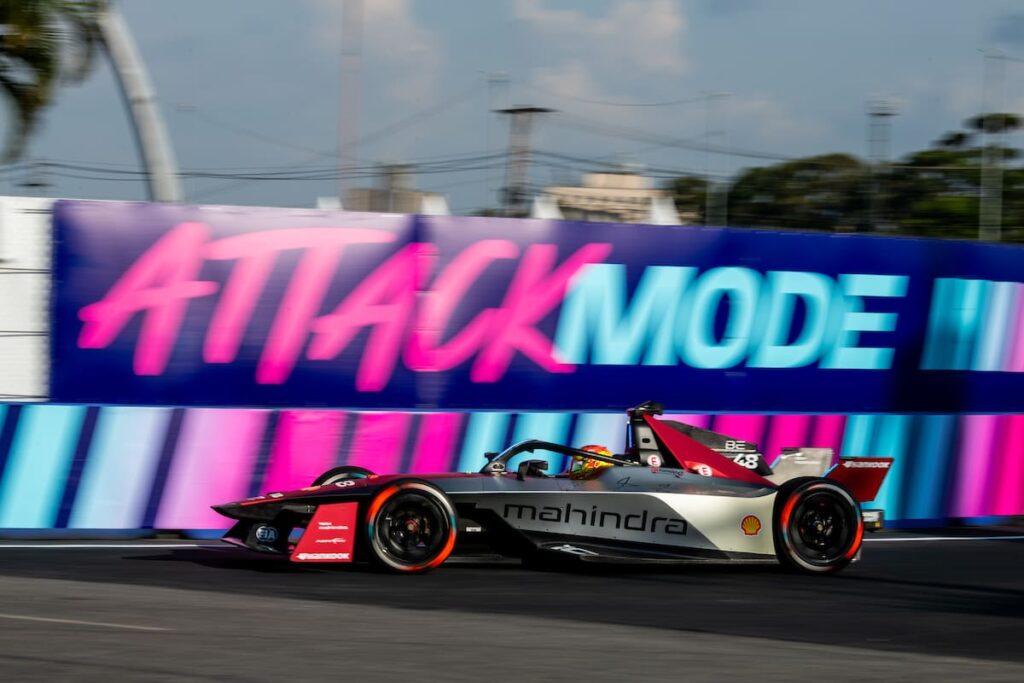
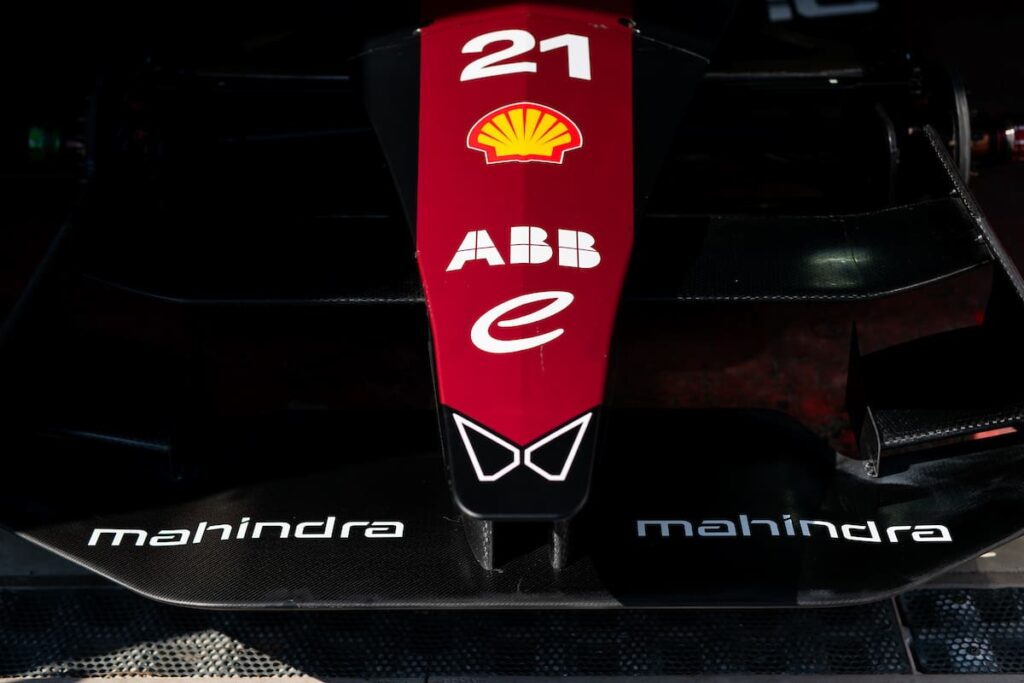
The project centres around Shell’s bespoke EV-Plus Transmission Fluid, specially developed for Mahindra Racing’s Gen3 powertrain in Formula E. Leonard Kieckebusch, the project lead, emphasised the crucial role of lubricants in Formula E, saying,“If you think of all the race teams out there in the garages, most of the parts of the cars are identical.”
“The main difference you can make as a race team is the driveline, it’s the electric motor, it’s the reduction gear set and the lubricant.”
Kieckebusch outlined three pillars of their development focus: power and efficiency, durability and reliability, and sustainability.

“Every Millisecond Counts”
“The main purpose is we would like to get as long as possible with the battery, and we want to have sufficient power to overtake. Even milliseconds count in Formula E.” he explained.
Shell rigorously tested the E-Fluid’s performance, finding improvements in all load conditions and driving situations. Kieckebusch noted, “We managed to find improvements up to 0.3 percent benefit, which doesn’t really sound a lot, but again, on the racetrack every millisecond counts.”
“And if you calculate this, it was around 0.25 seconds per race you can gain.”
Durability testing was equally impressive. “We were actually running 40 races in the actual gearbox on the test track, which is around 12,000 kilometres,” Kieckebusch revealed.
“There was no scuffing, pitting, extensive wear, so no damage to the wheels and the gears.”
The Sustainable Composition of E-Fluid
The sustainability aspect of the E-Fluid is particularly noteworthy. Kieckebusch explained, “The bespoke EV plus transmission fluid for Mahindra is tailor-made specifically for this gearbox.”
“It consists of renewable feedstock, so the base is from renewable biomass. This results in 60 percent of the content carbon being biogenic, which can be plant-sourced for example, and therefore this leads also to a higher biodegradable content.”
“Like New Again”: The E-Fluid Recycling Process Explained
Taking sustainability a step further, the new recycling project aims to reprocess the E-Fluid after Formula E testing and races. Kieckebusch demonstrated this with a sample of used oil from pre-season testing, explaining, “We wanted to find out if this oil can be recycled with low-energy input and be made like new again. By this, we managed to reduce the carbon footprint of the liquid by 27 percent on top.”
Kieckebusch detailed the recycling process, explaining, “In a race gearbox, you just have around 800–900 millilitres, so quite a low volume.”
“It doesn’t make sense to fly those small quantities from all the race locations to a lab and do some recycling and send it back around the globe, this is not the purpose of the whole thing.”
“So, we analysed and filtered larger volumes from testing and in the lab. We removed wear particles and re-added essential chemicals to ensure the recycled oil performed like new. We then tested it in our Gen3 gearbox setup in Hamburg, and it showed no difference in performance.”
This recycling process reduces waste and requires less new oil production for future races. Laboratory tests at Shell’s Technology Centre in Hamburg have successfully demonstrated that recycling the used fluid does not compromise performance.
Frederic Lissalde, President of Shell Global Lubricants, commented on the project: “This initiative exemplifies our commitment to pioneering sustainable solutions in high-performance environments. By recycling E-Fluids, we’re not just reducing waste; we’re reimagining the lifecycle of lubricants in motorsport.”
Formula E as a Testing Ground
The partnership between Shell and Mahindra Racing, which began in 2018, has been a catalyst for innovation in e-mobility solutions. Formula E serves as a crucial testing ground for these advancements, allowing Shell to develop technologies that benefit both racing teams and everyday road users.
Joseph Holten, Technical Director of Mahindra Racing, highlighted the importance of efficiency. He said, “What we need to achieve with racing is that as much of the energy that we store in our rechargeable energy storage system makes it to the road in terms of tractive effort.”
“We also need to ensure minimal losses and seamless reliability under multiple conditions. Using fluids like EV-Plus allows us to ensure that our powertrain components operate at peak performance consistently.”
Lewis Butler, Head of Design at Mahindra, also reflected on the technical partnership, saying, “The collaboration with Shell has been very positive, and the recycled oil project is particularly interesting for us going into subsequent seasons.”
“It may mean that we don’t need to replace the oil as often as we would have done in the past.”
Expanding Oil Recycling Initiatives in India
This project in Formula E complements a broader initiative between Shell and Mahindra Racing, as well as Mahindra dealerships in India, which has already collected over 270,000 litres of used oil for re-refining since September 2022.
Kieckebusch elaborated on the broader recycling initiative. “In India, around 1.2 million tonnes of used oil are generated annually, but only 13% is collected,” he explained.
“Together with Mahindra, we set up a recycling process where used oil is collected, separated, and re-refined into new base oil. This initiative not only helps in reducing waste but also ensures that used oil is not improperly disposed of.”
Looking ahead, Shell and Mahindra Racing are exploring ways to implement E-Fluid recycling in future Formula E seasons, further cementing their commitment to sustainable innovation in motorsport.