

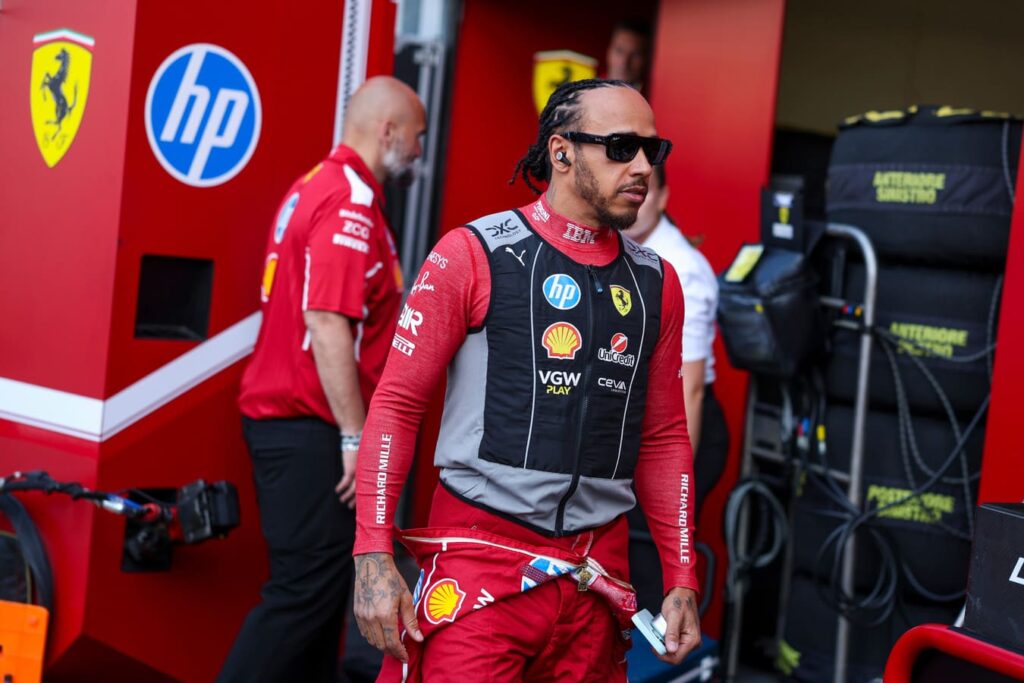
Photo: © Scuderia Ferrari (via Motorsport.com) – “Lewis Hamilton’s first Ferrari-factory visit” Jan 2025
When Lewis Hamilton signed for Ferrari, it was supposed to be the return of two Kings of Formula 1 — the most decorated driver of his generation joining the most storied name in motorsport. But less than a season in, the bubble of hope has burst.
The man once accused of making F1 predictable is now being called “washed.”
But pause for a moment and consider if the question isn’t whether Hamilton’s finished but whether Ferrari is capable of letting him prove he isn’t.
The Italian Rhythm vs. The British Precision
Ferrari is Italian to its core — heritage, passion, emotion, the hand gestures, the roar of the Tifosi. Not the German stereotypes of precision, data driven decisions and efficiency of Mercedes.
Hamilton left behind a decade of process, data, and calm control for a team built on instinct and legacy.
At Mercedes, he wasn’t just a driver — he was a co-architect. Every great era of his career was built on influence. At Ferrari, the hope was he wasn’t going to be expected to fit into an existing rhythm but bring that mentality with him.
That he would be asked to rewrite the tune, not dance to it.
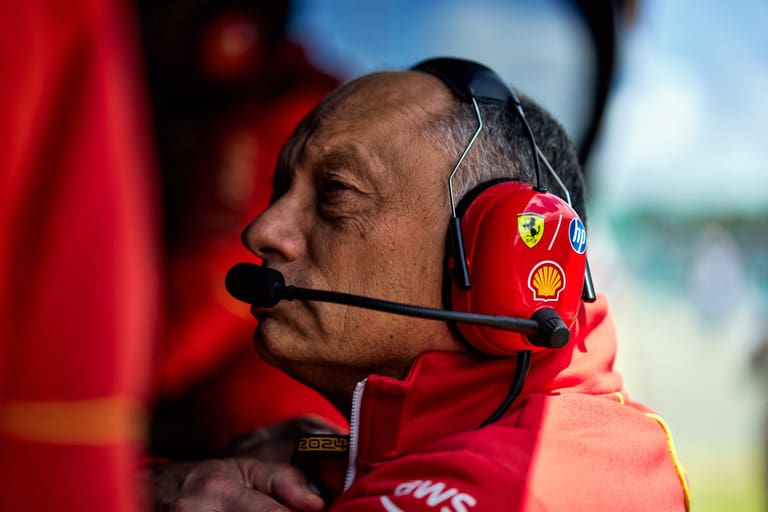
Evidence for the Defence: Hamilton Still Has It
I will start with what we’ve actually seen. Hamilton’s Ferrari career hasn’t been a total disaster. He won the Chinese Sprint — Ferrari’s first in nearly two years — and was genuinely quick in Austria, qualifying fourth. The flashes are still there.
When the car gives him confidence, the old precision returns: tyre management, strategic patience, late-race rhythm.
Those who say he’s “lost it” seem to forget that his decline began when Mercedes did. The W13 and W14 were flawed from the ground up — porpoising, drag, instability. Hamilton wasn’t off the pace; the car was. He matched ‘Mr. Consistent’ George Russell in raw qualifying pace across 2023–24, even in chaotic machinery.
Now at Ferrari, he’s driving a car designed around Charles Leclerc’s preferences. Leclerc has spent years shaping this concept — its front-end bite, its braking balance, its entry rotation. Hamilton, by contrast, built his driving style around late braking and throttle rotation — the very things Ferrari’s SF-25 resists.
So when Leclerc extracts time mid-corner and Hamilton doesn’t, it’s not age — it’s architecture.
“Leclerc has grown into this car concept. Hamilton’s feedback shows he’s fighting its characteristics, not driving around them,”
The Race
Hamilton’s feedback style — methodical, detailed, relentless — doesn’t translate instantly into lap time. It’s a long game. The same patience that turned Mercedes into a dynasty is what Ferrari has yet to give him
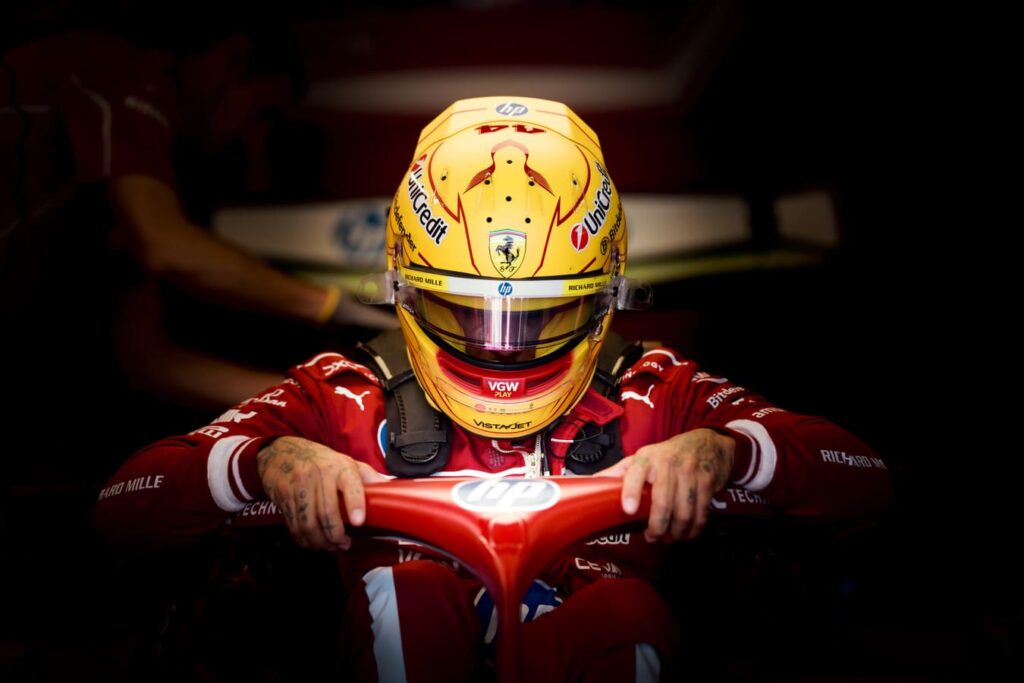
Photo: © Scuderia Ferrari – Lewis Hamilton in Ferrari red, Jan 2025
Evidence for the Prosecution: Ferrari’s Myth Machine
Behind the scenes, the same themes resurface — bureaucracy, image control, heritage over hunger. Drivers offering the usual line week after week:
“We’re not where we need to be, but we’re fully focused on the steps we need to take to compete at the front.”
Polite. Corporate. Predictable. But if you believe them, Ferrari has been “taking the right steps” for 15 years.
Former Ferrari driver Arturo Merzario went further, claiming “90 percent of staff didn’t want Hamilton to join,” calling it “more commercial than competitive.”
That’s not friction — that’s rejection.
Hamilton arrived in Maranello looking like a Don, carrying folders of notes, meeting department heads, trying to see where he make an impact, maybe even change the culture. But Ferrari is an institution that prefers to preserve its myth rather than let outsiders rewrite it.
That instinct comes straight from the top. Ferrari chairman John Elkann this week fired a public shot, saying the team’s drivers “need to focus on driving and talk less.”
“If we look at the Formula 1 championship … we certainly have drivers, for whom it’s important that they focus on driving and talk less, because we still have important races ahead of us and it’s not impossible to get second place.” — John Elkann
It’s a remark that might sound like corporate fire-fighting, but it reveals something deeper: a leadership still uncomfortable with internal critique. For a driver like Hamilton — whose greatest strength has always been his openness, feedback and relentless pursuit of answers — Elkann’s words feel like a warning. Ferrari’s hierarchy still values obedience over collaboration.
And history tells us how that ends. Alonso tried. Vettel tried. Both ran into the same wall of red bureaucracy.
Hamilton might be the latest name added to that list — another champion suffocated by the romance of Maranello.
The Fan Discourse: The Double Standard
Outside the garage, the impatience is just as glaring. Fans hand engineers like Adrian Newey years of grace to “let him cook” at Aston Martin, yet demand instant success from a seven-time world champion adapting to a new system.
We F1 fans are a fickle bunch, one good weekend for a driver and we’re engraving their name in the Word Driver trophy. Max wins Monza and it’s ‘Championship back on’ with a gap of 94 points to Piastri at that stage.
Maybe it’s not decline we’re watching, but dissonance. Has F1’s rush to brand legends as “past it” started to say more about the sport’s attention span than about Hamilton’s reflexes?

“Photo: © Scuderia Ferrari (Press Office)
The Verdict
Hamilton isn’t finished — he’s unfinished. But that all depends on Ferrari and whether they are able to let him show us that he’s still fast enough, sharp enough, hungry enough.
What he needs is a car built in his image.
Ferrari hired a champion, but they haven’t yet listened to one.
If they do, this story could still end with a title.
If they don’t, it’ll end like the others — another great driver swallowed by the same old dream.
As one Ferrari engineer told Autosport,
“Hamilton’s feedback is excellent — but this car wasn’t designed around him. That will come later.”
Until Ferrari stops romanticising the past and starts trusting the man who built his own future, The Hamilton Experiment will remain exactly that — an experiment.
Feature Image courtesy of Formula 1