

The Austrian circuit is home turf for Red Bull Racing, but there’s much more to its history than meets the eye.
[adrotate banner=”9″]
Get 10% off all official F1 Merch at TheRaceWorks.com using code ‘EF1‘ at checkout.

Circuit Stats
| Track Length | 4.318 km |
| Number of Laps | 71 |
| Race Lap Record | 1:05.619 (Carlos Sainz – 2020) |
| Qualifying Lap Record | 1:02.939 (Valtteri Bottas – 2020) |
| First Grand Prix | 1970 |
| First Race Winner | Jacky Ickx |
| 2023 Race Winner | Max Verstappen |
History of The Red Bull Ring
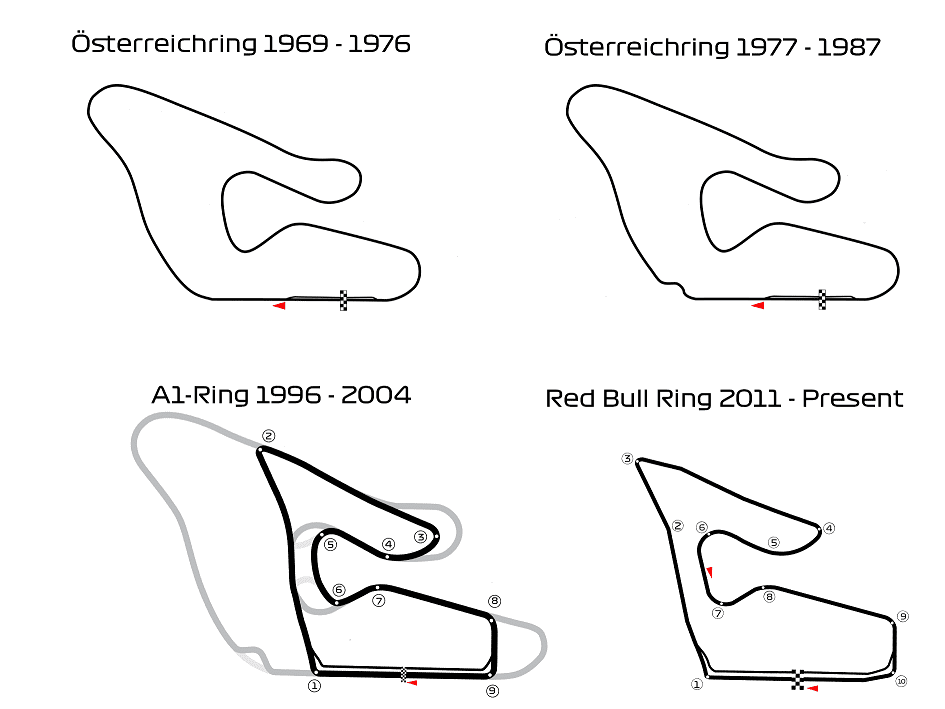
The Red Bull Ring has been through some major changes through the years. It’s been part of Formula 1 history for over 55 years, and is currently set to remain on the race calendar until 2030.
The 4.318km circuit sees drivers navigating their way around three fast straights, winding uphill turns and tight downhill corners. It’s played host to various motorsports, including Formula 1, MotoGP, DTM and more.

1969 – 1979
In 1969, the Österreichring replaced the old Zeltweg airfield circuit. Zeltweg was a track that had become hated by the drivers. Its flat, lacklustre and bumpy run down stretches of runway did little to inspire race participants. Österreichring was fast and almost regal in comparison to its predecessor, designed with the drivers in mind.
In 1970, the circuit hosted its first Formula 1 Grand Prix, with over 100,000 spectators in attendance. Austrian home hero Jochen Rindt qualified in pole, but an engine failure on lap 21 forced him to retire from the race. Rindt sadly passed away a few weeks later during the practice session of the Italian Grand Prix. 1975 saw the tragic death of Mark Donohue after his car rolled during the warm-up. The “Hella S” curve was installed in order to improve safety. The 1977 Grand Prix saw a forced moment of improvisation when Alan Jones took an unexpected victory. It was so unexpected that the band played “Happy Birthday” during the podium celebrations because there was no score of the Australian National Anthem.
1980 – 1989
In 1982, Formula 1 saw one of the closest finishes it had experienced so far. Elio de Angeles and Keke Rosberg were side by side at the chequered flag, with de Angeles taking the victory by 125 thousandths of a second. In 1984, Gerhard Berger made his debut, but it was Niki Lauda that was drawing in the local fans.
The 1987 Austrian Grand Prix was a spectacle of chaos, and had to be started three times. After the first start, several cars crashed and forced a race restart. The second start saw Nigel Mansell cause a 12-car pile-up on the start-finish straight. Two hours later, the race finally got underway and made it through to the chequered flag. There was no Formula 1 at the Österreichring in 1988, and the circuit would be absent from the race calendar until 1997.
1990 – 1999
The Österreichring underwent huge reconstruction, with Hermann Tilke designing a shorter and more modern version of the circuit. It was renamed in 1996, now known as the A1-Ring. The track was shortened to just 4.3km, with additional run-off areas being added in a bid to improve the safety during races. Sauber used the newly-opened circuit as part of their testing, with Alexander Wurz being the first to put in laps on the new track. Williams and Jordan also opted to use the new layout for their testing. However, the first race to be held on the brand new A1-Ring was a round of the Motorcycle World Championship. It was at this race that Valentino Rossi earned his first ever podium in the 125cc class.
In 1997, Formula 1 returned to Austria. It was bittersweet, as it would be local hero Gerhard Berger’s final home Grand Prix. Berger would finish 5th in the driver’s standings before retiring from Formula 1 that same year.
[adrotate banner=”9″]
Get 10% off all official F1 Merch at TheRaceWorks.com using code ‘EF1‘ at checkout.
2000 – 2009
2001 brought some controversy, when Rubens Barrichello was given a bold instruction – “Let Michael pass for the championship!”. Schumacher took second place, with Barrichello forcibly accepting third. Roll on 2002, and Ferrari’s team orders once again caused uproar. Barrichello had led the race from the moment the lights went out. As the final turn loomed, team principal Jean Todt instructed Barrichello to let his team mate pass. It meant that the Brazilian had to give up his hard-earned lead, with Schumacher taking the victory.
In 2003, it was the last Austrian Grand Prix on the current track layout, with Michael Schumacher taking the win (without team order this time). Bernie Ecclestone, not happy with the Austrian government’s support of anti-tobacco legislation in the EU, cancelled the contract for the race in 2004.
The circuit was sold to Red Bull’s Dietrich Mateschitz, and a bold £485 million project was planned. The project included plans to incorporate sections of the original circuit through extensions on the western side. It also would have seen the addition of a race school, hotel, auto museum, as well as somewhere for Mateschitz’s aircraft collection. The pit buildings and main grandstand were torn down in anticipation of the project, and the track was cut in two as an access trench was put in place through the main straight. Work came to a grinding halt when Austria’s Environmental Senate deemed that the project violated noise and pollution regulations. After a long wait, Projekt Spielberg was given the green light to breathe new life into the mothballed circuit.
2010 – 2019
On 15th May 2011, the new Red Bull Ring was presented to the motorsports world. In 2012, the circuit saw the addition of the 17.2 metre, 68 tonne steel bull that towers above the circuit. In 2014, Formula 1 returned to Austria, and a few months later the Red Bull Air Race made its first appearance at the Red Bull Ring.
The architectural highlight of the circuit, the Red Bull Wing, was added in 2015. The building’s design took inspiration from the rear wing of a Formula 1 car, and houses the Wing Cafe, Fan Shop and Welcome Centre. The entire Red Bull Ring was resurfaced between 2015 and 2016, prompting MotoGP to return to the circuit. More than 200,000 spectators celebrated Austria’s first motorcycle Grand Prix in 19 years.
In 2018, Max Verstappen took victory in Red Bull Racing’s first home win, and in 2019 it was announced that the contracts for both Formula 1 and MotoGP would extend until 2025.

2020 – Present
2020 saw Austria host the season opener for the first time in Formula 1 history. It was also the first time that Austria hosted two races, and without any spectators in attendance. The second race was given the title of the Styrian Grand Prix, and it helped to mark the 50th anniversary of Formula 1 in Austria.
2021 saw the Styrian Grand Prix on the calendar again as the Red Bull Ring’s 10th anniversary. 147,000 cheering fans witnessed Max Verstappen beat Alain Prost’s record for the most victories in Spielberg.
In 2023, Formula 1 extended the contract again, committing to racing in Austria until 2027. Just a few months later, this was extended further until 2030.
[adrotate banner=”9″]
Get 10% off all official F1 Merch at TheRaceWorks.com using code ‘EF1‘ at checkout.
Further Improvements
To avoid the growing problem that the circuit has previously experienced with track limit infringements, the Red Bull Ring has had new gravel traps installed ahead of the 2024 Grand Prix. The controversial conclusion to the 2023 Grand Prix saw the final classification announced hours after the race had finished. The stewards investigated a whopping 1,200 potential track limit infringements. 83 infringements were identified, and they all occurred at turns 9 and 10. Eight drivers received penalties, with Esteban Ocon racking up a total of four sanctions totalling 30 seconds.
Iconic Moment
The 1984 Austrian Grand Prix was chaotic from the get-go. A problem with the starting lights meant that the race had to be stopped shortly after it started. Niki Lauda claimed he had seen the lights go “red, green, yellow, then red again”. The faulty lights caused Elio de Angelis to hesitate off the line, almost causing a pile-up. Nelson Piquet then caused outrage on the formation lap for the restart by leading the pack at a crawling pace in a bid to prevent Alain Prost and Niki Lauda from being able to scrub in their newly fitted tyres.
At the restart, Alain Prost was running second behind Piquet, but his race would soon be cut short. On lap 28, he crashed out of the race after hitting an oil slick at the Jochen Rindt Curve. Lauda then took the lead from Piquet and it looked like it would be a guaranteed victory for the Austrian. However, the McLaren’s gearbox developed a mechanical failure, leaving Lauda with only 3rd and 5th gear.
Lauda’s lead ahead of Piquet allowed him to carefully nurse the McLaren over the finish line. It was Lauda’s first ever home victory, and it simultaneously put him back in the lead of the World Championship. It was also the first home win in the History of the Red Bull Ring.
What’s your most iconic moment in the history of the Red Bull Ring? Let us know in the comments!
[adrotate banner=”9″]
Get 10% off all official F1 Merch at TheRaceWorks.com using code ‘EF1‘ at checkout.
History of the Red Bull Ring – Featured Image Courtesy of the Red Bull Content Pool