

The Hungaroring was a curiosity when it first opened, and it remains a popular destination for Formula 1 fans.
[adrotate banner=”10″]
Get 10% off all official F1 Merch at TheRaceWorks.com using code ‘EF1‘ at checkout.
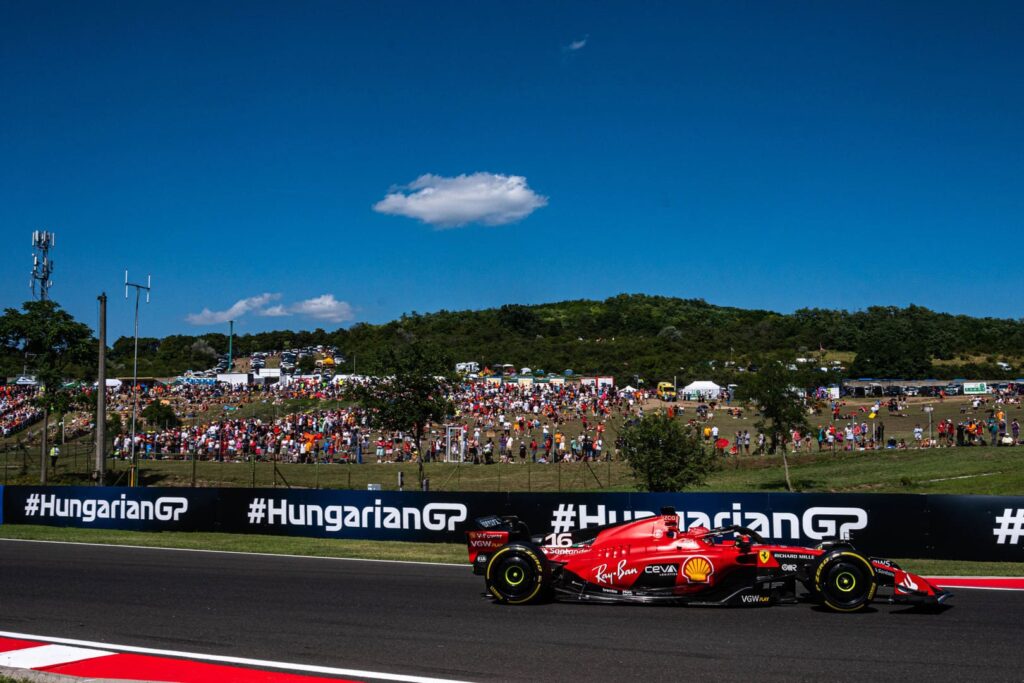
Circuit Stats
| Track Length | 4.381 km |
| Number of Laps | 70 |
| Race Lap Record | 1:16.627 (Lewis Hamilton – 2020) |
| Qualifying Lap Record | 1:13.333 (Rubens Barrichello – 2002) |
| First Grand Prix | 1986 |
| First Race Winner | Nelson Piquet |
| 2023 Race Winner | Max Verstappen |
Circuit History
In 1985, work began on a purpose-built racing facility in Mogyoród, Pest County, Hungary. Just nine months later, the Hungaroring was ready to host its first race.
It was something of a curiosity, being the first Formula 1 race to be held behind the Iron Curtain. Bernie Ecclestone had initially envisioned a race within the USSR, but a friend recommended Budapest as a more suitable location.
The history of the Hungaroring saw drastic changes made before the circuit construction even began. Initial plans had envisioned a street circuit, similar to the Circuit de Monaco, with eyes set on the Népliget park. However, the Hungarian government decided it would be much better to build a brand new circuit. This would be located outside of the city, close to a major highway.

On 1st October 1985, construction began. The facility was built in an astonishingly quick eight months. This makes it the fastest Formula 1 circuit to ever be built. On 24th March 1986, the first Formula 1 Hungarian Grand Prix took place. Nelson Piquet would take the first Hungarian Grand Prix win, famously taking the outside line to slip past Ayrton Senna and claim the lead.
2024 sees Hungary hosting its 39th Formula 1 Grand Prix. The Hungaroring has the rare privilege of being one of only two circuits to have hosted Formula 1 races without interruption (the other being Monza). Formula 1 is currently set to continue racing at the Hungaroring until 2032.
A Different Challenge
The Hungaroring has been compared to a “karting circuit” due to the lack of straights, bringing a challenge that many drivers enjoy. The twisting, bumpy track provides a tough fight for overtakes, which can prove extremely tricky in dry conditions. Such is the difficulty of overtaking at the Hungaroring, the circuit has earned the nickname “Monaco without the barriers”.
The Grand Prix takes place at the height of summer. Typically, the Hungarian Grand Prix takes place in a very hot and dry region. This results in the circuit usually being very dusty, largely due to the lack of use during the off-season. It wasn’t until 2006, Hungary’s 20th Grand Prix, that the first wet Formula 1 race took place at the Hungaroring.
Throughout the history of the Hungaroring, there have been several track layout changes. The first came in 1989, when the chicane located at Turn 3 was removed. The chicane had been added as a temporary measure, due to the discovery of a spring. The stream from the spring was culverted, and Turn 3 gained its sweeping profile.
In 2003, the main straight was extended by 200m (660ft). This also lead to the hairpin at the end of the straight (Turn 1) being tightened. It was hoped that this would increase the number of overtaking opportunities. The fast chicane that had been located at Turn 12 was also replaced. Now it features a straight that leads into a right-hander, again with the hope that this would increase possible overtakes. The changes ultimately increased the length of the circuit, from 3.975 km to 4.381 km.

[adrotate banner=”10″]
Get 10% off all official F1 Merch at TheRaceWorks.com using code ‘EF1‘ at checkout.
Massa’s Lucky Escape
One of the more bizarre incidents to have occurred at the Hungaroring happened on 25th July 2009. In the second qualifying session, Ferrari’s Felipe Massa suffered a terrifying injury. Massa was driving at high speed around the circuit, with the Brawn GP’s Rubens Barrichello further ahead. A suspension spring came loose on the Brawn GP car, breaking free and bouncing down the track. The spring flew into the air and collided with Massa’s helmet, subsequently knocking the Brazilian unconscious. The world held its breath as the Ferrari smashed head-first into the tyre barrier.
Massa was airlifted to the military hospital located in nearby Budapest, and underwent surgery around his left eye. Initially, it was believed that Massa’s condition was “life-threatening but stable”. Thankfully, this rapidly improved and he was discharged from hospital a week later.
Further tests concluded that Massa required a titanium plate to be inserted into his skull in order to strengthen it. The force of the spring hitting Massa’s helmet was described as being “the equivalent of being hit by a bag of sugar at 240km/h (150mph)”. Incredibly, Massa went on to make a full recovery, and returned to Formula 1 in 2010.
Memorable Maiden Wins
There have been a good number of dramatic duels and brilliant strategies that have played out across the history of the Hungaroring. However, no driver will have a fonder memory than that of their maiden win.
Damon Hill took his first Formula 1 win at the 1993 Hungarian Grand Prix, with a mighty drive in his Williams-Renault. Leading from lights out until the chequered flag, Damon dedicated his win to the “Hill family, past, present and future”. In the post-race interviews, Damon said “I can hardly find the words to explain how I feel at winning. It is such an overwhelming feeling.”.
Fernando Alonso claimed his first victory at the 2003 Hungarian Grand Prix. After a skillful drive, and some excellent strategy, Alonso took the chequered flag with a mighty 16.7 second lead. Jenson Button got the better of Alonso at the 2006 Hungarian Grand Prix. Starting from 14th on the grid, Button battled through the wet weather (and an appearance from the Safety Car). In a supreme display of skill, the Brit took the top step of the podium after 113 previous attempts at victory.
Heikki Kovalainen would achieve his first (and only) Formula 1 win at the 2008 Hungarian Grand Prix. With just three laps to the end, Felipe Massa suffered a sudden engine failure. Kovalainen took the opportunity to gain the lead of the race and take the chequered flag.
[adrotate banner=”10″]
Get 10% off all official F1 Merch at TheRaceWorks.com using code ‘EF1‘ at checkout.
Iconic Moment
In 2021, the rain made a rare appearance at the Hungaroring. It was a wet start to the race, bringing chaos along with it. A collision on the first lap forced Bottas, Perez, Norris, Stroll and Leclerc to retire from the race. The red flags were waved, and the race ground to a halt.
The race would resume on a standing start, however Mercedes misjudged the drying track conditions. The strategy? Stay out and stick with the intermediate tyres. This led to one of the most bizarre scenes in the history of the Hungaroring (and in the entire history of Formula 1). As the rest of the field pitted for mediums, Lewis Hamilton found himself as the only car on the grid for the restart.
Hamilton was forced to come in to change his tyres on the following lap, dropping him to the back of the field. Esteban Ocon became the unlikely race leader, and he fought off the challenge of Sebastian Vettel. This allowed Ocon to achieve his first ever Formula 1 victory. Lewis Hamilton managed a fine drive to get back up to 3rd by the end of the race. Hamilton was ultimately handed 2nd place when Vettel was disqualified for a fuel infringement.
What’s your iconic Hungarian Grand Prix moment? Let us know in the comments!