

Circuit Zandvoort is one of the most unique tracks on the Formula 1 calendar, and its long history is just as unique.
[adrotate banner=”9″]
Get 10% off all official F1 Merch at TheRaceWorks.com using code ‘EF1‘ at checkout.
Circuit Stats
| Track Length | 4.259 km |
| Number of Laps | 72 |
| Race Lap Record | 1:11.097 (Lewis Hamilton – 2021) |
| Qualifying Lap Record | 1:08.885 (Max Verstappen – 2021) |
| First Grand Prix | 1952 |
| First Race Winner | Alberto Ascari |
| 2023 Race Winner | Max Verstappen |
Circuit History
There’s been an intimate relationship between Circuit Zandvoort and motorsports racing that goes back as far as 1939. A temporary street circuit was built and a race, organised by enthusiasts, was held that year. It was so successful that plans were laid out to build a permanent facility between the Zandvoort dunes.
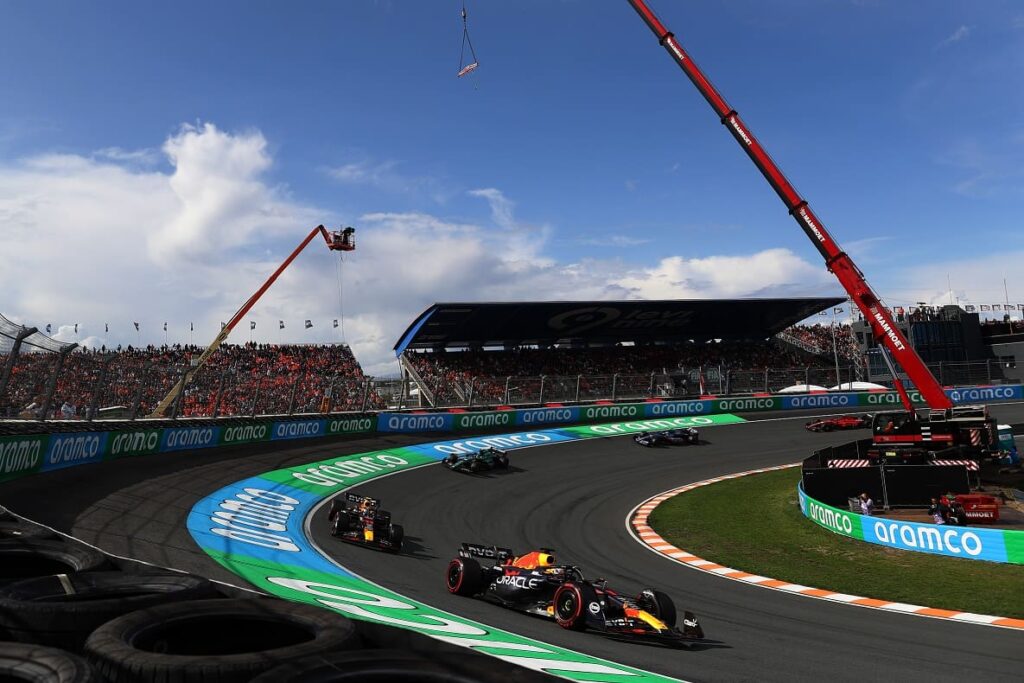
The track was built on communication roads that had been built by the occupying German army. Designed by the 1927 Le Mans winner, S. C. H “Sammy” Davis, the existing roads provided a good base for a race track. The current layout has an elevation difference of 8.9m (29ft), and three steep banked corners. Turn 3 (“Hugenholtzbocht”) sits at an 18-degree angle, whilst Turns 13 (formerly “Kumhobocht”) and 14 (“Arie Luyendijkbocht”) are sharper again at 19-degrees.

Zandvoort disappeared from the F1 racing calendar in 1986, but returned in 2020 only to be cancelled due to the Covid-19 pandemic. In December 2022, it was announced that Formula 1 and Zandvoort had extended their contract. The Dutch circuit is currently set to host Formula 1 until the end of 2025.
1948 – 1958
The first race to be held on the newly-built circuit was the “Prijs van Zandvoort” in 1948. It was renamed in 1949 to the “Grote Prijs van Zandvoort” (Zandvoort Grand Prix). In 1950, the name changed again, this time to “Grote Prijs van Nederland” (Dutch Grand Prix).
The first World Championship round was held in 1952. The race was run under Formula 2 regulations, in stark contrast to the other European rounds. This continued to be the case for 1953. Zandvoort was absent from the race calendar in 1954. In 1955, it hosted its first true race in the Formula 1 Driver’s Championship. Despite this, Zandvoort was absent from the race calendar again in 1956 and 1957.
[adrotate banner=”9″]
Get 10% off all official F1 Merch at TheRaceWorks.com using code ‘EF1‘ at checkout.
1958 – 1985
In 1958, the Dutch Grand Prix returned once more. It would remain on the calendar until 1972. The one-year absence was due to the circuit failing to meet security checks. 1973 brought Formula 1 back to Zandvoort, complete with a new corner – “Panoramabocht”. However, by the eighth lap of the race, a horrifying safety issue made itself known.
Roger Williamson lost control of his car at the high speed esses near Tunnel Oost (Tunnel East). His car flipped and ignited, with Williamson trapped beneath the burning vehicle. David Purley, driving for LEC Refrigeration Racing, abandoned his own race and ran to help his friend. The marshals, who were poorly equipped, were unable to assist as they did not have fireproof overalls. They had also mistakenly thought the burning car was empty and that Purley was trying to extinguish his own vehicle. By the time the first fire engine arrived, it was too late to save Williamson.
Safety adjustments were made once again, and the race returned in 1974. The Dutch Grand Prix would run every year after this until the end of 1985. After this, Formula 1 would not return to Zandvoort for 36 years.
1986 – 1989
In the absence of Formula 1, the circuit was used for a number of national motorsports series. In 1988, the Masters of Formula 3 was introduced. The concept? Take multiple Formula 3 winners and get them to race against one another. The prize? Proving that they were the “best of the best”. Winners of the Masters included David Coulthard, Jos Verstappen and Christian Klien.
1990 – 1998
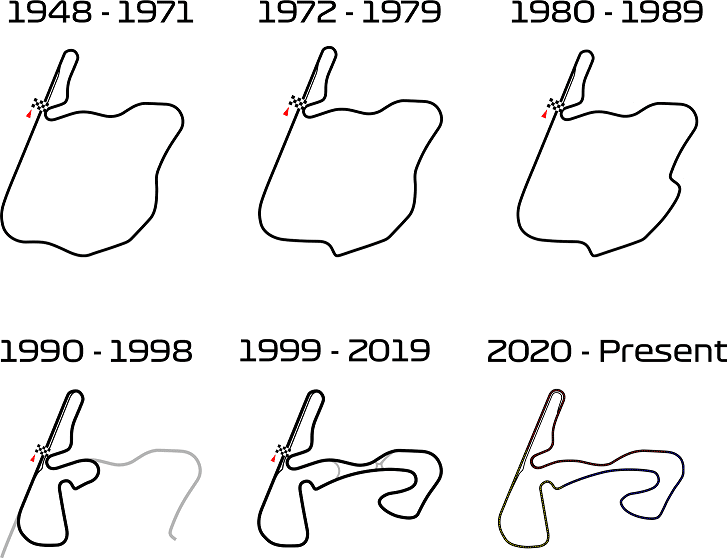
In a bid to tackle a number of problems, drastic changes were made to the circuit layout in 1989. One of the main issues was noise pollution for local residents. The southern section of the track was removed, and the track’s length reduced to 2.526 km (1.57 miles). A bungalow park was constructed on the now disposed of southern part of the circuit. This sat alongside new premises for the local field-hockey and football clubs.
[adrotate banner=”9″]
Get 10% off all official F1 Merch at TheRaceWorks.com using code ‘EF1‘ at checkout.
1999 – 2019
Between 2006 and 2010, the circuit played host to A1 Grand Prix and Superleague Formula. In 2016, the “old coastal racetrack” was being converted into a leisure and business site. With more permissions being granted for “sound days” by the municipality, the circuit’s track action grew. Zandvoort added the ADAC GT Masters, FIA Formula 3 European Championship, FIA GT3 European Championship and the Blancpain Sprint Series to its growing motorsports calendar.
Zandvoort generated national and international interest between 2017 and 2019, thanks to the “Jumbo Racedagen, driven by Max Verstappen”. Most importantly, it caught the eye of Formula 1. In November 2018, the owners of the Zandvoort circuit were invited to pitch for a race in 2020.
In March 2019, it was confirmed that an agreement had been made and a deadline had been set. Zandvoort had until the end of the month to secure the required funding to host a Formula 1 Grand Prix. Two months later, it was officially announced that Formula 1 would be returning to the Netherlands in 2020. The contract was initially set for three years, with the option to host a further two years beyond that. Major renovation works took place in order to meet the requirements needed for a Grade 1 licence. Part of these renovations saw banking being added at Turn 3 (“Hugenholtzbocht”) and Turn 14 (“Arie Luyendijkbocht”).
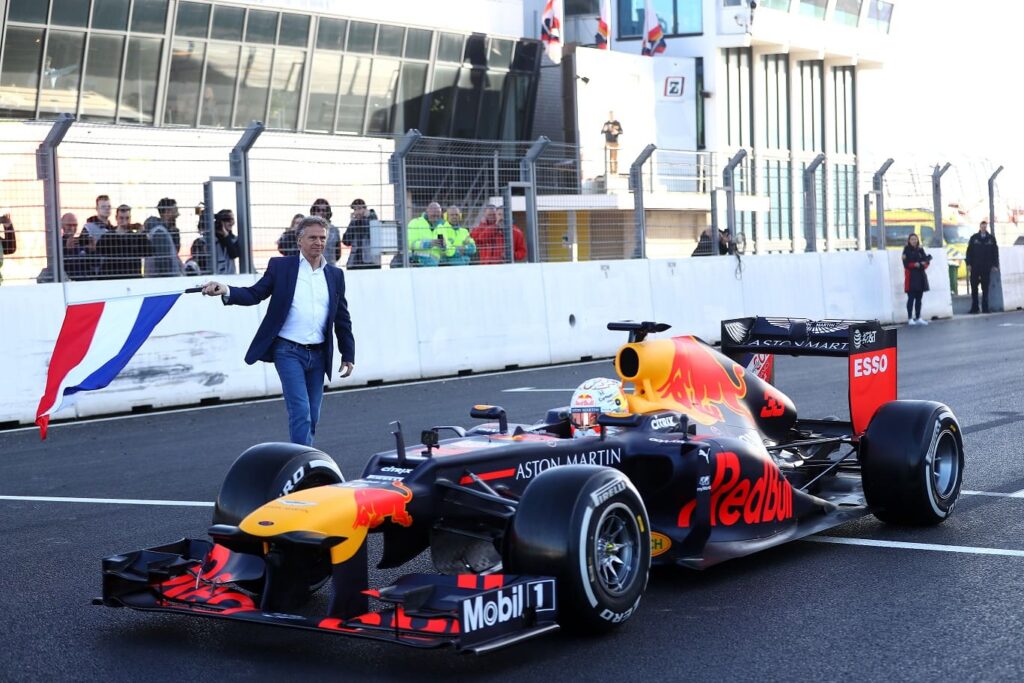
On March 4th 2020, Max Verstappen took to the track for the “Legendary Lap” in his RB07. Circuit Zandvoort had officially reopened in style.
2020 – Present
Zandvoort was ready to return for the 2020 season. However, the race was cancelled as a result of the Covid-19 pandemic. On 5th September 2021, Formula 1 finally raced at Zandvoort for the first time in 36 years. The weekend also saw racing from Formula 3, W Series and the Porsche Mobil 1 Supercup. Max Verstappen took the chequered flag, cementing his place in the history books as the first Dutch Formula 1 driver to win his home race.
With Covid restrictions fully lifted for 2022, the Dutch Grand Prix became an extravagant racing festival. For three days, over 100,000 fans made their way to the circuit – all by public transport, shuttle bus or bicycle. Adding to the party atmosphere, Max Verstappen took his second win in a row at Circuit Zandvoort.
Toto Wolff acknowledged the incredible efforts made to provide fans with an unforgettable event, saying that the circuit had “set a fan engagement benchmark for all Grand Prix promoters around the globe.”
Iconic Moment
Notorious for their flamboyant and carefree demeanour, Hesketh Racing were very much labelled as a playboy outfit. But in 1975, they sent shockwaves through the paddock when James Hunt claimed victory at the Dutch Grand Prix.
The race had been delayed by rainstorms. Teams made their pleas to the organisers to allow them to run on wet tyres. Their wish was granted, and the race finally got underway. Lauda stormed into the lead, with Jody Scheckter behind him. Vittorio Brambilla collided with the Tyrell of Patrick Depailler. Jochen Mass had metering unit issues and Jacky Ickx suffered from engine failure.
Hunt made the bold decision to switch from wet to slick tyres whilst the track was still drying. As it turned out, he called the changing conditions to perfection. By lap 15, the Hunt had swept past Lauda and into the lead. On lap 43, Jean-Pierre Jarier spun after his tyre burst. This gave Lauda the chance to chase after Hunt and pile on the pressure. Hunt kept the (much faster) Ferrari behind him for over 20 laps, and crossed the line to take victory.
He beat Lauda by a margin of just one second, becoming the first Englishman to win a Grand Prix since Peter Gethin four years earlier.
What’s your iconic Dutch Grand Prix moment? Let us know in the comments!