

The Circuit de Monaco is known as being “an exceptional location of glamour and prestige”, so we take a look at this iconic street circuit.
[adrotate banner=”10″]
Get 10% off all official F1 Merch at TheRaceWorks.com using code ‘EF1‘ at checkout.

Circuit Stats
| Track Length | 3.337 km |
| Number of Laps | 78 |
| Race Lap Record | 1:12.909 (Lewis Hamilton – 2021) |
| Qualifying Lap Record | 1:10.166 (Lewis Hamilton – 2019) |
| First Grand Prix | 1950 |
| First Race Winner | Juan Manuel Fangio |
| 2023 Race Winner | Max Verstappen |
Circuit History
The Circuit de Monaco is a race track that is instantly recognisable. Full of tight corners, narrow track limits and elevation changes, it’s a circuit that has seen many unique moments over the decades. It’s also the only Grand Prix circuit that does not adhere to the FIA’s mandated 305 kilometre (190 mile) minimum race distance for Formula 1 races.
Racing here dates back as far as 1929, after Antony Noghes (a cigarette manufacturer) gathered his friends from the Automobile Club de Monaco and proposed a little bit of friendly competition. It was officially sanctioned by Prince Louis II and supported by Monégasque racing driver Louis Chiron, who thought the landscape of Monaco was ideal for a race track.
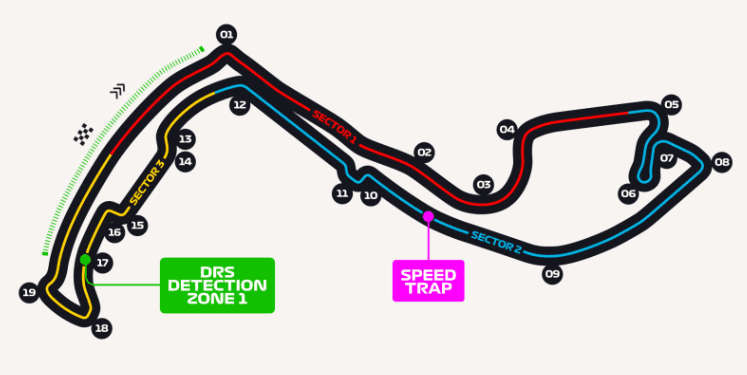
On two occasions, it was designated the European Grand Prix (1955 and 1963). This title used to be an honorary designation, given to a European race each year. During the course of the Grand Prix weekend, there are a number of temporary grandstands built around the circuit. These are largely located in the harbour area. Local residents and businesses also take advantage of the spectacular bird’s eye views of the race that are afforded from their balconies. For those who are fortunate enough, the harbour allows spectators to watch the action from the comfort of their luxury yachts.
Racing Heritage
The Monaco Grand Prix is usually held on the last weekend in May. It forms part of one of the biggest weekends in motorsports, as the race shares Sunday with the Indianapolis 500 (IndyCar) and the NASCAR Coca-Cola 600.
The Indianapolis 500, 24 Hours of Le Mans, and the Monaco Grand Prix also form the coveted “Triple Crown”. Graham Hill is currently the only driver to have won all three. The most successful Monaco Grand Prix constructor is McLaren, with a total of 15 wins. Their most recent was in 2008 when Lewis Hamilton claimed the top step of the podium.
1950 – 1959
Monaco has been on the Formula 1 calendar from the very beginning of the World Championship. In 1950, the first Monaco Grand Prix was won by Juan Manuel Fangio, with local hero Louis Chiron taking third. The following year in 1951, the race didn’t take place due to budget issues and the sports lack of regulations. 1953 and 1954 also saw Monaco absent from the calendar, due to the car regulations not being finalised.
In 1955, Monaco returned to the Formula 1 World Championship, where it began an incredible run of 64 consecutive years in which the race was held.
1960 – Present Day
During this time, Graham Hill would earn himself the title of “Mr Monaco”, taking victory five times between 1963 and 1969. Ayrton Senna won in Monaco a consecutive six times between 1989 and 1993, beating Graham Hill’s record. After the race in 1993, runner-up Damon Hill commented “If my father was around now, he would be the first to congratulate Ayrton.”
Bernie Ecclestone announced in 2010 that a new 10-year deal had been reached with the race organisers. Monaco was set to feature on the race calendar until at least 2020.
The 2020 race was postponed due to the Covid-19 pandemic, but was later confirmed by the Automobile Club de Monaco as being officially cancelled. This was the first time since 1954 that the Grand Prix had not been held in the principality.
In 2021, Formula 1 returned to the iconic streets of Monaco, with Charles Leclerc achieving pole position. However, a driveshaft failure would deny him a home win, with the Ferrari unable to even start the race. It would be Max Verstappen who took the chequered flag, making this his first Monaco victory.
2022 saw Charles Leclerc put his Ferrari on pole once again, but the Monégasque’s chances of victory were once again dashed, this time by a critical strategic error. Leclerc ended up fourth, with Sergio Perez taking the top step of the podium.
2022 also saw a new race contract signed, with Monaco to remain on the calendar until 2025. Part of this agreement saw the Automobile Club de Monaco relinquish their advertisement rights and TV coverage to Formula One Management. The TV coverage had previously been produced by Télé Monte-Carlo.

[adrotate banner=”10″]
Get 10% off all official F1 Merch at TheRaceWorks.com using code ‘EF1‘ at checkout.
A Unique Challenge
Monaco provides plenty of challenges for the drivers, testing their accuracy and bravery. It’s all too easy to push just a couple of millimetres too far, and end up hitting the barriers. Overtaking is also a lot trickier in Monaco, with the tight, narrow streets providing little opportunity for a heroic lunge. Unsurprisingly, the slowest corner in Formula 1 is located in Monaco. Turn 6 (aka “The Hairpin”) sees drivers navigating their way around the bend at just 30 mph, and requires full steering lock to successfully complete.
Another feature of Monaco is that it is just one of three circuits in Formula 1 to include a tunnel. The other two tunnel-featuring venues are the Detroit Street Circuit (used between 1982 – 1988), and the Yas Marina Circuit in Abu Dhabi. This can create difficulties with the sudden change from light to dark, then dark to light. It also has a profound effect on the aerodynamic quality, with cars potentially losing 20-30% of their downforce. Famously, during the extremely wet 1984 Grand Prix, Bernie Ecclestone ordered local fire crews to wet the tunnel floor. This had been requested by Niki Lauda, as it allowed for the same grip to be created that was being experienced around the rest of the circuit.

Criticisms
A lot of debate has surrounded Monaco’s place on the calendar in the last few years. Several commentators and drivers have called the Grand Prix “the most boring race of all the circuits”. Fernando Alonso has said that the race is “the most boring race ever”. Lewis Hamilton also claimed that the 2022 Grand Prix “wasn’t really racing”.
This is largely due to the low number of overtakes that happen. It’s well-known that you are almost guaranteed win if you secure pole during qualifying. This was most noticeable at the 2003 Monaco Grand Prix, which saw a grand total of zero overtaking manoeuvres!
However, the challenges presented by the circuit’s layout has also been the recipient of praise from drivers. Three-time world champion Nelson Piquet compared the tight confines of the track to “trying to cycle around your living room”, adding that “a win here was worth two anywhere else.”
Safety Concerns Prompt Changes
Jackie Stewart’s efforts saw several Formula 1 races cancelled in the 1970’s, and Monaco didn’t escape his gaze.
In 1969, Monaco added Armco barriers at specific points around the circuit for the first time in its racing history. Astonishingly, the circuit’s previous conditions were almost identical to when the roads were being used for everyday traffic. The danger was ever-present. If a driver went off, they would likely just crash into whatever happened to be next to the track at that location. This included buildings, lamp posts, trees, a train station, glass windows and even the harbour.
Further Armco barriers were added to specific points for the following two races. The circuit was almost completely lined by Armco by 1972. This would also be the first time in the circuit’s history that the circuit’s layout was altered, with the pits being moved next to the straight between the chicane and Tabac. The chicane was also moved further forward, becoming the merge point between the pits and the track.
In 1973, further changes were made to the course. The Rainier III Nautical Stadium was added to the straight behind the pits, and saw the introduction of a double chicane around the new swimming pool. This complex is simply known today as “Swimming Pool”. As this allowed plenty of space for a whole new pit facility, the circuit was changed again in 1979. The Sainte Devote corner was altered to reduce the speed, and a chicane was added just before the pit straight.
[adrotate banner=”10″]
Get 10% off all official F1 Merch at TheRaceWorks.com using code ‘EF1‘ at checkout.
Unusual Circumstances
Two drivers have been unfortunate enough to end up in Mediterranean waters during the Monaco Grand Prix.
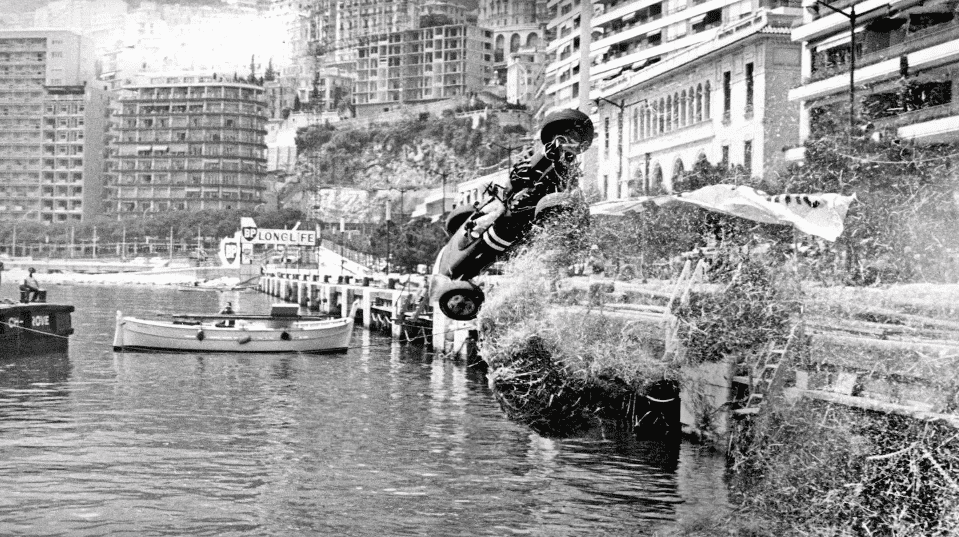
In 1955, Alberto Ascari approached the chicane too quickly, and crashed from the lead. He went through the “barrier” (made up of hay bales and sandbags) at speed. Ascari escaped with just a broken nose as his Lancia D50 sank in the harbour. 10 years later, in 1965, Paul Hawkins spun at the chicane and also ended up taking his Lotus 33 Climax R8 for a swim. Thankfully, Hawkins managed to avoid any injury from the incident and his Lotus was recovered from the harbour waters.
Iconic Moment
In 2006, Kimi Räikkönen delivered an iconic moment that, quite frankly, only Kimi could.
On lap 51 of the race, Räikkönen’s car caught fire. He was forced to abandon the McLaren just after the tight hairpin. But he wasn’t going to let this spoil his day, and decided he would simply take the rest of the afternoon off. Räikkönen promptly set off on foot, heading straight for his yacht (which in true Kimi fashion was named “No Name”).
As his rivals continued to race, the TV camera turned its view to the race retiree. Kimi had made himself comfortable in the yacht’s hot tub, and was now enjoying some cold drinks with his friends.
It’s a true testament to the Iceman’s no-frills approach to racing. It was no secret that he didn’t enjoy the corporate commitments that came with his career! More than that, it’s a hilarious off-the-cuff moment that Kimi fans will continue to fondly recall.
What’s your iconic Monaco Grand Prix moment? Let us know in the comments!