

The Spanish Grand Prix is moving back to Madrid in 2026, but there’s still two more races at the Circuit de Barcelona-Catalunya.
[adrotate banner=”10″]
Get 10% off all official F1 Merch at TheRaceWorks.com using code ‘EF1‘ at checkout.
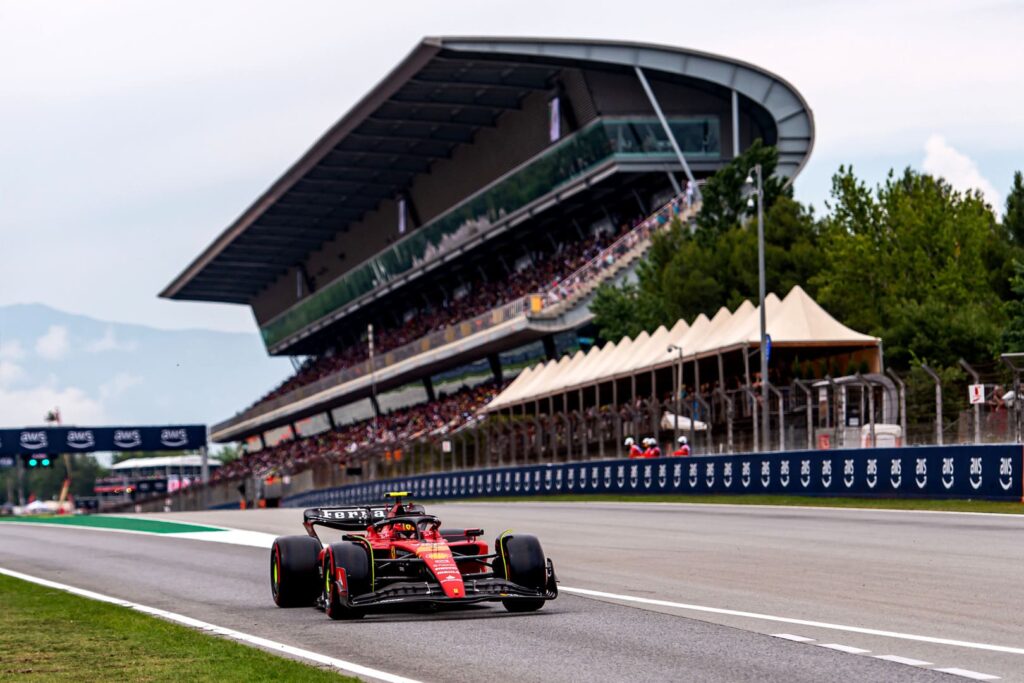
Circuit Stats
| Track Length | 4.657 km |
| Number of Laps | 66 |
| Race Lap Record | 1:16.330 (Max Verstappen – 2023) |
| Qualifying Lap Record | 1:12.272 (Max Verstappen – 2023) |
| First Grand Prix | 1991 |
| First Race Winner | Nigel Mansell |
| 2023 Race Winner | Max Verstappen |
Circuit History
Originally built as a test track for the Spanish car industry, the Circuit de Catalunya (as it was then known) hosted its first Formula 1 race in 1991. In 2013, a sponsorship deal was agreed with the Barcelona City Council, and the circuit was renamed to the Circuit de Barcelona-Catalunya.

Designed by the legendary Hermann Tilke, it quickly became a popular venue for motorsports events. It’s a track that is popular with Formula 1 drivers, featuring a mixture of high-speed and low-speed corners. Whilst not known for producing a particularly high volume of overtaking (despite the long straights), Turn 1 is a popular spot to slip by your opponent.
The circuit also regularly hosts MotoGP and World Superbikes. The first ever motorsports race held on the track was a round of the 1991 Spanish Touring Car Championship. The foundation stone for the circuit was laid in 1989, with the circuit itself being built as part of the development programme for the 1992 Olympics. It shouldn’t be confused with the Montjuïc Circuit however. Montjuïc hosted the Spanish Grand Prix on four occasions between 1969 – 1975. (It’s also actually located within the city of Barcelona!).
The Circuit de Barcelona-Catalunya is set to host the Spanish Grand Prix until the end of the 2025 season. In 2026, the race will relocate to a new circuit in Madrid.
Modifications
As with most circuits, there have been a number of changes to the layout over the years. For the Circuit de Barcelona-Catalunya, it was MotoGP that prompted some of the more major adjustments.
The circuit changes made for Formula 1 were not initially used for MotoGP. However, in 2016, Moto2 rider Luis Salom was involved in a fatal crash, and the Formula 1 layout was implemented. This meant that riders would use the chicane, slowing them down. In 2017, further changes saw grandstands removed and additional runoff added. This allowed the FIM to keep the La Caixa (Turn 10) hairpin, but eliminate the chicane.
The La Caixa hairpin was remodelled again in 2021, with the alterations aimed at making the safety of the riders even greater. The track was resurfaced in 2004, but underwent further resurfacing works in 2018. This was due to the MotoGP riders calling for improvements to grip on the surface.
In 2023, Formula 1 adopted the MotoGP layout, opting to use the sweeping curve between Turns 13 and 14 instead of the chicane.

First Times
The Circuit de Barcelona-Catalunya has witnessed a number of firsts throughout the years. In a very wet 1996 Spanish Grand Prix, Michael Schumacher achieved his first race win as a Ferrari driver. Ten years later in 2006, Fernando Alonso became the first Spanish Formula 1 driver to win the Spanish Grand Prix.
Fast forward to 2016. Max Verstappen, who had qualified 4th on the grid, claimed his first Red Bull victory. At just 18 years and 228 days of age, he broke several records. Verstappen became the youngest driver to have led at least one lap of a Formula 1 Grand Prix, and the youngest driver to have stood on the podium. He also became the youngest driver to have won a Formula 1 race, and the first Dutchman to do so as well.
Iconic Moment
In 2012, there were 7 different winners in the first 7 races of the season. And in Spain, the twists and turns would just keep coming.
Pastor Maldonado qualified a surprising 2nd place on the grid. This was then converted to pole, as Lewis Hamilton was sent to the back of the grid due to a fuel irregularity. At the start of Sunday’s race, Maldonado quickly lost the lead to Fernando Alonso. Following his pit stop, Alonso got caught in the traffic of the backmarkers, and Maldonado regained the lead position.
Not one to have dealt with many of the front-runners during his career so far, Maldonado found himself battling it out with Alonso and Kimi Räikkönen to the end of the race. The Venezuelan managed to keep his competitors at bay, bringing his Williams to the chequered flag. Maldonado claimed his maiden Grand Prix win, and the first win for Williams since 2004.

The celebrations were cut short as, 90 minutes after the race had ended, black smoke billowed into the pit lane. The Williams garage had caught fire, believed to have been caused by a KERS unit sparking a fuel fire. Multiple pit crews from other teams sprung into action to help Williams battle the flames. It was an inspiring display of camaraderie that the paddock can be proud of.
Pastor Maldonado would not set foot on a podium again during the remainder of his career in Formula 1. However, his win in Spain showed the world that nothing is impossible.
What’s your iconic Spanish Grand Prix moment? Let us know in the comments
[adrotate banner=”10″]
Get 10% off all official F1 Merch at TheRaceWorks.com using code ‘EF1‘ at checkout.