

A popular addition to the race calendar, the Baku City Circuit combines a strong test of skill with a beautiful and unique backdrop.
Circuit Stats
| Track Length | 6.003 km |
| Number of Laps | 51 |
| Race Lap Record | 1:43.009 (Charles Leclerc – 2019) |
| Qualifying Lap Record | 1:40.203 (Charles Leclerc – 2023) |
| First Grand Prix | 2016 |
| First Race Winner | Nico Rosberg |
| 2023 Race Winner | Sergio Perez |
[adrotate banner=”10″]
Get 10% off all official F1 Merch at TheRaceWorks.com using code ‘EF1‘ at checkout.
Circuit History
Baku’s link to motorsports started in 2012. The GT City Challenge had raced at the Hungaroring and in Bucharest previously, but in June 2012 an agreement was made to host a street race in Azerbaijan. However, the deal would be short and sweet. In 2014 it was announced that Formula 1 was coming to Baku.
All attention shifted to creating a brand new street circuit along the shoreline. Hermann Tilke was drafted in to design the 6.003km (3.730 mile), anti-clockwise circuit. It’s the fourth-longest circuit on the calendar, behind Spa-Francorchamps, Jeddah and Las Vegas.

The Baku City Circuit boasts 20 corners, bringing some sharp angles to the overall layout. One of the key features of the circuit is the 2.2km (1.34 mile) high speed straight at the end of the lap. It brings drivers out of the old city section and back across the start/finish line.
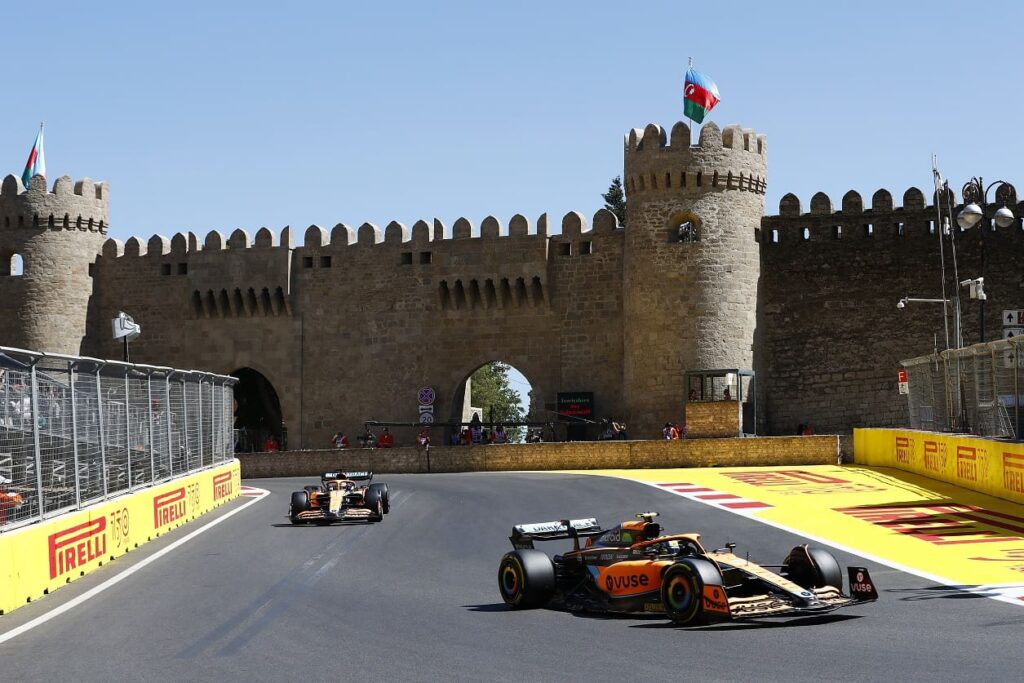
There’s also the incredible scenery to take into account, with Baku’s old city providing a unique backdrop. When navigating ancient streets, there are a multitude of tough challenges. Drivers must weave their way through tight corners. The narrow, slow-speed sections can also be unforgiving if you get out of shape. And besides, where else in the world can you find a Formula 1 car racing past a 12th century fortress wall?
In 2016, Azerbaijan hosted Formula 1 in the form of the European Grand Prix. The following year, the European Grand Prix was once again dropped from the calendar. In its place, was the inaugural Azerbaijan Grand Prix. It’s been on the race calendar ever since (except in 2020 due to the Covid-19 pandemic), and Azerbaijan is currently set to host Formula 1 in Baku until 2026.
A Rocky Start
New circuits often bring new problems, and Baku was no exception. Pirelli revealed that in Free Practice for the 2016 Grand Prix, 90% of the rear tyres used had been cut by bolts used to secure the kerbs.
A lack of run-off areas caused concern with drivers, and drain covers proved to be an even bigger issue. In 2016, Valtteri Bottas was forced to watch Free Practice 3 from the side-lines. A drain cover came loose during the session, significantly damaging his Williams. In 2019, a similar situation occurred in Free Practice 1, when a loose drain cover hit the Williams of George Russell. The session ultimately ended up being cancelled because of the incident.
Perhaps one of the biggest criticisms of the first-ever Formula 1 race in Baku was the timing. The race weekend was held on 17th-19th June 2016. However, this meant that the race start ended up clashing with the finish of the Le Mans 24hrs. Fans were left frustrated by the scheduling, but things would improve.
In 2017, the date was moved to avoid a clash with Le Mans. Kerb bolts were drilled further into the ground, and drain covers stayed put (for now). The fact that so few changes have been made to the circuit since its debut in 2016 is a true testament to its brilliant design.
High Praises
Drivers relish the test of skill that Baku throws at them, and some have openly expressed their feelings on the circuit.
Daniel Ricciardo described Baku as being “different to other street circuits – because there are places where you can pass.” He noted that “the trickiest thing in Baku is braking. There’s so many braking points where you have to commit and you have to brake as late as you can – but there’s no room for error. Once you’ve committed to that braking point, if you’ve locked a wheel, you’re in the wall.”
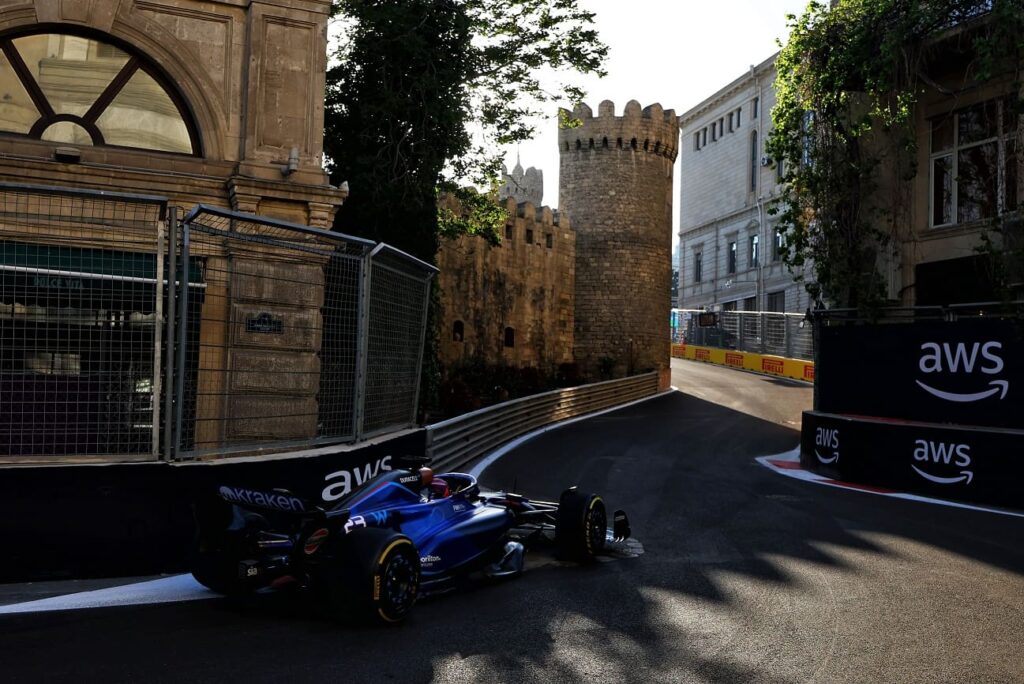
Max Verstappen has said “Baku in my opinion is quite a special street circuit. It’s really unique in terms of having quite wide sections but also some of the tightest parts of track on the calendar.”
Nico Rosberg, also sang high praises for the circuit after winning the 2016 Grand Prix: “Thank you all here in Baku for welcoming us in this way. It’s been spectacular, great track you’ve made, really exciting racing.”
Fans also have a love of Baku, with tens of thousands flocking to the city for the race weekend. Whilst Baku hasn’t announced any official attendance figures since 2018 (with 85,000 spectators), the demand for tickets is seemingly on the rise. In 2019, it was estimated that 94,000 people attended. Ahead of the 2024 Grand Prix, seating capacity has been increased by 35% to meet ticket demand. There has been several new grandstands added around the track.
[adrotate banner=”10″]
Get 10% off all official F1 Merch at TheRaceWorks.com using code ‘EF1‘ at checkout.
Iconic Moment
If there’s one golden rule in Formula 1, it’s “don’t crash into your teammate”. Something that Daniel Ricciardo and Max Verstappen fell foul of at the 2018 Azerbaijan Grand Prix.
The season had been tumultuous for Red Bull, with a strained relationship between their drivers. Verstappen had stamped his place as the de facto number 1 driver, with Red Bull seeming to back this up. Ricciardo was frustrated, having been the better performing driver for Red Bull so far in the season. The Aussie was ahead of his Dutch teammate in the points. In Baku, Ricciardo managed to out-qualify Verstappen.
On race day, the pair found themselves in a tense battle for fourth position. Verstappen had managed to squeeze ahead in the early stages. There had been multiple moments of wheels touching. Both cars were continually arriving at Turn 1 side-by-side as the laps rolled by. But on lap 41, the brewing trouble finally boiled over.
Ricciardo got into Verstappen’s slipstream and tried to position himself to pass. The Aussie’s late braking saw him drive straight into the back of his teammate, taking them both out of the race. Ultimately, it was the straw that broke the camel’s back (or should that be the bull’s back?), and Ricciardo parted ways with the team at the end of the 2018 season.
What’s your iconic Azerbaijan Grand Prix moment? Let us know in the comments!