

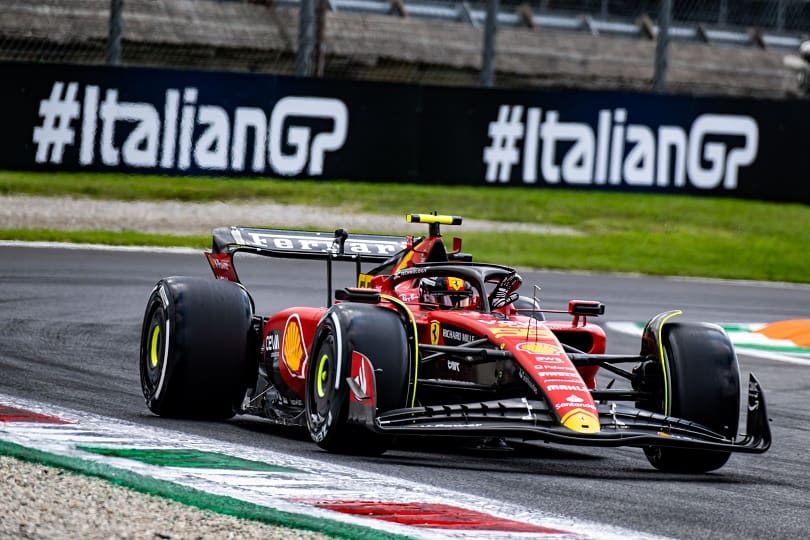
In 1922, the Autodromo Nazionale Monza became the world’s third purpose-built race track. Now, it’s one of the greatest Formula 1 circuits on the calendar.
Circuit Stats
| Track Length | 5.793 km |
| Number of Laps | 53 |
| Race Lap Record | 1:21.046 (Rubens Barrichello – 2004) |
| Qualifying Lap Record | 1:18.887 (Lewis Hamilton – 2020) |
| First Grand Prix | 1950 |
| First Race Winner | Giuseppe “Nino” Farina |
| 2023 Race Winner | Max Verstappen |
[adrotate banner=”3″]
Get 10% off all official F1 Merch at TheRaceWorks.com using code ‘EF1‘ at checkout.
Circuit History
In January 1922, the Automobile Club of Milan wanted to celebrate the association’s 25th anniversary in style. What better way to do so than build a race track?
The project was entrusted to architect Alfredo Rosselli. Initial plans incorporated a speed track alongside a road ring, creating a 14km (8.699 mile) circuit. The first stone was laid in February 1922. However, work would be immediately suspended and there was a long debate around the “artistic, monumental and landscape conservation value”. The value and “absolute necessity” of a race track came out on top, and a circuit design was completed. It was similar to the original plans, albeit reduced in length to 10km (6.213 miles).

Constructed in an impressively quick 110 days, the Autodromo Nazionale Monza became the world’s third purpose-built race track. It joined an exclusive club, alongside Brooklands (UK) and Indianapolis (USA). In similar fashion to the other two tracks, the Autodromo Nazionale Monza featured some incredible banked curves. It also retains a large portion of the “outfield” section that is still used today.
The Autodromo Nazionale Monza is currently contracted to host Formula 1 until the end of 2025. Automobile Club of Milan president, Geronimo La Russa, says that “The Monza GP is an icon of Italy in the world”. He is confident in extending the contract into 2026 and beyond.
Magic & Speed
The Autodromo Nazionale Monza was dubbed “La Pista Magica” (The Magic Track) by locals. It’s also earned the moniker “The Temple of Speed”, and it’s easy to see why. The cars push at full throttle for around 80% of the lap, and reach eye-watering speeds.
There are three sections of the track where cars cross the 300 km/h (186.4 mph) threshold. However, the ultimate section for this is along the main straight and into the “Prima Variante” (aka “Variante del Rettifilo“).
In the 2005 Grand Prix, Kimi Räikkonen hit 370 km/h (229.9 mph) as he blasted down the straight towards the chicane. Juan Pablo Montoya hit 372 km/h (231.1 mph) in the same car during free practice.
[adrotate banner=”3″]
Get 10% off all official F1 Merch at TheRaceWorks.com using code ‘EF1‘ at checkout.
1922 – 1938
Construction of the track was undertaken by 3500 workers, 200 wagons and 30 trucks. A five-kilometre railway with two locomotives and a further 80 wagons was also used. In order to host spectators, the main grandstand was built to seat 3000 people. There were also six other stands capable of seating 1000 spectators each. The official opening took place in September 1922, with Prime Minister Facta in attendance.
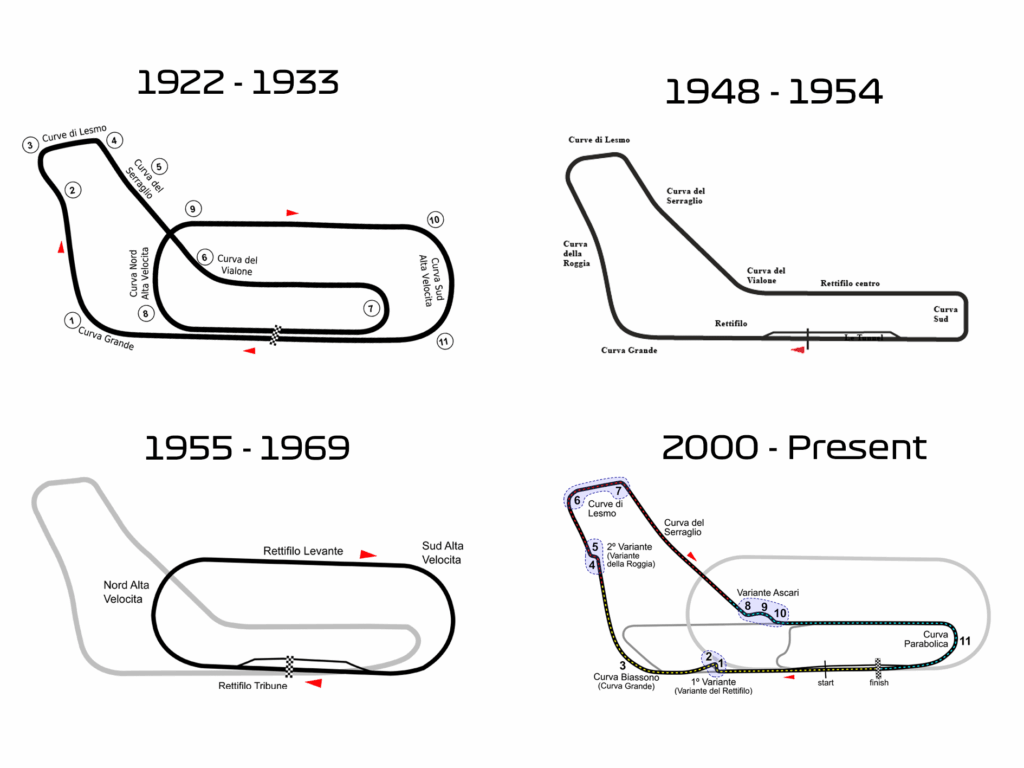
In 1929, safety concerns saw the Monza Grand Prix being held using only the high-speed ring section of the circuit. Vincenzo Floria, president of the Automobile Sports Commission, studied a new track. The so-called “Florio Circuit” allowed for racing to resume on the complete circuit layout in 1932. In 1933, Giuseppe Campari, Baconin Borzacchini and Stanislaus Czaykowski all lost their lives at Monza. It led to two artificial chicanes being added, slowing the cars by a significant amount. The cars returned to the “Florio Circuit” layout for the next two years. A brief move to the slower Livorno Circuit then followed, before a final exhibition on the “Florio Circuit” in 1938.
An extensive amount of adjustments were made to the circuit in 1938. The two elevated curves of the speed track were demolished and the road layout was reconstructed. A new grandstand was added, with more seats and a restaurant on the ground floor. In addition, new garages and service buildings were built.
Wartime Hiatus
All activities at the Autodromo Nazionale Monza were suspended during the war. The race track took on various new roles during this time, including being used as offices for the Milan Automobile Club and archive space for the Public Automobile Registry.
In 1945, Allied armoured vehicles paraded on the track. A short while later, vast areas of the circuit were used as storage for military vehicles. By the start of 1948, the Automobile Club Milano decided that a complete restoration of the circuit would take place. On 17th October 1948, the roar of engines could be heard at Monza once again.

Racing Returns
In 1950, Monza joined the original Formula 1 World Championship race calendar. It was the last race in a season that saw Giuseppe “Nino” Farina and Juan Manuel Fangio in a tight battle for the championship. After Fangio retired from the race, the win fell into place for Farina – the victory meant that Farina also clinched the World Championship title.
1955 saw more transformation works, improving functionality of the venue overall. A 10 kilometre (6.2 mile) circuit was restored. Similar to the original 1922 layout, it included both a road sector and a high-speed sector. Other improvements included the construction of two large towers with luminous pictures placed on the sides of the grandstands, plus 14 metal towers for the display of the rankings to the public. There were also new officers for the race directors, 39 representation boxes, and a two-storey press pavilion.
By 1972, an agreement was made with the GPDA (Grand Prix Drivers Association) to create two chicanes in order to reduce speed when entering the two fastest curves on the track – “Curva Grande” (aka “Curvoni”) and “Ascari” (aka “Vialone”). The chicanes, however, would only be a temporary solution to safety concerns, and resulted in multiple minor accidents and collisions.
Further Changes
In the following three years, more changes were made in order to improve speed reduction and safety. The chicane located on the grandstand straight was changed to a variant. The number of pit spaces increased from 10 to 46, and a “paddock” was created behind the pits themselves. Further extensions to the “Curva Grande” and “Curva Parabolica” were added, along with sand and tyre barriers. The guardrail at “Lesmo” was moved and a service road was created for emergency vehicles.

[adrotate banner=”3″]
Get 10% off all official F1 Merch at TheRaceWorks.com using code ‘EF1‘ at checkout.
1994 – Present
Following the deaths of Ayrton Senna and Roland Ratzenberger at Imola in 1994, safety became paramount. Monza’s three main curves had larger gravel traps installed, shortening the lap to 5.770 kilometres (3.585 miles). In 2000, the main straight chicane was altered to a single right-left chicane rather than the double left-right – this was in an attempt to reduce the frequent accidents at the race starts. The second chicane also saw adjustments being made. In the 2000 Grand Prix, a fire marshal, Paolo Gislimberti, was sadly killed by flying debris following a huge pile-up at this chicane.
2007 saw the gravel run-off at the second chicane changed to asphalt. By late 2016, plans were made to install a new first bend that would bypass the first chicane into “Curva Grande”. It was hoped that these would be ready for 2017, but the work was suspended due to the track being located in the historic Monza Park.
Whilst it has changed its appearance completely on multiple occasions since 1922, the Autodromo Nazionale Monza is now one of the most beautiful and functional circuits in the world. It holds its status as the fastest track on the Formula 1 calendar, cementing its legacy as the Temple of Speed.
Iconic Moment
Often seen as being icy-cool, Mika Häkkinen’s emotions were there for all the world to witness at the 1999 Italian Grand Prix. The Finn was embroiled in a tight championship battle with Ferrari’s Eddie Irvine. It looked like there was no stopping Häkkinen in claiming the race win at Monza. However, an uncharacteristic mistake in the 1st chicane sent the McLaren spinning and caused Häkkinen to retire from the race, much to the delight of the Tifosi.
In scenes that became famous worldwide, Häkkinen threw his steering wheel from the car and slammed his gloves to the ground as he hastily left the scene. The Finn could be seen from the helicopter camera crouching down in tears as his emotions got the better of him.
Whilst many took this as an opportunity to criticise Häkkinen, his then-wife, Erja, said “It was a terrible moment for Mika, but in a way, I also felt relieved, because I don’t like this picture which is sometimes given about F1 drivers that they are cold people, like robots. For once he shared his feelings with the fans.”
The Tifosi revelled in the Finn’s misfortunes that day. However, Mika would have the last laugh, ultimately going on to win the 1999 world championship.
What’s your iconic Italian Grand Prix moment? Let us know in the comments!