

The Mexican Grand Prix never fails to bring that fiesta feeling, and the Autódromo Hermanos Rodríguez provides the perfect setting.

[adrotate banner=”9″]
Get 10% off all official F1 Merch at TheRaceWorks.com using code ‘EF1‘ at checkout.
Circuit Stats
| Track Length | 4.304 km |
| Number of Laps | 71 |
| Race Lap Record | 1.17:774 (Valtteri Bottas – 2021) |
| Qualifying Lap Record | 1.14:758 (Max Verstappen – 2019) |
| First Grand Prix | 1963 |
| First Race Winner | Jim Clark |
| 2023 Race Winner | Max Verstappen |
Circuit History
In 1959, Mexico had a pair of highly successful racing brothers – Ricardo and Pedro Rodríguez. Rather conveniently, their father was an advisor to Mexican President, Adolfo Lopez Mateo. The suggestion was made to the President about building a racing circuit. Mexico City’s Magdalena Mixhuca Sports Park was the perfect location, with existing internal roads providing a good base for a circuit.

Sitting over 2km (1.24 miles) above sea level, the thin air at the circuit pushes the drivers and their cars to the limit. It has hosted many prestigious races over the years, including Formula 1, the FIA World Endurance Championship and the Mexican NASCAR series. The combination of tight corners, long straights and elevation changes means that the Autódromo Hermanos Rodríguez rarely comes up short when it comes to thrilling race moments.
In 1953, the original circuit was designed by a student named Óscar Fernández as his thesis. In 1959, work began on the construction of the circuit, and was completed in less than a year. A non-championship race was held in 1962 before the circuit held its first official Grand Prix in 1963.
Mexico City is currently set to host Formula 1 until the end of 2025, and remains one of the most popular destinations for race fans.
Layout Changes
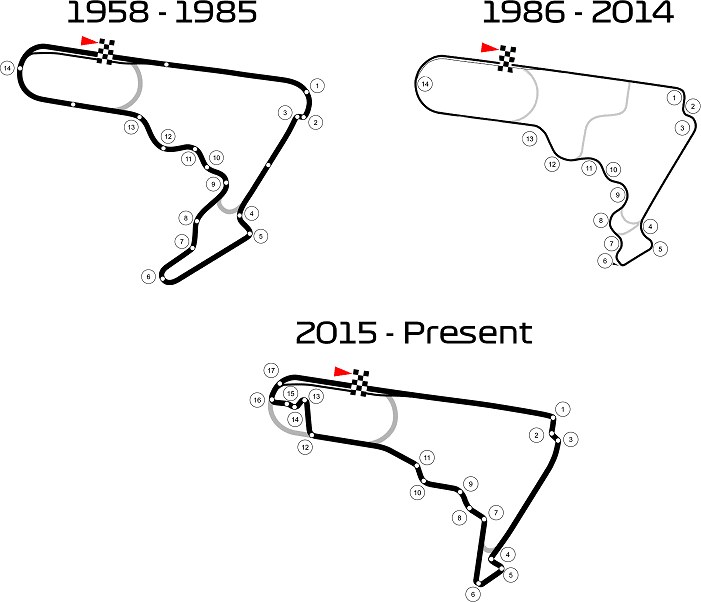
Whilst the current layout of the circuit still largely follows the original design, there have been multiple changes over the decades. Some were to provide a more exciting race and to improve the venue. Others were changes made out of necessity due to safety concerns. There’s also an oval layout that sees NASCAR action twice a year, and forms part of the Formula E circuit.
In 1971, Mexico City disappeared from the Formula 1 calendar due to spectator overcrowding at the 1970 Grand Prix, which caused unsafe conditions. It returned in 1986, and the circuit had improved the overall safety. It also debuted a brand new pit complex. Turns 1, 2 and 3 were reprofiled into the sweeping Esses Moisés Solana. The Turn 6 hairpin was replaced by a sharp right-hander, and Turn 8 was extended into a smooth curve.
In 1992, safety concerns once again forced Mexico off the calendar. But in 2001, D3 Motorsport Development were given the task of bringing much needed improvements to the circuit. A complete upgrade was done, including incorporating the former Foro Sol baseball stadium. This created one of the most recognisable and unique grandstands in motorsport. There was no sign of Formula 1 returning to Mexico, however, and it wouldn’t be until 2012 that the first signs of hope would arrive.
[adrotate banner=”9″]
Get 10% off all official F1 Merch at TheRaceWorks.com using code ‘EF1‘ at checkout.
Further Design Improvements
The return was promised to be a five-year deal (starting in 2013) that would see the Mexican Grand Prix replace the European Grand Prix in Valencia. However, Mexico was left off the calendar again in 2013. It was provisionally added for 2014, but once again was snubbed on the final schedule. In December 2014, the Mexican Grand Prix was officially listed on the race calendar. Formula 1 was finally set to return in 2015.
Under the direction of legendary track designer, Hermann Tilke, the Autódromo Hermanos Rodríguez underwent significant renovations. The extension and reprofiling of the front straight allowed for a new paddock area and media centre to be built. The legendary esses situated between Turns 7 and 13 had the majority of their wide bends replaced with fixed angle turns. The Foro section of the track was altered to a low-speed left-right combination. This meant cars would bypass the first half of the Peraltada curve and re-enter halfway through the corner.
Overall, the circuit was shortened by 560ft (170 metres). The turbocharged Formula 1 cars were predicted to reach speeds in excess of 328 km/h (204 mph). The maximum straight line speed in a 2023 Formula 1 car was recorded along the start/finish straight, clocking in at an eye-watering 361.9 km/h (224.9 mph).
In 2019, the Mexican Grand Prix was renamed to the Mexico City Grand Prix. The 2020 race was cancelled as part of a drastically revised calendar due to the Covid-19 pandemic. The Autódromo Hermanos Rodríguez burst back onto the scene in 2021, hosting the first Grand Prix under the new name.
Iconic Moment
The 1990 Mexican Grand Prix had mainly been about Senna v Prost. Senna was forced out of the race due to tyre issues, and Prost took the win after a masterclass drive. Not much further down the road, another scrap was underway for second place. The gladiators in this epic battle? Gerhard Berger and Nigel Mansell.
On lap 66, Gerhard Berger sent his McLaren up the inside of Mansell at Turn 1. It wasn’t the cleanest of manoeuvres, however, and he locked his wheels in the process. Mansell desperately looked for a way to get back past the Austrian. The final section of the lap approached quickly, and as the pair approached the Peredalta curve, Mansell made his move.
Sticking to the outside line, the Brit kept his foot down. Using the slight banking of the corner, he managed to slingshot himself past Berger and disappear into the distance.
Speaking after the race, Mansell said “I’d made my mind up that I was just going to go in there flat, and that’s exactly what I did. Fortunately, Gerhard lifted!”.
It was an audacious and daring move, and is without a doubt one of the best overtaking moments in Formula 1 history.
What’s your iconic Mexico City Grand Prix moment? Let us know in the comments!