

Williams Racing recently announced that their heritage department has undertaken an extensive restoration of an FW11 chassis from 1986. The rebuilt car will run at the 2025 Goodwood Festival of Speed, with original driver Nigel Mansell at the wheel. Fellow 1980s Williams drivers Riccardo Patrese and Thierry Boutsen will also get a chance to pilot the restored machine.
Significantly, the restoration program was undertaken jointly with Honda, who supplied the car’s turbocharged V6 engine when it ran competitively. This marks the firms’ first collaboration in some 38 years, following their somewhat acrimonious split after the 1987 season.
A Breed Apart
While perhaps slightly overshadowed by the later FW14B, the FW11 certainly ranks among Williams’ most iconic and successful cars.
The FW11 is also significant because in many ways it symbolises the end of an era. 1986 was the final season where turbocharged engines were allowed to compete unencumbered by boost pressure limits. The only factors restraining power outputs at the time were the 1.5 litre capacity limit for turbocharged engines and the 195 litre fuel tank size limit during the race.
While not the outright most powerful car of 1986, the FW11 is an excellent example of the kind of unbelievable performance figures these lax limits could lead to. The car’s Honda RA166E engine produced some 1200 horsepower in qualifying, with boost pressures reaching over 5 bar (72.5 PSI). Even in race trim with the engine’s boost pressure restricted to avoid consuming too much fuel, the car’s power output still nudged against the magical 1000 horsepower mark.
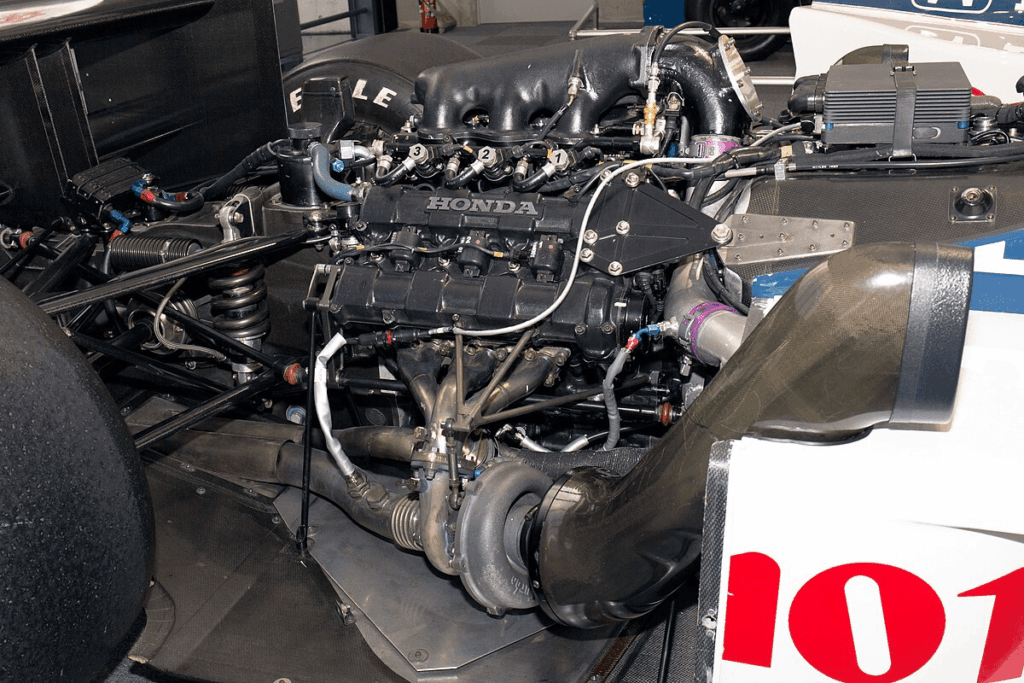
Image Credit: Morio – Own Work, CC BY-SA 4.0, Link.

The engine was not the FW11’s only strength however. The car’s chassis was similarly refined for the time, and proved an ideal match for Honda’s snarling power unit. Williams chief aerodynamicist Frank Dernie poured hours into optimising the car’s aerodynamics and cooling systems for maximum efficiency. The result was a car which was visibly sleeker than rival machines such as McLaren’s MP4/2C or Ferrari’s F1/86, despite being only Williams’ second full carbon-fibre chassis.
Start as You Mean to Go On
The FW11’s refinement was not just skin deep, and was a direct contributor to the car’s dominance. In the hands of Nigel Mansell and Nelson Piquet, the car won a total of 18 races over two seasons. This impressive tally contributed to two constructor’s titles in 1986 and ‘87, along with a driver’s championship for Piquet in the latter of the two years.
With such results in mind, it is perhaps unsurprising that the FW11’s illustrious career got off to a winning start. Indeed, the car’s first race at the 1986 Brazilian Grand Prix proved an emphatic demonstration of the FW11’s strengths.
Surprisingly, at least in 1986, qualifying was not chief among those strengths. The first race of the season aptly demonstrated this, with single lap maestro Ayrton Senna pipping the Williams duo to pole in his Renault-engined Lotus.
The Lotus held the edge on the FW11 when it came to qualifying horsepower, thanks to a combination of Renault’s policy of building special engines just for qualifying, along with their engine’s advanced pneumatic valve springs which allowed for a higher rev limit. In the race however the FW11 proved unmatched. Its cutting-edge engine management system provided excellent fuel consumption, which allowed Williams’ drivers to run more aggressive boost in race trim.
Piquet was therefore able to scythe almost effortlessly past Senna, and manage the race to claim a comfortable win. Considering Williams had been wracked by a life-changing car accident for its founder mere weeks earlier, the victory was a much-needed morale boost.
Mansell Mania
Piquet was signed as Williams number 1 driver, and was expected to deliver results like the Rio win regularly. However, the man in form for much of the year actually proved to be Williams’ second driver Mansell.
Hints of Mansell’s rise were seen as early second race of the year in Spain. There, Mansell memorably duelled with Senna to deliver an iconic photo-finish result. Unfortunately for Williams though, the Lotus driver just managed to hold off the charging Briton to win by 0.014 seconds.
Mansell didn’t let being pipped to victory dampen his spirits though, and he continued to build momentum. While an in-form Alain Prost claimed a pair of victories for McLaren’s in San Marino and Monaco, Mansell finally broke through to win his first race of the year at the fifth race of the season at Spa.
That victory also showcased the FW11’s technical prowess. A key factor in Mansell’s win was Williams’ pioneering use of both telemetry data and a pit-to-car radio. Using these systems, Williams were able to monitor Mansell’s fuel and engine data, and coach their driver on when he could push and when he needed to hold back. It was very much a herald of the future of the sport.
Tensions Build
Mansell’s Belgium victory set him off on a truly dominant run of form. Between round 5 and round 9, he won four out of five races. Only a masterclass from Senna on the streets of Detroit was able to prevent a clean sweep for the Briton.
Mansell’s scintillating form triggered tensions within Williams however. Piquet was the contractual number 1 driver, and he became suspicious that he was not being given the treatment Williams had promised him. A rift formed within the team as a result, with each driver keeping their setup information secret from the other side of the garage.
Despite this lack of collaboration, the FW11 remained the car to beat. Piquet deftly proved this by winning both the German and Hungarian Grands Prix to bounce back from his slump. The latter of these two races also included a memorable overtake where Piquet drifted his Williams around the outside of Senna’s Lotus at turn 1 to take the lead. The audacious move is often considered one of the best overtakes of all time, and perfectly illustrated the FW11’s prowess.
The Best-Laid Plans
With both of their drivers on form and the FW11’s performance still well clear of its rivals, Williams winning both championships in 1986 looked a certainty. Indeed, the team secured the constructor’s championship with two races to spare, following another victory for Mansell in Portugal.
The situation in the driver’s championship was slightly more complex however. Mansell and Piquet had each found form at different stages of the season, and proved fairly closely matched. This meant that Williams’ drivers effectively took points off each other in the title race.
As a result, despite the FW11’s dominance the gap to the likes of Prost and Senna in the championship was not as big as it likely should have been. While Williams still looked the team to beat, this created the possibility of a rival driver springing an upset.

Image Credit: Dominique Faget – AFP/Getty Images, CC BY-SA 2.0, Link.
As it turned out, fate ordained exactly that. If there is one lingering image of the 1986 season that even people who weren’t alive at the time recognise, it is Mansell’s famous blowout at the final title deciding race in Adelaide.
That dramatic puncture was the final nail in the coffin for Williams’ chances of winning the driver’s championship that year. However, it was not the sole reason for that failure. Instead, it was the policy of allowing their drivers to squabble and take points off each other that really did the damage. Wily world champion Prost did not need much more of an invitation to sneak the championship out from under Williams’ nose, despite not having a car as potent as the FW11 at his disposal.
Aging Like Wine
Despite the disappointment of not having won the 1986 driver’s championship Williams and Honda still had reason to be proud. The FW11 was almost universally lauded as the best car of the season, and set a new standard for technical prowess in F1.
Indeed, Williams themselves recognised the car’s proficiency. They therefore pressed the FW11 into service once more in upgraded FW11B specification for the 1987 season. This new revision featured a new Honda RA167E engine, a longer wheelbase, and a revised front wing with larger endplates.
With these upgrades in tow, the FW11B if anything proved even more effective than its predecessor. Mansell and Piquet were therefore the only realistic contenders for that year’s title, with the Brazilian eventually winning out despite a horror crash at Imola.

Image Credit: United Autosports – LAT Images, CC BY-SA 2.0, Link.
Despite their dominance, Williams kept upgrading the FW11 throughout 1987. Notably, one such upgrade late in the season came in the form of Williams’ first active suspension system. This allowed the FW11Bs to run less wing, with Piquet taking full advantage of this benefit to claim victory at the Italian Grand Prix.
Active suspension would prove a key part of some of Williams most successful cars over the following seasons. It would be fair to say therefore that the FW11 and FW11B directly laid the groundwork for Williams’ future domination, while also being highly successful themselves. The car’s legacy is therefore beyond doubt.
Certainly a run at Goodwood and a place of pride in Williams Heritage collection seems richly merited for such pedigree.
Featured Image Credit: Williams F1
Get 10% off all official F1 Merch at TheRaceWorks.com using code ‘EF1‘ at checkout.