
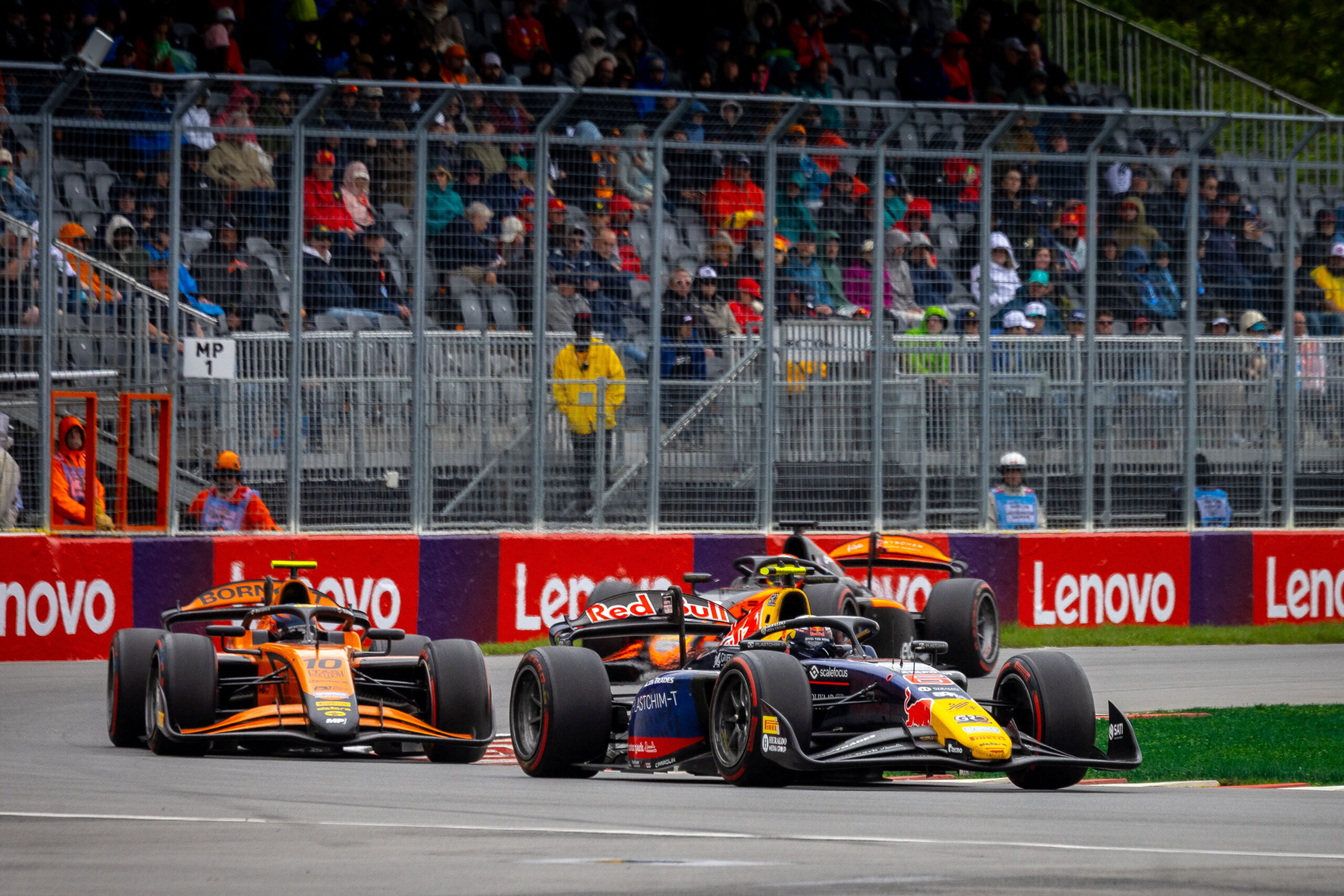

The 2026 F2 calendar demands ultimate adaptability from its young drivers.
When geopolitical shifts alter the racing schedule – such as the late addition of Miami and Canada to the calendar following the cancellation of rounds in Qatar and Abu Dhabi – drivers are forced to learn demanding international tracks.
However, following this back-to-back run, Gabriele Mini, Martinius Stenshorne and Alex Dunne opened up about the sophistication of modern racing preparation, revealing that modern simulation tools now allow them to hit the ground running with total confidence.
From Screen to Circuit
When asked how they adapt their driving styles so quickly when tackling two unfamiliar circuits back-to-back, Mini opened the discussion by downplaying the idea that any circuit on the calendar is truly unknown to a modern driver.
“We pretty much know all the tracks but, as you said, those two were pretty new to us,” Mini noted.
“It’s always the same procedure, to be honest. You always go on the simulator […] there is not really a new track for us because we always watch it on the TV, we play it on the simulator. Even, all three of us, we always play the simulator together, so we knew this track from there.”
While home setups offer a baseline, transitioning to professional-grade team simulators and on-site engineering is where the real work begins.
“Then, of course, we prepare with our own team, we do the track work,” Mini explained.
As a member of the Alpine Academy, Mini also highlighted the immense competitive advantage of utilising top-tier Formula 1 resources to accelerate that adaptation process.
“Both me and Alex [Dunne] can get more information, even feedback, from the drivers at Alpine, so it’s always very useful. Then it’s up to us how quickly we can go close to the limit and how easy it is for the setup; you have to maximise it. It’s a good learning curve that will help us through the season.”
Erasing the Rookie Disadvantage
Building on Mini’s points regarding the heavy reliance on virtual preparation to tackle these new racing environments, Stenshorne agreed that the line between a new track and a familiar one has become incredibly blurred.
“It’s a new track in real-life, but we’ve all driven it, many laps on the simulator, both at home altogether, and also at the simulator, at the team,” the Norwegian emphasised.
Furthermore, modern preparation virtually erases the traditional disadvantage of being a rookie at a new venue, allowing drivers to focus immediately on performance.
“So yeah, it’s a new track. But in the end, we have done many laps on it. And we’re very happy with the pace we’ve shown in these two races on the new tracks,” Stenshorne added.
Bridging the Gap
Dunne offered a deeper look into just how early that preparation actually begins, echoing how informal sim sessions often lay the groundwork long before official team duties even begin.
“A couple of months ago, before we even knew we were coming here, Gabi (Mini) and I were driving Porsche Cup cars and F3 cars on iRacing around Miami,” Dunne revealed.
“So I think all of us have spent a lot of time on our own, home simulators, driving Canada, Miami, and numerous different tracks.”
Similarly, the Irish driver noted that this casual, proactive preparation meant they weren’t starting from scratch when they landed across the Atlantic.
“Like they said, it is a new track for us in real-life, but most of us had a very good idea of where we were going when we first got to the track.”
Once the basic muscle memory is established, the focus quickly shifts to fine-tuning the specific demands of their F2 machinery with their respective engineering crews.
“We did a lot of prep with Rodin, and I’m sure Gabi (Mini) did with MP as well at the sim, and when we got to Miami […] our first lap of FP, at least for me, didn’t really feel like my first lap. I already had a pretty good idea of what to focus on and where I needed to go,” Dunne concluded.
“I think, nowadays, the simulators are so realistic that, thankfully, like I said, we’re in a position where your first lap of the weekend doesn’t really feel like your first lap. You still, yes, there’s a couple of things with setup and driving that you need to get more comfortable with as the weekend goes on, but you always start in a pretty good place.”
Formula 2 resumes in Monaco, from 4 June, 2026 – 7 June, 2026.
Featured Image Credit: Red Bull Content Pool