

June 25th marks the official release date of the much-anticipated F1 movie. Like many fans, I was among the crowds queuing up to see how my favourite sport would be portrayed on the silver screen.
[adrotate banner=”10″]
Get 10% off all official F1 Merch at TheRaceWorks.com using code ‘EF1‘ at checkout.
Following its initial announcement, the film understandably attracted a mixture of cautious optimism and concern from F1 fans. With the team behind Top Gun: Maverick onboard, many hoped for a movie which would take F1 racing action on the big screen to a new level. Similarly, some saw an opportunity for another F1 marketing coup on the level of Drive to Survive.
Some however viewed the announcement more cynically. For these people, the expectation was an unrealistic film riddled with clichés which did not pay respect to the sport. Some were even quick to declare the prospect of an official F1 movie as a step in the sport’s supposed decline.
In actuality however, at least in my opinion, this particularly pessimistic outlook is not the case. It is certainly true that there are areas where the film goes awry in ways which will frustrate F1 fans. However, overall the product is an enjoyable one, and one I feel will be a net positive for the sport in the long run.
An Underdog Story
At its heart, the F1 movie is really a story about three underdogs. One is American racer Sonny Hayes, played somewhat controversially by Brad Pitt. Hayes is the archetypal old-school racer who lost his big shot in F1 in the 1990s to a crash caused by a combination of bad luck and his own cavalier attitude. The usage of Martin Donnelly’s horrifying Jerez 1990 accident as a stand-in for the aforementioned crash proves particularly effective.
[adrotate banner=”10″]
Get 10% off all official F1 Merch at TheRaceWorks.com using code ‘EF1‘ at checkout.
The other lead and Hayes’ eventual teammate is Joshua Pearce, played by Damson Idris. He represents the raw, slightly hot-headed rookie looking to make a name for himself in a cutthroat sport. Nevertheless, the young racer also has a softer side, as demonstrated by his relationship with his doting mother.
The force which brings these two contrasting characters together is the third underdog in the story — the team. APX GP starts the story as a hapless backmarker whose largely faceless board of directors have somehow been able to impose a stipulation that the team must win a race before the end of the 2023 F1 season or else face being shut down.
With half the season over and no points scored up to that point, the team’s situation looks bleak. Team principal and former racer Ruben Cervantes (played by Javier Bardem) therefore decides to bring his former teammate Hayes into the team as a last ditch attempt to inject some experience into the floundering squad. The resulting comeback after three decades out of F1 would make even Robert Kubica blush.
The film at least seems aware of the incredulity of this premise, however. Cervantes even breaks out a reference to Louis Chiron when trying to convince Hayes to join the team, which had the historian in me smiling.
A Treat for the Eyes
Viewed dispassionately, the storyline of a grizzled veteran who lost his chance and a raw rookie is indeed slightly cliché. However, it’s also hard to say that the dynamic doesn’t work. While dramatized, Hayes and Pearce butting heads and trading barbs about each other’s abilities certainly recalls real instances of teammate acrimony in F1 history in a way that makes for compelling viewing even for dedicated F1 fans.
It is in the racing scenes where the F1 movie really comes into its own though. Just as many hoped, the experience of the Top Gun: Maverick crew pays dividends here. The quality of the onboard shots combined with Hans Zimmer’s thumping score creates a truly scintillating experience. At times it’s almost enough to make you question F1’s real onboard camera offerings.
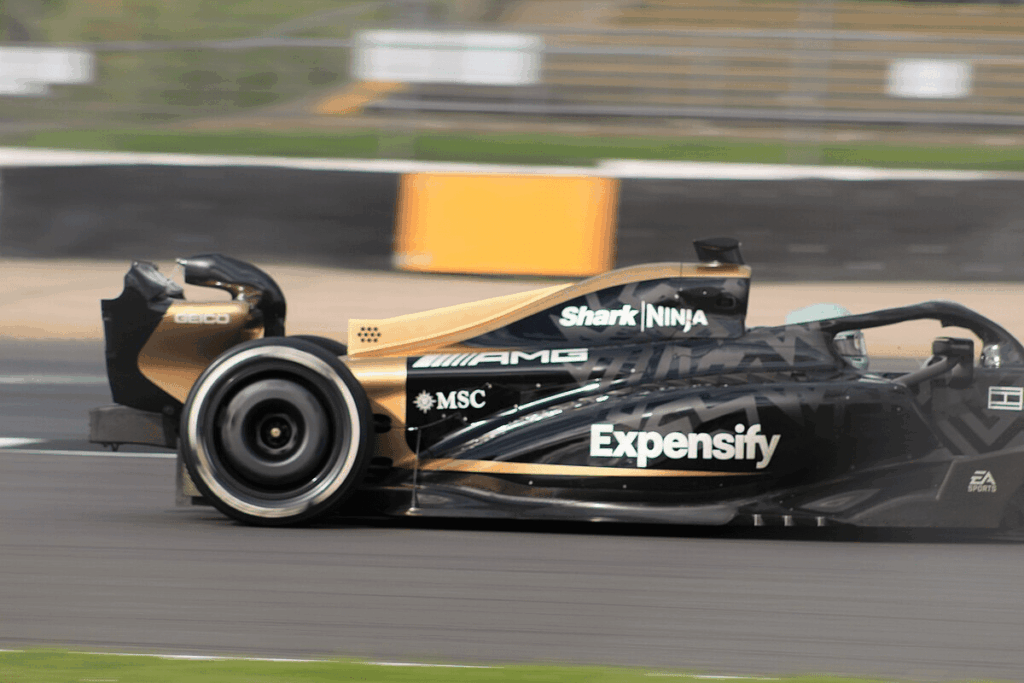
Image Credit: Mac Edmunds – Own Work, CC BY-SA 4.0, Link.

Indeed, capturing the visuals of F1 is one of the film’s greatest strengths. Familiar faces such as Will Buxton and Rachel Brookes all appear, anchoring the movie firmly in the world of F1. The real drivers are also frequent sight, along with beautiful shots of their machines. Overall F1 comes off looking like the cosmopolitan, glamorous sport that FOM’s big-wigs doubtless hoped it would.
This is definitely enhanced by the film’s unprecedented access, allowing on-location shooting at the real F1 circuits. Previous F1 films like 2013’s otherwise-brilliant Rush making do with passing Brands Hatch off as umpteen different tracks looks almost amateurish by comparison. In terms of presentation, this is by far and away the slickest F1 has ever looked on the big screen.
Taking the Rough With the Smooth
Where the realism starts to slip is with the actual content of the racing scenes, however. More than once during the screening I actually asked myself how FOM allowed F1 to be depicted in such a farcical manner.
Hayes in particular is portrayed as an absolute menace, regularly crashing deliberately to bring out safety cars at favourable times. A certain incident at Singapore some 17 years ago immediately sprang to mind for me, yet these antics are played as merely being crafty tactics. I suppose the filmmakers had to come up with some way for a previously backmarking team to suddenly coming good, but it feels a little much at times.
Even in these moments however, there are elements that will win dedicated F1 fans over. When Hayes needs to cause one of his timely yellow flags, he often turns to Kevin Magnussen for assistance. Non-F1 fans will think nothing of this, but for those in the know it adds a little streak of comedy given the Dane’s reputation. Alonso giving Hayes a post-race fistbump after executing one of his “Plan C for Chaos” races also elicited a smile.
Other flaws with the film are rather less jovial, however. One area which has attracted the most criticism is the movie’s romance subplot, and for the most part it is frankly justified. The film regularly plays up how Kerry Condon’s character Kate McKenna is F1’s first female technical director. She even plays a pivotal role by designing an upgrade which turns APX GP’s chassis into “a car for combat”. To then turn around and have her become little more than the love interest for Pitt’s character feels rather reductive. The relationship doesn’t even really have any impact on the plot, and honestly feels like it could have been left out entirely.
Against All Odds
Despite the entire APX team’s best efforts, it seems they will finish the season without their much-needed win. While a combination of their upgrade and their willingness to push the boundaries gets them towards the front of the field, their best chance for a victory goes begging at Monza when Pearce tries an overambitious move in the wet at Parabolica. The resultant crash provides one of the more arresting moments of the film, though the sight of an F1 car flying well over the catch fences and nearly into the trees at Monza is perhaps a little over the top.
Nevertheless, Pearce being put out of action for several races is perhaps the key turning point of the film. When he returns he finds the team has coalesced around Hayes. This now makes him the outsider like Hayes was at the start of the story. While this initially leads to more conflict, eventually the pair grow and learn to work together as a result. This lends a reasonable justification to the characters’ arcs and make their later collaboration feel earned.
I’ll spare you the details so as to avoid fully spoiling the ending, but needless to say it is only as a result of the two driver’s collaboration that APX GP is able to triumph in its goal of winning a race.
The final climactic racing sequence that leads to that win is perhaps the finest in the whole film. Other films have captured the essence of F1 before, but this sequence in particular is perhaps the first I’ve seen which really showcases the ability of our sport to leave you teetering on the edge of your seat thinking about nothing but what might happen next. For that the filmmakers certainly deserve applause.
Sparking an Interest
For some readers, hearing of the tenuous details and cliché plot points in the F1 movie will cause frustration. Indeed, it seems like I’ve been pretty critical of the film myself here. However, the key question in this area is: “what is the purpose of this film?”
After watching, I came to a conclusion which I felt might be likely before I went in. While anyone, including a fan like myself, can appreciate its visuals, where the movie really excels is with people who are not already into F1.
I watched the film with some friends who at most had a passing interest in Formula 1 before they went in. Despite this, the film managed to grip them completely. Indeed, after it was over they had a bevy of questions for me on how realistic the racing scenes were and if anything like the storyline seen in the film had ever actually happened. It was probably the most interest I have ever seen them show in the sport.
Whether that interest will translate into a genuine passion for the sport, I don’t know. However, if Drive to Survive is anything to go off, for some people it almost certainly will.
As a result, for all its flaws, I do feel like F1: The Movie deserves applause. For the diehard, it is a feast for the eyes, even if some of the details might irk us. Perhaps more importantly though, its existence is a sign of the sport’s growing stature, and also another valuable tool in F1’s arsenal when it comes to recruiting new fans. When it comes to the health of the sport, that is pretty undeniably a good thing.
[adrotate banner=”10″]
Get 10% off all official F1 Merch at TheRaceWorks.com using code ‘EF1‘ at checkout.