

There was no shortage of heated debates, drama and controversy at the 2005 United States Grand Prix, making for one of the strangest races in Formula 1 history.

About The United States Grand Prix
In 1959 Formula 1 went Stateside. The inaugral United States Grand Prix was held at the Sebring International Raceway in Florida. Since then, there have been a whole host of venues in the USA that have hosted a Formula 1.
Aside from Sebring, races have been held at Riverside International Raceway and the iconic Watkins Glen Grand Prix Race Course. It has raced around street circuits in Detroit, Dallas, Phoenix and Las Vegas (with the infamous “car park”).
The United States Grand Prix disappeared from the race calendar at the end of the 1991 season. It wouldn’t return until almost a decade later. In 2000, it was back with a bang and set to feature at the Indianapolis Motor Speedway. Indianapolis hosted Formula 1 until the end of the 2007 season, when the race disappeared from the schedules once more. It was a further five years before Formula 1 made its US comeback, with a brand-new circuit to boot. The Circuit of the Americas (COTA) in Austin, Texas, now stands out as the home of Formula 1 in America. It’s a popular destination for fans across the world, with crowds growing every year.
As it stands, COTA is contracted to host the United States Grand Prix until the end of 2026. But with the popularity of the sport on the rise across the pond, a contract extension is surely inevitable.
The 2005 United States Grand Prix
There’s been countless races where everybody starts, but not everybody finishes. Let’s face it, that’s fairly unavoidable in motorsport. There’s also been a long list of races where not everybody even makes the start, with mechanical gremlins ready to ruin the fun at any given moment.
But how about a race where only three teams start? Welcome to Indianapolis for the 2005 United States Grand Prix…
Tyre Troubles
During Friday’s afternoon practice session, Ralf Schumacher had a heavy crash at Turn 13. Suffering a failure in his left-rear tyre, he was sent spinning into the concrete wall on the outside of the corner, before drifting back across the track. He came to a much gentler stop as his Toyota came to rest against the pit wall. Ralf tried to climb through a gap in the pit wall fence, but soon hunched over with pain. The German was ruled out of competing any further during the weekend due to injury. He was temporarily replaced with Toyota’s test driver; Ricardo Zonta. Shockingly, Zonta also suffered a left-rear tyre failure during practice. When lightning strikes twice in Formula 1, it generally raises a few eyebrows.
Michelin reported that it didn’t understand why the tyres were failing in Turn 13. The banking on this corner allowed cars to pass through at eye-watering speed. Because of this, it was generally known that the tyre loads were greater than usual. There was also a more abrasive surface that had been added since the previous year. This meant that the tyres were potentially being put under even more load. Worryingly, there were seven teams who used Michelin tyres; BAR, McLaren, Red Bull, Renault, Sauber, Toyota and Williams. To quell any concerns, Michelin announced they would fly in different specification tyres. Ironically, the replacement tyres that arrived were the same as those used in the Spanish Grand Prix earlier that year. When tested, these ended up having the same problem as the tyres already being used.
Proposed Solutions
A letter was written by Michelin and addressed to FIA Race Director Charlie Whiting,. Michelin stated that they could not find a cause for Toyota’s tyre failures. They did, however, go on to say that unless the cars could be slowed down in Turn 13, there was no guarantee of the tyres’ safety beyond 10 laps. Whiting responded swiftly, surprised that Michelin hadn’t brought more suitable tyres. He suggested to the teams that they should limit their drivers to the maximum safe speed as specified by Michelin through Turn 13.
The teams themselves proposed multiple solutions. One of these was to use the new specification tyres that had been flown in overnight. However, this was deemed to be “a breach of the rules to be addressed by the stewards”. Another suggestion was to place a chicane in the turn, which would help reduce the overall speed. Whiting firmly responded that this was “out of the question”, as any track layout changes would mean it was no longer FIA sanctioned. Michelin then wrote a second letter, stating they would not allow their teams to race on the tyres used in qualifying without changes to the circuit.
Whiting’s reply was brief, and he doubled-down on the fact that no such changes would be permitted. Instead, he gave the teams three options. One – limit their drivers speeds through Turn 13. Two – use a different tyre specification to those used in qualifying, subject to a penalty. Three – change tyres every 10 laps to make sure they didn’t exceed Michelin’s suggested safety limit.
Final Ultimatum
A meeting was called at around 10:00am on race day. Those present included Speedway owner Tony George, two Michelin senior representatives and Bernie Ecclestone. The teams’ principals and the teams’ Michelin technical representatives were also summoned to the meeting. The only notable absentees were Jean Todt, team principal for Scuderia Ferrari, and FIA President Max Mosley. After much debate, it was decided that the best solution to the problem was to install a chicane after all. Ecclestone offered to consult Todt and Mosley and to reconvene the meeting when he had their responses. When he returned, he informed the group that Todt had refused to agree to the chicane and that Mosley had stated “if any attempts were made to alter the circuit, he would cancel the Grand Prix forthwith”.
Having exhausted all options, it was decided that the 2005 United States Grand Prix would go ahead, as a world championship race, and as originally planned. Or at least that’s what the public were led to believe. Behind the scenes, the Michelin teams agreed they would complete the formation lap, but not participate in the race.
Race Or Revolt?
It seemed like business as usual, with all 20 cars lining up on the grid. Jarno Trulli was on pole for Toyota, with McLaren’s Kimi Räikkönen lining up beside him on the front row. Behind them were BAR’s Jenson Button in third and Giancarlo Fisichella in fourth for Renault. Michael Schumacher had qualified fifth for Ferrari, whilst Fernando Alonso had managed to stick his Renault in sixth. The sister Ferrari of Rubens Barrichello was starting from sixth, whilst Takuma Sato (BAR), Mark Webber (Williams) and Felipe Massa (Sauber) rounded off the top ten.
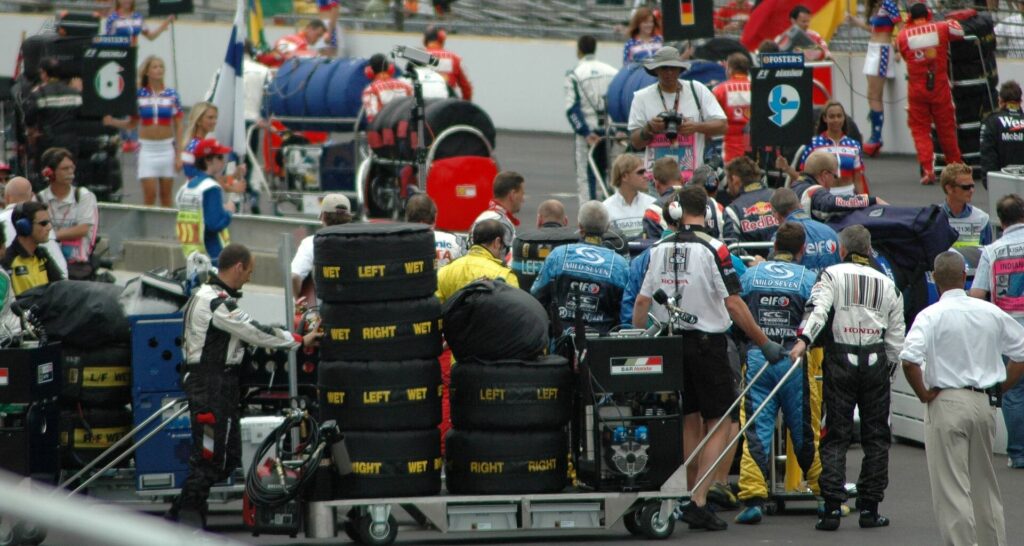
The green light went on, and the pack made their way around for the formation lap. It looked for all the world like spectators were in for an interesting race, with the ever-present threat of tyre failure adding to the anticipation. However, as the cars reached Turn 13, a secret revolution was launched. All seven of the Michelin-running teams had their drivers return to their pit boxes, as pre-agreed as a result of the earlier meeting. Unaware of this plan, fans were left infuriated as only the three Bridgestone teams of Ferrari, Jordan and Minardi were left lining up on the grid. The Grand Prix had been reduced to just a six car race before it had even started.
The Strangest Race Gets Underway
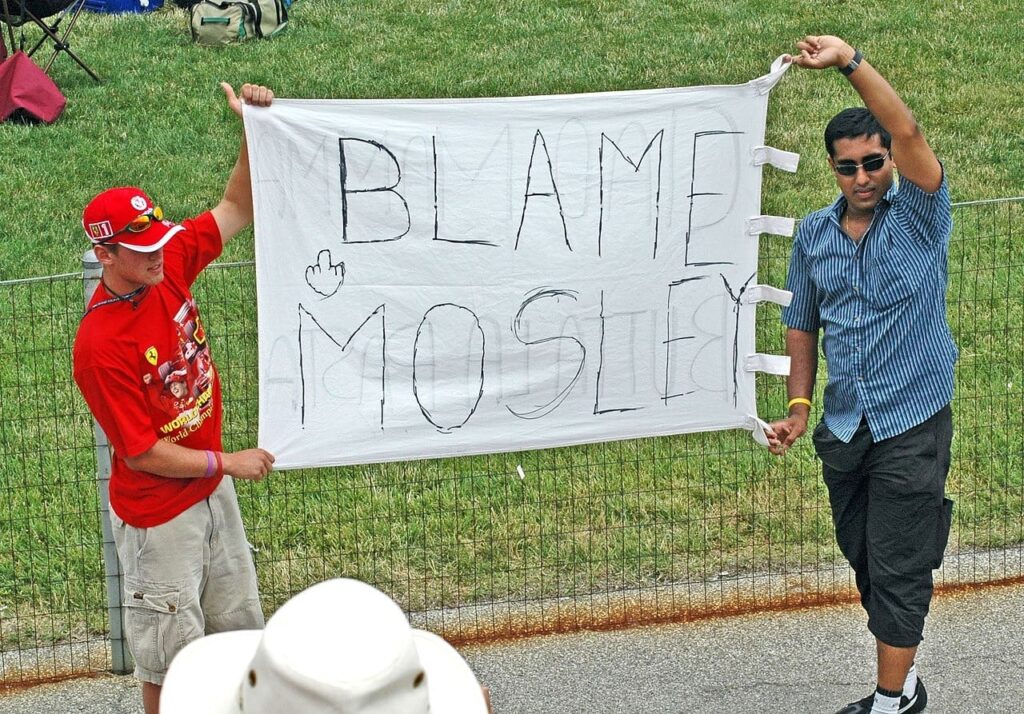
Michael Schumacher and Rubens Barrichello suddenly became the foremost starters, as everyone ahead of them had pulled out of the race. Schumacher, unsurprisingly, retained the lead at the race start. With just six cars in the running, there was just a handful of overtakes across 73 laps. Minardi’s Christijan Albers passed the Jordan of Narain Karthikeyan before they reached Turn 1. Karthikeyan took the place back on lap 10 when Albers came in for a pit stop. By this time, thousands of fans had left the grandstands, many heading straight to the ticket office to demand refunds. Throughout the race, boos could easily be heard. Some fans even resorted to throwing beer cans and water bottles onto the track.
On lap 26, Schumacher pitted and emerged back onto the track 32 seconds later, handing the lead to Barrichello. He pitted again on lap 51 and had an incredibly quick stop of just 23.6 seconds, meaning he came back out alongside Barrichello, forcing him onto the grass and re-taking the lead. Both Ferrari drivers were reprimanded by their team over the radio and sternly reminded not to crash out of the race. The pair settled down, with an extremely comfortable lead over those behind them. After what felt like an eternity, the chequered flag finally waved and Schumacher took the win. Barrichello finished just 1.5 seconds behind him, whilst Tiago Monteiro took the final podium spot for Minardi. Narain Karthikeyan, Christijan Albers and Patrick Friesacher finished fourth, fifth and sixth respectively.
The podium ceremony was a muted affair, with none of the nominated dignitaries present. Ferrari accepted their awards quietly and made for a quick exit. In a bittersweet moment, Monteiro stayed to celebrate his first (and only) podium finish.
Post-Race
Despite Minardi being one of the teams to compete, team boss Paul Stoddart was noticeably furious with the FIA, calling the race “a farce”. He added that “the FIA needs to get a grip with itself and sort this sport out before there’s no f***ing sport to sort out” and called for Mosley’s resignation. He later went on to admit that all nine teams present in the morning meeting had agreed not to race, and that if Jordan hadn’t changed their mind at the last minute, Minardi would also have boycotted the race.
The seven teams that boycotted were summoned to a hearing at the FIA World Motorsport Council headquarters on 29th June 2005. They were asked to explain their failure to participate, something that was likely to be deemed as a breach of the Concorde Agreement. The teams were charged with violating article 151c of the International Sporting Code, which refers to “acts prejudicial to the interests of competition or motorsport generally”. The FIA World Motorsport Council found the teams guilty of not being in possession of suitable tyres (albeit with “strong mitigating circumstances”), and failure to allow their cars to start the race. The punishment was to be decided and announced on 14th September, however on 22nd July the FIA World Motorsport Council voted to overturn its previous decision and cleared the seven teams of all charges.
Michelin announced that they would offer compensation to all spectators who had purchased tickets for the Grand Prix. They also planned to issue refund cheques through the Speedway ticket office that would cover the price of all tickets for the race by the end of September. Michelin also purchased 20,000 tickets for the 2006 Grand Prix, which were to be distributed to spectators who attended the 2005 Grand Prix.
Summary
It’s easy to dismiss the 2005 United States Grand Prix as something that should be forgotten and left to gather dust in the archives. But there was a lot to be learned and, moreover, it was an incredible display of unity in what can often be a cutthroat sport. We’ll likely never again see the same strategic battles as we did in the Michelin vs Bridgestone era. For me, the 2005 United States Grand Prix deserves to be remembered, even if it is for being arguably the worst race in Formula 1 history.
Which United States Grand Prix do you think is a race to remember? Let us know in the comments!
Feature image credit – By tpsdave – indianapolis-motor-speedway-1848561 archive copy at the Wayback Machine, CC0, Link