

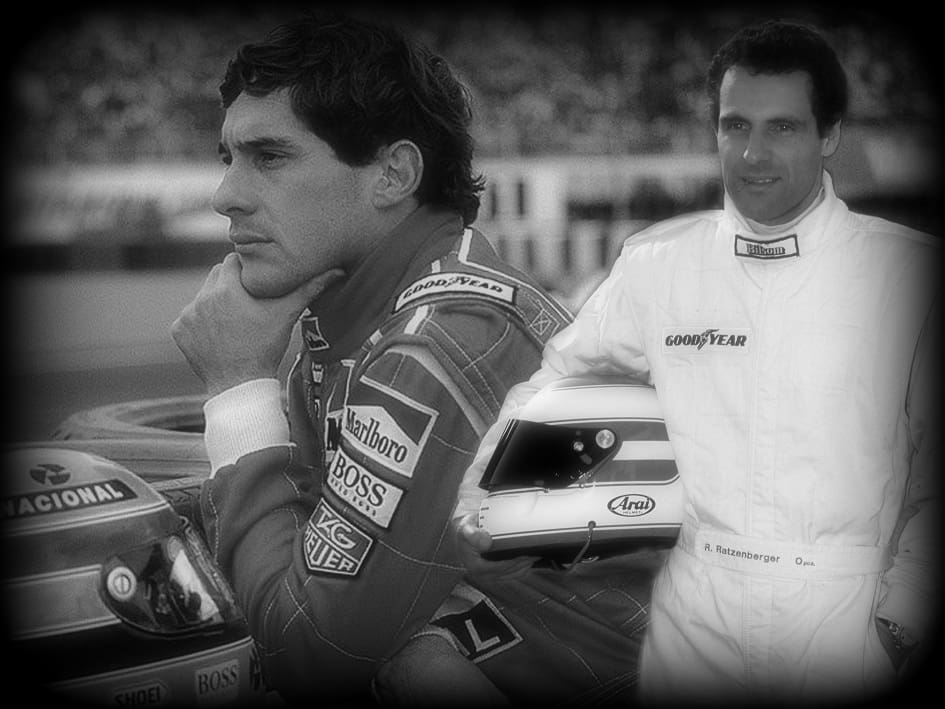
In 1994, the world mourned after one of the darkest and most tragic weekends in Formula 1 history.
About The Emilia Romagna Grand Prix
The Emilia Romagna Grand Prix has gone by many names over the decades. In 1980, the Autodromo Internazionale Enzo e Dino Ferrari hosted the Italian Grand Prix. Between 1981-2006 it was given a new name – the San Marino Grand Prix (with the Italian Grand Prix returning to Monza). The race was dropped from the calendar in 2007, but returned in 2020 as the Emilia Romagna Grand Prix.
[adrotate banner=”10″]
Get 10% off all official F1 Merch at TheRaceWorks.com using code ‘EF1‘ at checkout.
The circuit itself is a complex combination of challenges for drivers. The Autodromo Internazionale Enzo e Dino Ferrari features 19 complex and technical turns. Weather conditions in the area can change on a whim, adding an extra headache for both drivers and strategists.
The circuit was originally named “Autodromo di Imola” between 1953 and 1956. In 1957, the name was changed to “Autodromo Dino Ferrari”. In 1988, the name was extended to “Autodromo Internazionale Enzo e Dino Ferrari”. Imola is considered the home race of Ferrari, as the team is situated in nearby Maranello. It has since hosted multiple motorsports events, including Formula 1, the European Le Man Series, MotoGP and World SBK Superbike.
[adrotate banner=”10″]
Get 10% off all official F1 Merch at TheRaceWorks.com using code ‘EF1‘ at checkout.
The 1994 San Marino Grand Prix
It’s easy to remember races for exciting battles, unexpected winners and glorious highs. However, the 1994 San Marino Grand Prix resulted in possibly the darkest few days in Formula 1 history. The world fell silent as tragedy unfolded before their very eyes.
Friday
The race weekend got off to a dramatic start during the first practice session. Rubens Barrichello hit the kerb at the Variante Bassa corner at 225 km/h (140 mph). It sent his Jordan flying through the air before hitting the top of the tyre barrier at 95g. Barrichello was knocked unconscious, his car rolling multiple times before finally stopping upside down. Medics were quick to arrive, providing what treatment they could, including clearing the Brazilian’s airway that had become blocked by his tongue during the crash.
Barrichello was taken to the medical centre where, upon regaining consciousness, opened his eyes to see Ayrton Senna looking down at him. Content that his fellow countryman had survived, Senna returned to his garage to continue with the practice session. Barrichello was later transferred to hospital for routine checks and observation. Astoundingly, he came away with just a sprained wrist and broken nose. He returned to the circuit the following day, although was forced to sit out for the rest of the weekend due to his injuries.
Saturday
With Barrichello’s lucky escape the previous day, Saturday’s qualifying session got underway as normal. Initially, there were no real surprises, but eighteen minutes into the final qualifying session, disaster struck.
Roland Ratzenberger ran over a kerb at the Acqua Minerale, causing damage to his front wing. Despite this, he pushed on in an attempt to improve on the time set in his previous lap. However, the front wing snapped off and wedged itself under the car, lifting the front wheels. No longer able to steer, and the rear brakes not having sufficient power to slow the car on their own, Ratzenberger lost control of his Simtek at the Villeneuve Curva. The car left the track at 314km/h (195mph) and crashed head-on into the concrete barrier at a force of 500g (the highest impact ever registered in Formula 1).
The session was stopped immediately and medics swiftly arrived at the scene. Ratzenberger was taken to the medical centre before being transferred to the Maggiore Hospital, the second driver to have been taken there in as many days. Just eight minutes after arriving at the hospital, Ratzenberger’s death was officially declared. He was found to have suffered three fatal injuries – a basilar skull fracture, blunt force trauma and a ruptured aorta. The impact had killed him immediately, marking the first Formula 1 fatality since the 1982 Canadian Grand Prix. Astonishingly, the qualifying session was restarted 48 minutes after the crash, but several teams chose to take no further part.
[adrotate banner=”10″]
Get 10% off all official F1 Merch at TheRaceWorks.com using code ‘EF1‘ at checkout.
Sunday – Race Start
The race itself didn’t get off to the smoothest start. Michele Alboreto had to give up 15th on the grid to start the race from the pit lane, thanks to his Minardi developing an issue. As the race got underway, JJ Lehto stalled and was hit from behind by Pedro Lamy. Shockingly, some of the flying bodywork was sent over the safety fencing, causing minor injuries to eight spectators and a police officer. Bertrand Gachot narrowly avoided colliding with Lamy amidst the chaos.
The Safety Car was deployed. Ayrton Senna, who had been one of a number of drivers to express concerns over the Safety Car not going fast enough to keep F1 tyres warm, pulled alongside several times to try and urge the driver to go faster. Érik Comas and Éric Bernard had a minor shunt during the Safety Car period. It was enough to cause Comas’ car to experience a vibration that saw him duck into the pits for evaluation. Once the track had been cleared of debris, the Safety Car came back in and the race got back underway at the start of lap five.
Senna and Schumacher both sped away from third-place man Berger. Berger himself was also breaking away from Damon Hill, who had lost time due to a poor restart. It was business as usual for lap six, and on lap seven Senna was still leading from Schumacher. As Senna pushed his Williams to speeds of 305 km/h (190 mph), he was unable to make the turn at Tamburello. Senna made desperate efforts to brake and slow the car, but he ended up straight off the track and into the concrete barrier at a speed of 211 km/h (131 mph).
Red Flag & Restart
The red flag was shown to bring a halt to the race, and the world once again held its breath. FIA medic Sid Watkins was quick to arrive at the scene to attempt to treat Senna. Larrousse, who had been so focussed on fixing Comas’ car, were completely oblivious to the crash. They sent Comas to the end of the pit lane, confused as to whether he could rejoin. Eventually, the pit lane marshals let Comas onto the track. As he approached the emergency vehicles and marshals on the track at Tamburello, he managed to stop his car to avoid any further collision. Upon seeing the accident scene, Comas was so distressed that he withdrew from the race. It would be over 10 years before he spoke of what he had witnessed.
Senna was lifted from the wreckage. After around 15 minutes of on-scene medical attention, he was airlifted to the Maggiore Hospital. 37 minutes after the crash, the race was restarted. Schumacher had a poor start, allowing Berger to take the lead. On lap 12, Schumacher regained his lead when Berger came in for his first pit stop. Berger ended up retiring on lap 16 due to a handling issue with the car.
[adrotate banner=”10″]
Get 10% off all official F1 Merch at TheRaceWorks.com using code ‘EF1‘ at checkout.
Middle Stint to Chequered Flag
The retirements continued throughout the middle stint. Gachot drove into the gravel trap at Acque Minerale on lap 25 due to a reduction in oil pressure. Brabham retired four laps later, whilst Gianni Mobidelli retired on lap 41. Lap 48 saw Michele Alboreto come in for a pit stop, but the right rear tyre came loose as he left. The tyre hit two Lotus and two Ferrari mechanics, all of whom needed hospital treatment. Gerhard Berger, Bernie Ecclestone and Niki Lauda all went to race control to ask for the event to be stopped, but the request was refused and the race continued.
On lap 55, Christian Fittipaldi retired from the race thanks to a hardening brake pedal that left him trapped in the gravel. Schumacher took the chequered flag to claim the race win, ahead of Nicola Larini. Sauber’s Karl Wendlinger was chasing Mika Häkkinen for third, but Häkkinen was able to fend him off and retain the final podium spot. The podium ceremony was a relatively muted affair, with no champagne sprayed out of respect for Ratzenberger and Senna.
The world awaited news of Senna, who had been described as being in a “critical condition” whilst the podium was taking place. At 6:40pm local time, Doctor Maria Teresa Fiandri made a public address to confirm that Ayrton Senna had sadly died. It would later be revealed that he had suffered fatal skull fractures and severe head trauma as a result of the impact.
Summary
As with any motorsport, safety measures are constantly discussed, reviewed and evolved. Things have come a long way since the era of hay bale barriers and drivers wearing goggles. After Ratzenberger’s death, an agreement was made to reform the Grand Prix Drivers’ Association. Ayrton Senna, Gerhard Berger and Michael Schumacher were chosen to be the directors, and the association immediately pressed for improvements to both car and circuit safety.
It’s always tragic when it takes the loss of life to put such things into motion. The 1994 San Marino Grand Prix will forever be remembered as the darkest weekend in Formula 1 history. But it will also be remembered for the lasting legacy and monumental change that it brought to the sport.