

It was a dazzling show when Formula 1 returned to Las Vegas in 2023, but back in 1982 things looked a lot different.
About The Las Vegas Grand Prix
As of 2025, Formula 1 will have raced in Las Vegas just five times in the sport’s history. And it didn’t exactly have the most glamorous start in “Sin City”.
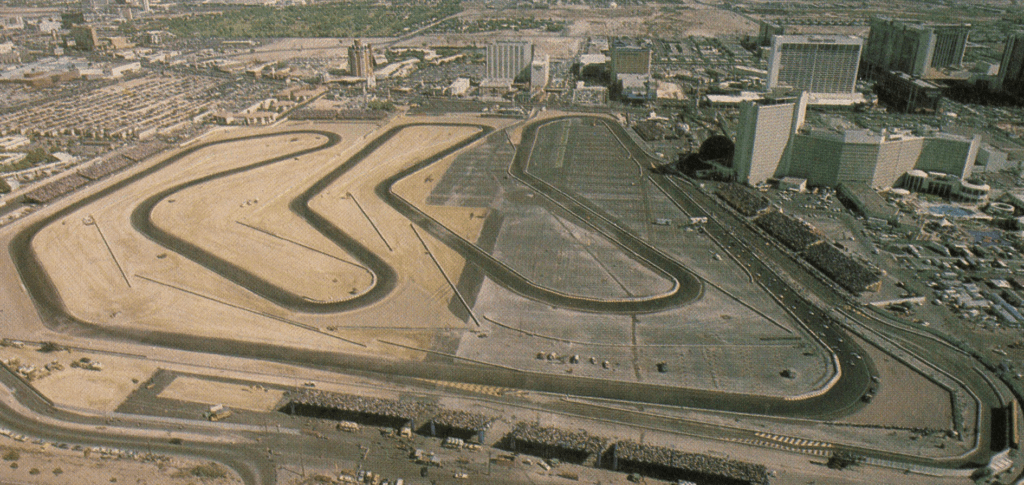
In 1981, the inaugural Caesars Palace Grand Prix was set as the season finale. A temporary circuit was laid out in the parking lot of the Caesars Palace hotel, with a wide track to allow overtaking and plenty of ample run-off areas. But it was not popular with the drivers, who complained about the flat, repetitive nature of the circuit. It also failed to excite spectators, and resulted in a huge financial loss for the hotel. Despite this, Formula 1 returned in 1982, before Las Vegas disappeared from the race calendar.
40 years later, the news broke that Formula 1 would return to Las Vegas. Now under the name of the Las Vegas Grand Prix, cars would race on a street circuit at night. The newly designed Las Vegas Strip Circuit would fully embrace the glittering lights that have become as famous as the city itself. In June 2025, it was announced that a two-year extension was agreed, bringing Formula 1 to Las Vegas until the end of the 2027 season.
The 1982 Caesars Palace Grand Prix
The race was held on Saturday 25th September 1982. It was the final race of the season, and the championship was still up for grabs. Las Vegas in September was also impossibly hot, with the race being held in 37.1 °C (98.8 °F) degree weather.
Alain Prost had secured pole, and beside him on the front row was Renault teammate René Arnoux. Mario Andretti, bidding a final farewell to Formula 1, was standing in at Ferrari for an injured Didier Peroni. Patrick Tambay was declared as unfit to race, whilst Roberto Guerrero and Jean-Pierre Jarier were unable to start due to mechanical issues.
As the remaining drivers lined up on the grid in the scorching Nevada sun, they hoped that Lady Luck would be on their side.
Race Start
As the lights went green to signal the start of the race, Alain Prost retained the lead with René Arnoux close behind. American driver Eddie Cheever sent his Ligier up the inside of Michele Alboreto at Turn 1 in a bid to take third position. Their tyres touched, but they both managed to continue. More importantly, Alboreto managed to stay ahead of Cheever. McLaren’s John Watson dropped from ninth to 12th, now stuck behind the Brabham of Nelson Piquet.
Arnoux managed to slip past Prost to take the lead and the two Renaults quickly began to power away from Alboreto’s Tyrrell. On lap five, Jaques Laffite retired from the race when his Ligier suffered ignition problems. Nigel Mansell was the next to fall after he was involved in a collision on lap eight. Watson managed to get past Piquet on lap 12. Alboreto put his foot to the floor, and began to match Arnoux’s lap times. On lap 15, Prost overtook his teammate and reclaimed the lead, whilst Alboreto closed in. Riccardo Patrese’s Brabham developed a clutch issue, ending his race by lap 17. This was good news for Watson, who passed Rosberg, Andretti and Cheever in quick succession and was now third.
Thinning Out The Herd
By this time it was clear that Arnoux had some sort of issue in his car. On lap 21 his engine finally gave up, forcing him to retire from the race. Andretti, who had managed to avoid any major drama so far, saw his fortunes fade on lap 27. The Ferrari’s rear suspension link had snapped, and he slid off the track directly in front of Rosberg, prematurely ending his final Formula 1 race. Piquet also retired on the same lap after a fault with the Brabham’s spark plugs. Just two laps later, Elio de Angelis was forced to stop with an engine issue.
Up at the front, the battle was heating up. Alboreto was inching ever closer to Prost, whilst Watson also closed the gap behind. Derek Warwick’s race ended on lap 33, caused by problems with the spark plugs in his Toleman. Tommy Byrne spun off and out of the race on lap 40, with Niki Lauda suffering engine failure to become the final retiree on lap 54. There were now just 18 runners remaining in the race, and both the cars and the drivers were suffering in the intense heat.
Sweet Victory
It was on lap 54 that Alboreto finally managed to pass Prost and take the race lead. Prost was struggling to fight back, with vibrations in his tyres from picking up rubber. It wasn’t long before Watson also passed the Frenchman, but he couldn’t gain ground on Alboreto as he was having the same issue as Prost. With just nine laps to go, Prost’s woes continued as Cheever managed to slip past the ailing Renault.
With no real challenge from behind, Alboreto cruised to the chequered flag. He had finally achieved his first ever race win, making him the 11th different winner that season. Watson came home in second place, with Cheever holding on to third. Prost limped home in fourth, whilst Rosberg finished just three seconds behind him to claim fifth. Crucially, it was enough for Rosberg to be crowned World Champion.
Summary
Let’s face it. The Caesar’s Palace Circuit was not particularly lavish compared to the modern day Las Vegas Street Circuit. But 1982 would be the last time Formula 1 raced in Las Vegas for four decades. It was the last ever Formula 1 race for American racing legend Mario Andretti, as well as both the Ensign and Fittipaldi teams. Michele Alboreto earned his first race win, bringing Tyrrell’s first win in four years with it. Keke Rosberg managed to snag his first world championship title, despite only winning one race all season. Ferrari clinched the constructor’s title even with one driver unable to start the race and the other not making it to the end.
The 1982 Caesars Palace Grand Prix was a spectacle the likes of which we will likely never see again, and that makes it worthy of being a race to remember.
Which Las Vegas Grand Prix do you think is a race to remember? Let us know in the comments!
Feature image credit – By Yoyodu10 – Own work, CC BY-SA 4.0, Link