

The F1 world received some fun news over the Hungarian Grand Prix weekend, as it was announced that the Sepang International Circuit in Malaysia would host the Bahrain Grand Prix in October. With the war in the Middle East continuing, this unique decision was made to ensure A race still goes ahead. The powers that be have placed the race between the Azerbaijan and Singapore Grand Prix to create a tough triple header and a run of 6 races in 7 weeks.
While it will take some time to get used to seeing Bahrain Grand Prix branding all over the Sepang circuit, I am really happy to see the ‘Grand Prix in Malaysia’ back on the calendar.
Having debuted in 1999, the Malaysian Grand Prix quickly became a fan favourite. Its high-speed corners, long, wide straights and heavy braking zones created great action between the drivers. Coupled with the intense heat, humidity and ferocious rain showers, made it one of the most unpredictable races on the calendar. Unfortunately, disagreements between the race organisers and former F1 figurehead Bernie Ecclestone meant that the race was discontinued in 2017.
In celebration of a return to this iconic circuit, let’s look back at some of its standout moments:
Schumacher’s Emphatic Return – 1999
The first Malaysian Grand Prix in 1999 inserted itself right into that year’s title fight. Debuting as the penultimate race of the season, it saw Mika Hakkinen and Eddie Irvine battling it out for the Drivers’ title. The two drivers were split by only 2 points, with Hakkinen leading the way. However, the star of the show was Michael Schumacher, returning from a broken leg sustained 6 races earlier at the British Grand Prix.
Schumacher sensationally took pole by nearly a second and dominated the race before allowing Irvine through to win. The Irishman would also take the lead in the championship going into the final round. Hakkinen would come home 3rd to limit the damage and go into the final round in Japan 4 points back.
But the drama didn’t finish once the chequered flag came out. Hours after the race, both Ferraris were disqualified after the FIA found their bargeboards didn’t comply with the regulations. This looked to hand Hakkinen the championship before a successful appeal from Ferrari reinstated the result and their championship lead.
The Malaysian Grand Prix was off to a fast start.
Kimi’s First Win – 2003
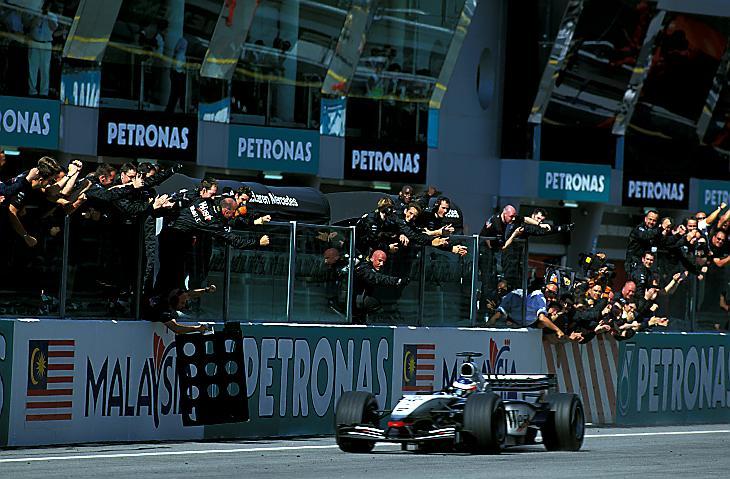
The 2003 Malaysian Grand Prix beckoned in a new generation of F1 superstars. Kimi Raikkonen, in only his 3rd season in F1, took his first victory while Fernando Alonso took his first F1 pole and podium.
The two Renaults of Alonso and Trulli locked out the front row, followed by Schumacher in third. Eventual race winner Raikkonen started 7th but with a heavier fuel load. In the age of refuelling during the races, this meant he was on a different strategy to those around him.
The race got off to a dramatic start as Schumacher took out Trulli at Turn 2, spinning the Renault driver around and causing havoc behind. A few front wings had to be changed, and Juan Pablo Montoya had his rear wing changed, losing 2 laps.
Alonso led the early stages, but McLaren’s heavier fuel load strategy started to pay off. Raikkonen was able to run longer than his rivals, so when they came in to refuel, he used his much lower fuel load to pump in fast laps and jump them in the pits. Once he was in the lead, he never looked back. He would win his maiden Grand Prix by 40 seconds from Barrichello and Alonso.
Raikkonen and Alonso would go on to win 3 World Championships and 52 more races between them, with the Malaysian Grand Prix of 2003 being a key point in their legendary F1 careers.
Hamilton Schools the Ferraris – 2007
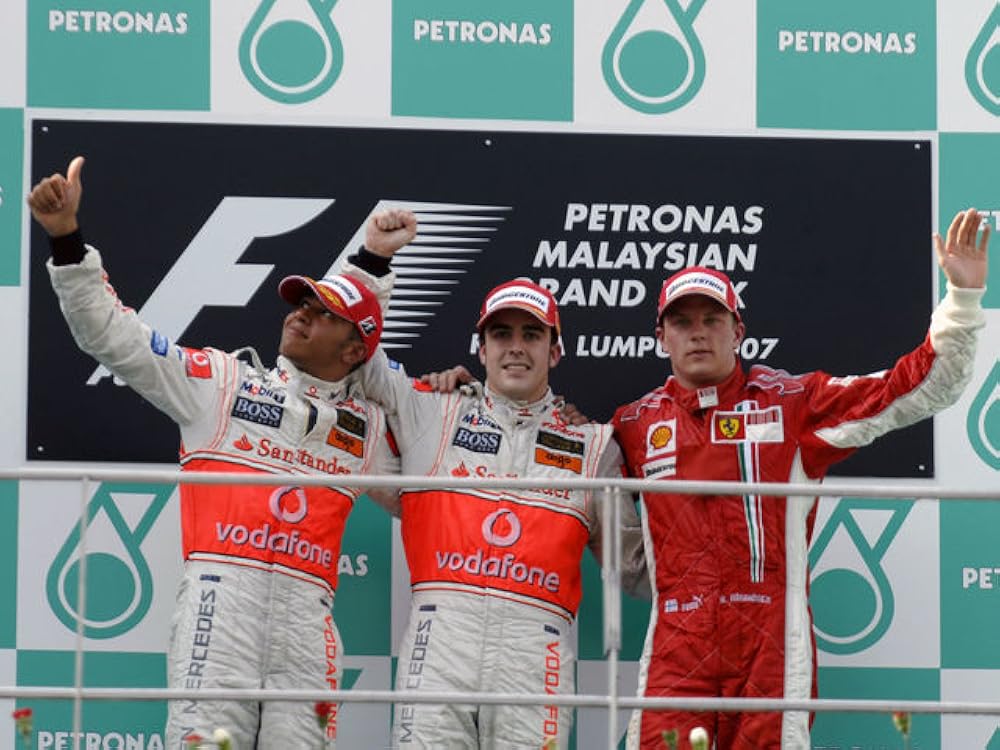
Lewis Hamilton burst onto the scene at the 2007 Australian Grand Prix with a fantastic 3rd place on debut. He would go on to show that this was not a fluke at the next race in Malaysia, expertly overtaking both Ferraris at the start before holding them off to take 2nd behind his teammate.
Hamilton would start the race in 4th, behind Massa on pole, his teammate Alonso in 2nd and Raikkonen in 3rd. However, he would quickly dispatch both Ferraris at the start. Firstly going down the inside of Raikkonen into Turn 1 before sliding around the outside of Massa into Turn 2. This gave his teammate Alonso key breathing space over the apparently faster Ferrari package.
While Alonso disappeared up the road, Hamilton pulled off a fantastic rear-guard performance. He made Massa look silly twice in the early stages at Turn 4. First performing a perfect switch-back move to defend Massa’s dive down the inside, before forcing Massa into a silly mistake that ran himself off the road and out of contention while attempting the same move the following lap.
Once Massa was out of the picture, Hamilton held off Raikkonen’s pressure for the rest of the race to complete McLaren’s first 1-2 since Brazil 2005.
While Alonso won the race emphatically, this performance from Hamilton in only his 2nd race proved that he could hold his own with the big boys, showcased his overtaking abilities and his calmness under pressure. It laid the foundations for arguably the best rookie season in F1 history and proved to the F1 world that Lewis Hamilton was indeed the real deal.
Multi 21 – 2013
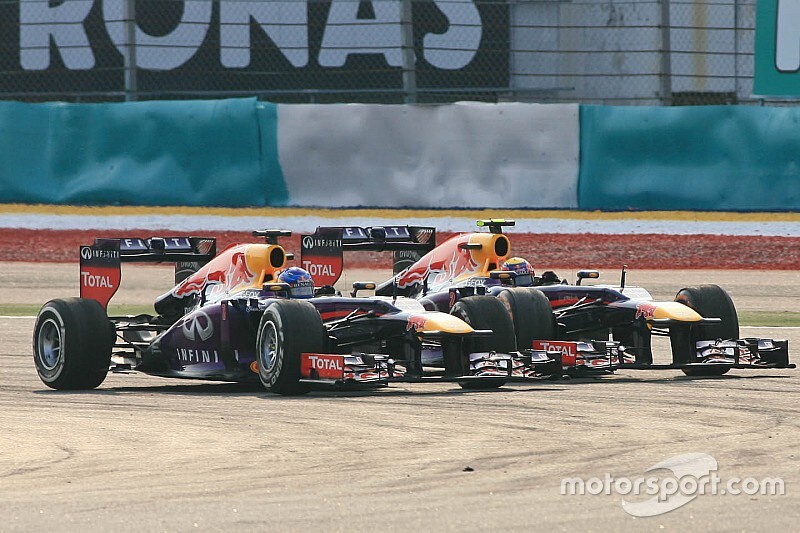
This is potentially the most iconic moment of the Malaysian Grand Prix era! In the final year of Red Bull’s dominant run, Sebastian Vettel turned up and took pole position from the two Ferraris, with teammate Mark Webber down in 5th.
Rain before the start meant all drivers started on the intermediates but on a rapidly drying track. After first lap contact between Alonso and Vettel, which ended with Alonso stuck in the gravel trap, his front wing stuck underneath his car, the two Red Bulls battled it out.
Webber took the lead after the first stops, and Vettel was quickly getting annoyed and telling the team to “get him out of the way”. Of course, the team didn’t fulfil this request.
Little did we know at the time but there was reason behind Vettel’s annoyance. Beyond the usual. Red Bull had a coded team order. Whichever driver came out of the final pit stops ahead would be safe from attack from their teammate. And on this occasion, Webber came out ahead. Soon, Red Bull were on the radio to Vettel, telling him “Multi map 2-1”. Meaning car 2 ahead of car 1.
However, their driver ignored their orders. Vettel went on the attack, and after a battle from the main straight to Turn 4, he was past.
At the chequered flag there weren’t the usual happy faces on the pit wall, or in the garages. Awkwardness was the emotion of the day.
The awkwardness didn’t stop there. Once the drivers got into the cool-down room before going to the podium, Webber ignored his teammate at first, before repeatedly saying “Multi 21, Seb, Multi 21!”, and some great The Office-style camera work, as it panned to said Seb awkwardly downing his bottle of water. Like a naughty schoolboy!
This was an episode the two teammates would never recover from. It was the final straw for Webber, who had long known who the team’s favourite really was.
Hamilton’s Title Chances Go Up in Smoke – 2016
Lewis Hamilton and Nico Rosberg rocked up to the 2016 Malaysian Grand Prix in the middle of their third epic championship battle. Three years of blood, sweat and quite a few tears had brought their friendship and the team’s nerves to breaking point. Hamilton had won the last 2 championships, but this time, Rosberg was in the driver’s seat (no pun intended). He led by 8 points with 6 races to go. All to still play for.
The two Mercedes locked out the front row, with Hamilton on pole. Both got off the line fine but disaster struck for Rosberg at Turn 1. Vettel’s Ferrari dived down the inside of Verstappen’s Red Bull but didn’t factor in the Mercedes on the outside. He missed the Red Bull but ran straight into the rear of Rosberg, spinning him around. He dropped to the back of the field.
Out in front, Hamilton was driving away. He just had to bring the car home to close the gap to his teammate as Rosberg made his way back up the field.
However, the racing gods weren’t looking out for him this time. On Lap 41, Hamilton’s engine failed on the main straight and ground to a halt. A devastated Hamilton knelt by his car, knowing his title chances had potentially gone up in flames with his engine.
The points flip was massive. Instead of taking a 5-point lead into the Japanese Grand Prix, Hamilton now trailed his teammate by 23 points.
Despite winning 4 of the final 5 races, Hamilton couldn’t overturn the deficit, and Rosberg became World Champion. This engine blowout would become THE turning point of an iconic season.
