
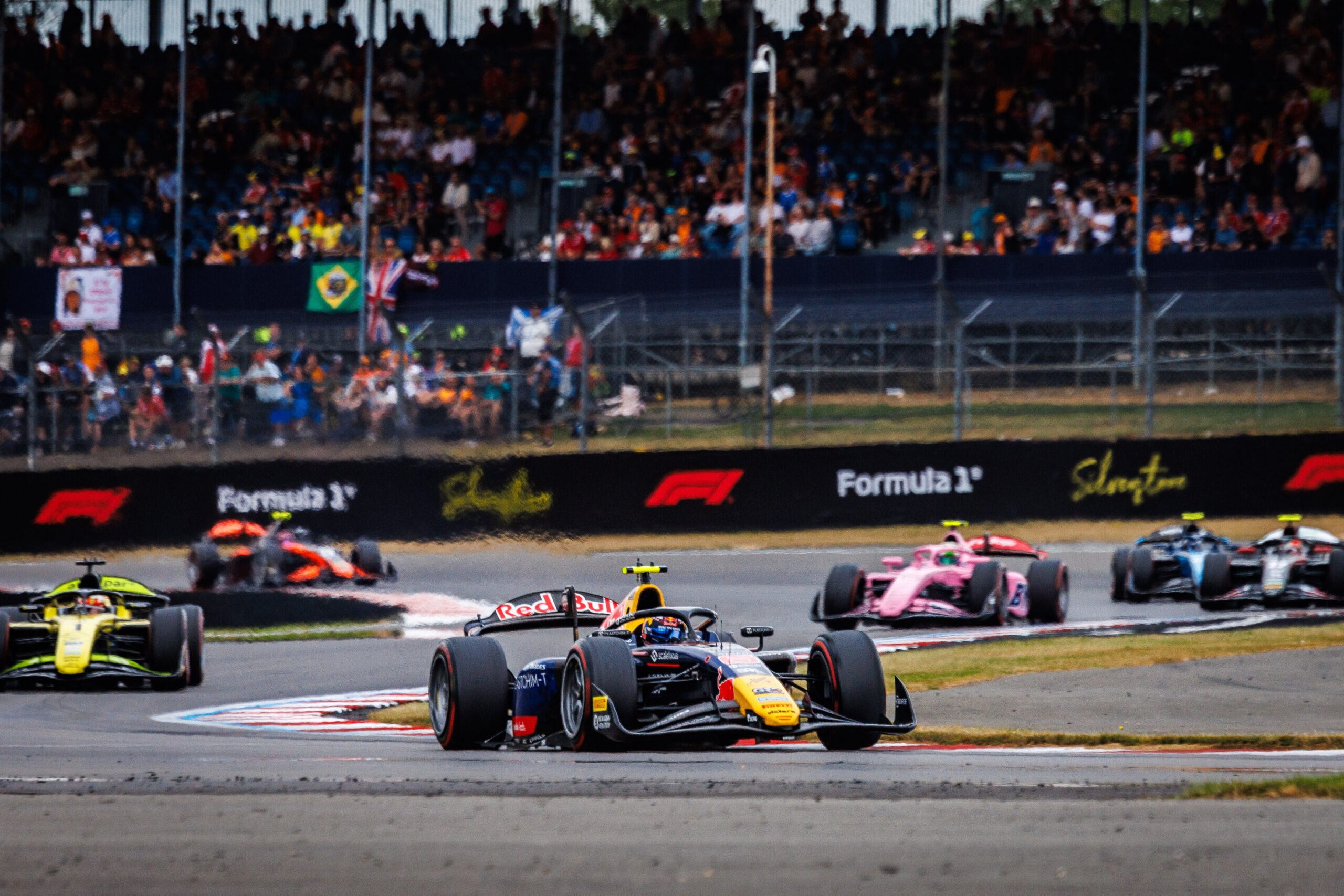

Nikola Tsolov may have left Silverstone with both race victories and the championship lead, but his battle with Gabriele Minì is proving there is more than one way to build a title challenge.
While Tsolov has repeatedly converted opportunities into victories throughout 2026, Minì has remained firmly in contention by consistently maximising every weekend. Speaking after the Silverstone Sprint Race, both drivers reflected on their contrasting campaigns, revealing that despite the different results, their underlying philosophy is remarkably similar.
Different routes to the top
Nikola Tsolov leaves Silverstone at the top of the F2 Drivers’ Championship. The Bulgarian did a double and took both Sprint and Feature Race wins at Silverstone. While he now has a points advantage over Gabriele Minì, the championship fight continues to highlight two very different approaches to success. One has been built on outright victories, the other on relentless consistency and podium finishes.
Tsolov’s Silverstone double further underlined the strengths that have defined his campaign. The Campos Racing driver has built his title challenge around converting opportunities into victories, while Minì has remained firmly in contention through relentless consistency. Although the Italian has stood on the top step fewer times, his ability to maximise points whenever victory isn’t within reach has kept him within striking distance.
Despite the contrast in style, neither sees it as a philosophical divide but more as a reflection of circumstance.
“It’s hard to say which one is more sustainable,” Tsolov said after the race. “If you’re consistently winning, I think that’s the best thing you can do… I’ve just been in a situation more times where I had the opportunity to win, and I took it.”
Winning when it matters
Tsolov pointed to execution rather than aggression as the defining factor in his approach. He argues that consistency ultimately underpins both strategies.
“I think consistency is more important than win count,” he added, while still reinforcing the core of his season: “When you can win, you win.”
Minì’s response underlined a similar philosophy from the opposite direction. One shaped by the realities of race management, risk, and survival in a tightly packed championship.
“To win, you have to create the opportunity and risk quite a lot,” he explained. “Of course that’s not sustainable, because it can go well once or twice, but the other three or four times it can go wrong.”
Instead, the MP Motorsport driver framed his campaign around maximising outcomes in every situation, rather than forcing victories that may not be available.
“The goal is always to maximise the results,” he said. “For me it’s been podiums, for Nikola it’s been wins. We just have to keep doing what we’ve been doing.”
Winning versus consistency
That shared understanding has defined one of the most compelling subplots of the F2 season so far. Two drivers separated by approach but not by performance. While Tsolov has edged ahead in the standings after Silverstone, Minì’s consistency continues to keep him firmly in title contention.
Minì also highlighted that the respect between the pair is rooted in familiarity rather than formality. Having worked together in junior categories and through shared academy programmes, their on-track rivalry is underpinned by a long-standing off-track relationship.
“We know each other quite well,” he said. “He’s a really nice guy. Of course we are rivals on track, but we always respect each other.”
That respect was visible after the flag at Silverstone. The pair exchanged a brief handshake despite the intensity of a late-race fight for victory. It was a small but telling moment in a title battle that is becoming increasingly defined by fine margins.
From a performance standpoint, the numbers reflect the difference in approach as clearly as the driving does. Tsolov’s six victories have given him a higher peak return on individual weekends. While Minì’s consistency has kept him firmly in title contention despite fewer visits to the top step.
Although Tsolov now holds the advantage in the championship, both drivers were quick to stress that neither philosophy carries a clear advantage over the course of a long season. The reality, they argue, is more fluid. Winning requires opportunity, consistency requires control, and both depend heavily on circumstance.
As Tsolov put it, the key is not choosing between the two, but executing both when possible: “When you can win, you win.”
A title fight far from over
Silverstone ultimately swung in Tsolov’s favour yet the underlying battle remains far from settled. With several rounds still to come, the championship continues to pit two contrasting approaches against one another. One built on taking every opportunity to win, the other on maximising every available result.
If the opening half of the season has shown anything, it’s that both methods are capable of delivering a title challenge.
Formula 2 returns in Spa from 17 July – 19 July, 2026.
Featured image credit: Red Bull Content Pool