
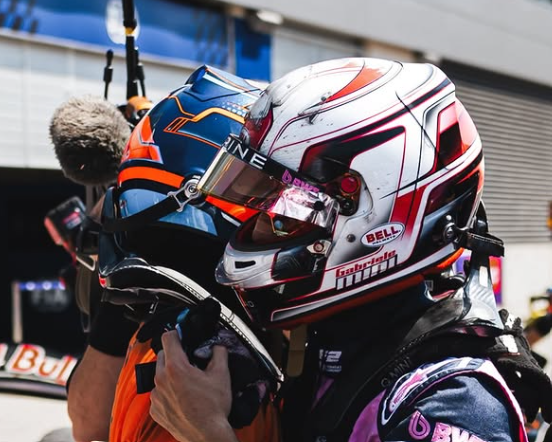

The FIA Formula 2 Feature Race at the 2026 Austrian Grand Prix combined strategic precision with demanding conditions at the Red Bull Ring, as Nikola Tsolov (Campos Racing) led the narrative alongside MP Motorsport teammates Gabriele Minì and Oliver Goethe in the post-race press conference.
Tsolov’s takeaways
Tsolov’s race was defined early on by a decisive start that set him up for control at the front.
“My reaction time was quite good… I came out first out of T3,” he explained, describing a bold but calculated opening phase.
Despite that strong launch, he admitted a costly mistake in the pit lane, “I didn’t hold the brakes… I lost maybe two seconds”, which added pressure to the remainder of his race. Even so, victory at the Red Bull Ring carried particular emotional weight. While the result narrows the championship gap, Tsolov remained measured: he keeps one eye on the standings but insists it is “still very early in the season.”
MP Motorsports drivers’ takeaways
Minì’s race, by contrast, highlighted instinct and strategic timing. He pointed to a near-miss with Boya as a moment of pure reaction, admitting he was unsure how he avoided contact. His decision to extend his stint proved crucial, allowing him to emerge ahead of key rivals after the pit cycle. “It felt like I could do one more [lap]… it was the right moment,” he said. In terms of the title fight, Minì acknowledged that racing directly against Tsolov subtly alters his approach, encouraging greater risk, but reiterated that his priority remains to “maximize everything” rather than focus too heavily on championship calculations.
For Goethe, the race marked a breakthrough. Securing his first Formula 2 podium, he described the result as overdue: “It’s about time… better late than never.” The MP Motorsport driver emphasized both strong execution and restraint, particularly in managing extreme tire degradation in the heat. “I didn’t want to take any risk,” he noted, choosing patience over aggressive moves to preserve performance across the stint. His strategic call to pit early under the Virtual Safety Car proved decisive, driven by deteriorating tire feel, “it was just safer to go one lap earlier”, and ultimately validated by a strong run to the finish.
Tricky conditions and strategies
The race conditions themselves played a significant role. Compared to the previous day, a drop of around 10°C in track temperature made the feature race more manageable. Tsolov described the sprint race as “very weird” due to overheating, whereas Sunday allowed for more controlled execution, even if tire management remained central.
That theme extended across all three drivers. Goethe admitted he pushed hard early, “I used the tire quite a lot in the first laps”, before shifting into management mode. Tsolov, meanwhile, highlighted the advantage of running in DRS behind Dunne, allowing him to “cruise” while maintaining lap time and preserving tires for the closing stages. Minì similarly described a more controlled approach than the day before, focusing on avoiding excessive stress on either axle.
Tsolov also had to contend with front wing damage, though he downplayed its impact. “It wasn’t crucial,” he said, noting that as long as the main structure remained intact, performance loss was manageable, his greater concern being the risk of a complete failure.
For MP Motorsport, placing both drivers on the podium was a clear positive. The team split strategies between Minì and Goethe primarily to avoid double-stacking in the pit lane, a decision both drivers described as straightforward rather than complex. The result underlined both strategic flexibility and execution.
Consistency, however, remains central to the broader picture. Minì emphasized its importance in a highly competitive field, while Tsolov pointed to their ongoing rivalry as a source of improvement: competing closely, he suggested, raises the level for both.
Long-awaited podium
Goethe’s podium also carries wider significance for his season. After a difficult start marked by errors and misfortune, he described the result as “very relieving,” reinforcing confidence in both his pace and the team’s direction. While he believes the potential “has been there” all along, he acknowledged that the key step forward lies in consistently maximizing results.
That achievement was made more challenging by his lack of running in the sprint race. Although teammate data offered some guidance, Goethe noted that “you don’t get as much rhythm” and must adapt more on the fly. Even so, he was able to overcome that deficit and convert opportunity into a long-awaited podium.
Overall, the Austrian Feature Race illustrated the fine margins that define Formula 2: instinctive decisions, tire discipline, and strategic timing all converged to shape a race where execution proved just as critical as outright pace.