

Team orders have existed in Formula 1 since the very beginning, but did Ferrari go one step too far at the 2002 Austrian Grand Prix?
[adrotate banner=”3″]
Get 10% off all official F1 Merch at TheRaceWorks.com using code ‘EF1‘ at checkout.
About The Austrian Grand Prix
The Austrian Grand Prix has been part of Formula 1 since 1970, when the Österreichring hosted its first race. In the 1990’s the circuit underwent major reconstruction to shorten and refine the track, and was rebranded as the A1-Ring. In 2011 the circuit was rebranded again, becoming the now iconic Red Bull Ring.
For the first time ever in 2020, the Red Bull Ring hosted two races. It was the result of the Covid-19 pandemic forcing a drastic change to the race calendar. The first of the races was the Austrian Grand Prix, whilst the second was named the Styrian Grand Prix (which also featured on the 2021 race calendar).
In 2023, the Austrian Grand Prix was surrounded in controversy. The strict track limits meant that the stewards had to review 1,200 potential infringements. The findings saw the results of the race dramatically altered hours after the chequered flag had been waved. 83 infringements were identified, and they all occurred at Turn 9 and Turn 10. Eight drivers received penalties, with Esteban Ocon racking up a total of four sanctions totalling 30 seconds. It was arguably one of the most infamous Austrian Grands Prix in history. But for me, the 2002 Austrian Grand Prix really takes the cake.
The 2002 Austrian Grand Prix
After the highly unpopular team orders controversy in 2001, Ferrari’s reputation was tainted. The fateful words “let Michael pass for the championship” still echoed within the minds of fans. As the 2002 Austrian Grand Prix weekend rolled on, Rubens Barrichello set a blistering lap to claim pole. His Ferrari teammate, Michael Schumacher, was starting the race from third.
With the dark cloud of the previous year’s controversial radio message still a sore subject, all eyes were on Ferrari. As much as Ferrari and team orders were now pretty much a hand-in-hand combo, there was surely no way that lightning would strike twice…or so we all thought. Cue the 2002 Austrian Grand Prix.
Race Start
As the lights went out, Barrichello got a good start off the line and maintained the lead as the pack rounded Turn 1. Michael Schumacher managed to slot into second, and Nick Heidfeld jumped to third after passing Ralf Schumacher. Behind them, Felipe Massa dipped onto the grass as he battled Kimi Räikkönen, dropping him to tenth. The Arrows of Enrique Bernoldi and Heinz-Harald Frentzen collided, but both were able to carry on. Frentzen’s woes continued, as Jacques Villenueve briefly lost control and hit Frentzen up the inside. Frentzen was sent into the gravel trap, which took an age to carefully get back out of. Jaguar also had issues on the opening lap, with Pedro de la Rosa’s throttle pick-up cutting out and forcing him to retire from the race.
Barrichello and Michael Schumacher began to demonstrate the dominance of Ferrari. Both drivers began to pull away from the rest of the field, seemingly already having a much smoother race than those behind them. Heidfeld ran wide at the Castrol Kurve, handing third place back to Ralf Schumacher. Bernoldi retired on lap three with a broken front brake pipe and front wing as the result of his lap one collision. On lap six, Räikkönen pulled off to the side of the track with engine failure. Lap seven saw Massa pull into the pit lane with a failed left-rear suspension. Up front, Barrichello was a second clear of his teammate, and both were a mighty 17 seconds ahead of Ralf Schumacher in third.
Early Stint
There was a sudden heart-in-the-mouth moment on lap 16 as Frentzen put a wheel on the grass, spun 180 degrees and rolled backwards in front of the race leaders. The Ferraris, unfazed by the near-miss, continued to streak away and extend the gap to the rest of the pack. On lap 23, Villenueve was handed a drive-through penalty for his lap one collision with Frentzen. One lap later, Olivier Panis’ engine seized, locking his wheels and sending him spinning into the middle of the track. The Safety Car was deployed to allow marshals to remove the stranded BAR-Honda.
Ferrari called their drivers into the pits, with Schumacher driving slower to allow for the double-stack. Barrichello rejoined the track still in first place, whilst Schumacher ended up rejoining in third, behind the Williams of his brother Ralf. Williams had opted for the opposite strategy to Ferrari, leaving their drivers out and planning for a one-stop race. At the end of lap 27, the Safety Car came in and Barrichello led the pack away to restart the race.
A Brief Restart
Just one lap after the Safety Car came in, Nick Heidfeld noticed smoke coming from the Minardi of Alex Yoong. Heidfeld hit the brakes hard, locking his rear wheels and causing him to lose control. Heidfeld spun across the grass at 280 km/h (170mph) and was launched off the crest of the hill. At the apex, Juan Pablo Montoya was trying to pass up the inside of Takuma Sato. Heidfeld narrowly avoided a collision with Montoya, but the out-of-control Sauber went side-on into the right-hand sidepod of Sato’s Jordan. The collision was massive and the Safety Car was deployed once again. Debris was sent scattering over a wide area of the track. Heidfeld’s rear structure, including the titanium gearbox, punctured a hole in the Jordan. Both drivers came to a stop in the gravel trap, and a shaken Heidfeld was helped out of his Sauber by the marshals.
Heidfeld had sustained severe bruising to his left leg, and both knees had struck the steering column with enough force to break it in half. Sato sustained soft tissue damage in his right thigh, and his helmet was squeezed between the head restraint. It took 10 minutes to extract Sato from his car, before transporting him to the medical centre by ambulance. Both Heidfeld and Sato were then taken to hospital by helicopter. As the Safety Car period went on, Ferrari and Williams were the only teams to leave their drivers out. All of the other teams called their drivers in for additional fuel and a fresh set of tyres
[adrotate banner=”3″]
Get 10% off all official F1 Merch at TheRaceWorks.com using code ‘EF1‘ at checkout.
The Race Gets Underway Again
At the end of lap 36, the Safety Car came back in and the race resumed once again. Barrichello led the charge, with Ralf Schumacher, Michael Schumacher, Juan Pablo Montoya and David Coulthard completing the top five. As lap 38 began, Villenueve passed Giancarlo Fisichella for sixth place, whilst Eddie Irvine came into the pits to retire his Jaguar due to a hydraulics failure. Two laps later, Villenueve passed Coulthard for fifth place. Jarno Trulli retired on lap 45 as his Renault lost fuel pressure, and Yoong soon joined him on the list of retirees as his Minardi caught fire.
The first of the regular green-flag pit stops finally came on lap 47. Williams called Ralf Schumacher in, and he dropped down to fifth. Montoya stayed out, hoping to get the overcut. He came into the pits on lap 51 and rejoined the track in fourth, ahead of his teammate. Both Williams drivers soon found themselves in third and fourth, as Villenueve pitted on lap 53, dropping him to ninth position.
Barrichello pitted for the second time on lap 61, with Michael Schumacher taking over as the race leader. The following lap, Michael also came in for his second stop, handing the lead back to Barrichello.
The Dreaded Déjà Vu
Jean Todt’s voice came across the Ferrari team radio, with the team principal instructing Barrichello to give the lead position back to his teammate. The call was made in order to help improve Michael’s standings in the championship. Barrichello’s reply was heartfelt, referring to the promise he made after the previous year’s race that he would not relinquish a victory to another driver. Todt instructed Barrichello to “follow his orders in order to preserve the team’s “best interests”. Over the next seven laps, the Ferrari pit wall noticed that Michael wasn’t getting close enough to Barrichello for a clean swap to be made…and the clock was rapidly ticking.
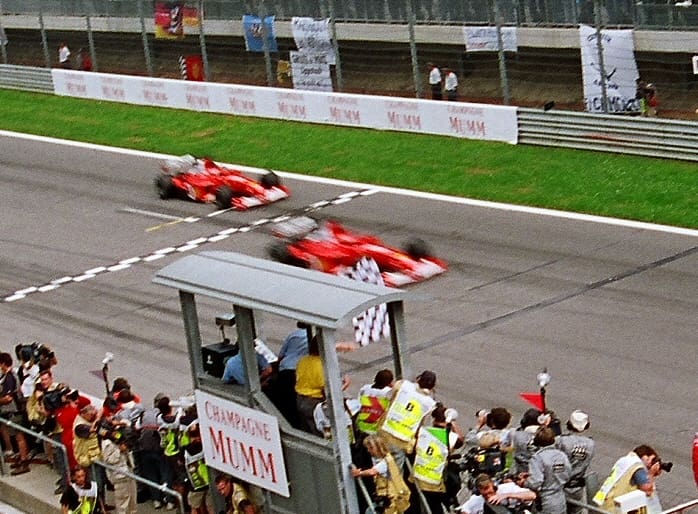
As the final lap got underway, the two Ferraris were a second apart. As Barrichello came round the final corner, the team’s technical director Ross Brawn got on the radio to Schumacher to confirm that Barrichello would yield and allow him to pass for the win. Barrichello applied the brakes in the final 100 yards in order to follow the team orders. Astonishingly, Schumacher slowed more than his teammate as it had been his hope that no team orders would be applied. Ultimately, Schumacher passed Barrichello across the line to take the race win, but it left a bitter taste in the mouths of both the drivers and the fans.
[adrotate banner=”3″]
Get 10% off all official F1 Merch at TheRaceWorks.com using code ‘EF1‘ at checkout.
Post-Race
As the team assembled in parc fermé, the crowds were quick to make their feelings known. Spectators booed, jeered and whistled as the podium ceremony began. In a display of his own feelings, Schumacher insisted that Barrichello stood on the top step as the German national anthem played out. He then joined him as the Italian anthem played for the Ferrari team, a symbolic gesture in itself. The booing continued in the post-race press conference. Barrichello said there was “no point in arguing” with the team orders, whilst Schumacher stated that he understood the team’s decision.
Summary
The controversy that erupted from the 2002 Austrian Grand Prix overshadowed the race itself. Barrichello had been a dominating force, leading almost every lap from the race start. The fallout was so strong, that it prompted the FIA to ban “team orders that would interfere with the race result” as of the 2003 season. This was a major shift in the acceptable use of team orders within the sport (although admittedly brought about the clever use of coded messages).
Overall, the fact that Ferrari had forced Barrichello to hand over the race win to Schumacher at the same Grand Prix two years in a row was shocking to say the least. Team orders will always exist in Formula 1 in one form or another, but in 2002 Ferrari took things one step too far.
Which Austrian Grand Prix do you think is a race to remember? Let us know in the comments!
Feature image sourced from the EverythingF1 OneDrive