

[adrotate banner=”10″]
Get 10% off all official F1 Merch at TheRaceWorks.com using code ‘EF1‘ at checkout.
The upcoming 2025 Saudi Arabian Grand Prix marks only the fifth visit by the F1 circus to the Middle East’s largest country. Since the race’s debut in 2021 the event has notably split opinion, with some relishing the high speed, challenging nature of the circuit, while others question its place on the calendar in light of various human rights issues associated with Saudi Arabia.
Another factor which has also come into question is Saudi Arabia’s racing heritage. However, as this article will explore, that is an area where the country has had more involvement than many realise…
Kickstarting a Legend
Saudi Arabia first shot to global prominence in the 1970s, with their role in the 1973 oil crisis seeing the nation emerge as a power on the world stage. It would also fittingly be that same decade which also saw the Saudis first get involved with Formula 1.
That involvement came in the form of a deal with a future legend of the sport — Frank Williams.
Throughout the 1970s, Williams had struggled to find a place for himself in Formula 1. His first team, Frank Williams Racing Cars, was almost permanently short on money, and by 1976 he had little choice but to sell a majority stake to Canadian investor Walter Wolf.
Williams initially stayed on as team principal of the newly renamed Wolf-Williams team. However, he soon grew tired of being a subordinate in his own company. He therefore resolved to leave and start again, founding a new team called Williams Grand Prix Engineering in 1977.
There was one problem for this new Williams team though — Money. With very little cash of his own to fund his venture, Williams would need a major backer to get the team off the ground.
Fortunately for Williams, a rare opportunity arose at the same time. With the wealth and status of Saudi Arabia rising during the 1970s, the nation became interested in the glamour of Formula 1. Sensing a chance to secure the backing he needed, Williams flew to Riyadh personally to talk sponsorship. After a meeting with potential backers, the smooth-talking Briton was able to obtain crucial backing from Saudia airlines.
[adrotate banner=”6″]
Get 10% off all official F1 Merch at TheRaceWorks.com using code ‘EF1’ at checkout.
A Promising Start
Saudia’s money initially went towards establishing a base of operations for the new team — an old carpet factory in Didcot. The team also purchased a customer March chassis for a token first season in 1977.
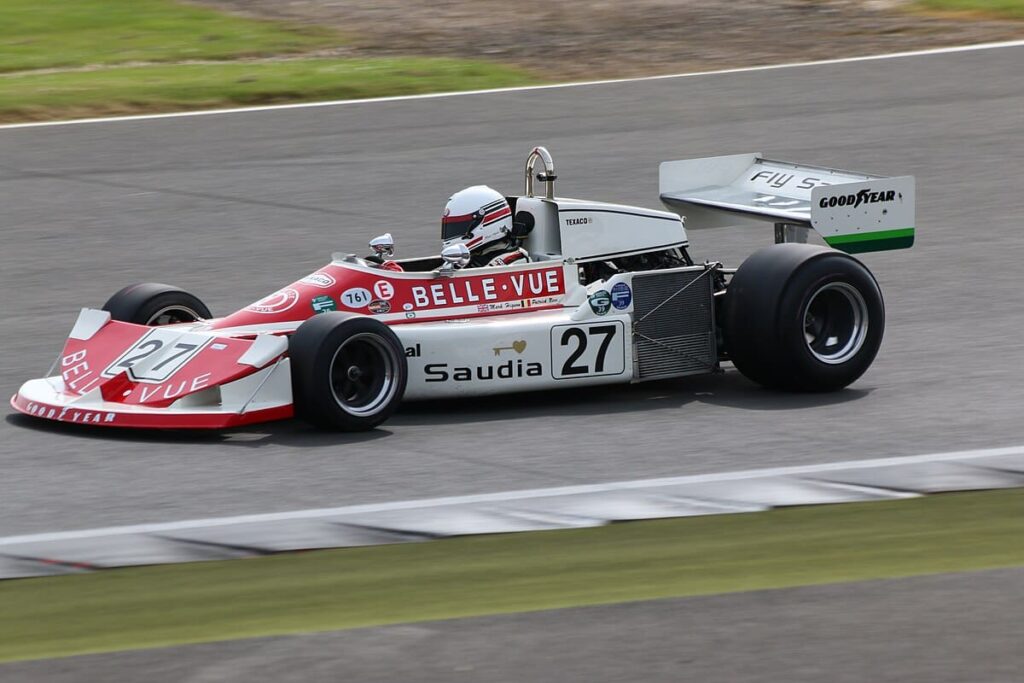
Image Credit: Andrew & Alan Frost – Own Work, CC BY-SA 2.0, Link.
.jpg)
However, behind the scenes Williams’ designer and co-founder Patrick Head was hard at work creating the new team’s first true car in time for 1978 — the FW06.
The FW06 was a relatively simple car, which notably didn’t take advantage of the ground-effect aerodynamic principles introduced to F1 by Lotus the year before. However, with driver Alan Jones at the wheel it nevertheless proved solidly competitive, scoring points third time out at Kyalami.
Jones then followed his Kyalami showing with a remarkable performance at the Long Beach street circuit. After qualifying 8th he charged up to second and challenged for the lead for several laps. Only front wing failure ultimately prevented him from taking at least a podium.
In all, Williams racked up an impressive 11 points in their first season as a constructor, including a second place finish in Canada. Such results soon saw a bevy of other Saudi companies flocking to get their name on this rising star of F1.
Among these new sponsors, perhaps the most notable was Techniques d’Avant Garde. While the firm itself was based in Luxembourg, it was founded by Saudi entrepreneur Akram Ojjeh and his son Mansour, and held strong links to the state. Better known as TAG, this company would go on to become inextricably linked to Formula 1.
Money Well Spent
The money from Saudia, TAG and other Saudi backers allowed Williams to scale up immensely for 1979. Former Ferrari driver Clay Regazzoni joined in a second car alongside Jones, while the team hired young aerodynamicist Frank Dernie to help Patrick Head with the design of the team’s new car.
That car — the FW07 — proved to be a revelation thanks to its advanced ground effect aerodynamics. After a brief period of acclimatisation following its introduction at the fifth round of the 1979 season, Williams soon found themselves with the car to beat.
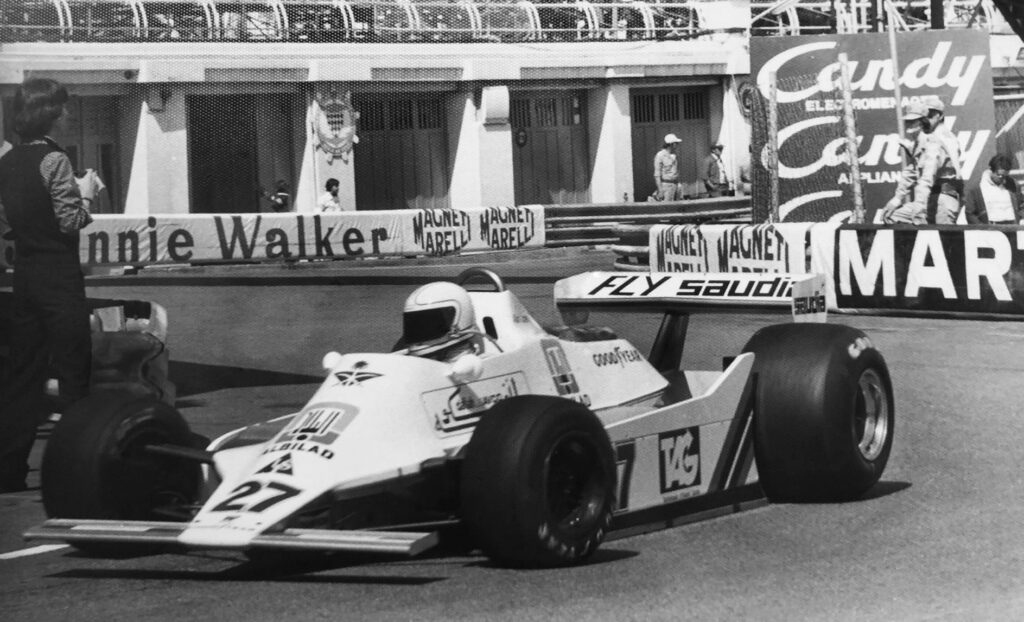
Image Credit: Martin Lee – Own Work, CC BY-SA 2.0, Link.
.jpg)
The team’s breakthrough first victory came on home soil at Silverstone following a dominant showing where Williams’ cars led every lap. For a tearful Frank Williams it was the culmination of what had been his life’s work up to that point, while for his Saudi backers it was a brilliant return on their investment.
Williams would just miss out on winning the championship in 1979, but they were now clearly on the path to greatness. The FW07 chassis had ample room for development, and the team was now flush with money to spend on doing just that.
Williams and Jones were the pundits favourites for both titles in 1980, and in the end they proved this faith to be well-placed. Jones’ aggressive driving style meshed brilliantly with the car, and he duly claimed five victories in it including another home win at Brands Hatch. New teammate Carlos Reutemann also secured another win at Monaco, and with 12 other podiums Williams secured their first championships just three years after the team’s founding. Both the team and their sponsors were understandably overjoyed.
Changing Allegiances
The Saudi sponsors Williams had accrued since their debut in 1977 stayed with them following these early successes. Another constructor’s title in 1981 and driver’s crown for Keke Rosberg in 1982 were their reward.
However, despite winning the championship, 1982 saw Williams’ competitiveness start to slip as cars with turbocharged engines began to dominate. This led to Williams’ backers wavering somewhat about whether to stick with the team that had given them a taste for F1 success.
It is at this point that a rival team enters the equation — the equally legendary McLaren outfit, at the time run by Ron Dennis.
Dennis had just signed a deal with Porsche to obtain turbocharged power from the German firm. However, he was struggling to find the money to pay for such an engine.
Knowing that Williams’ position was weakening, Dennis approached Mansour Ojjeh of TAG with a proposition. If Ojjeh funded McLaren’s Porsche engine, he would give TAG not just a sponsorship of McLaren, but part ownership of the entire team. He even offered to give TAG the naming rights to the Porsche engine if they agreed to finance it.

Image Credit: Hullian111 – Own Work, CC BY-SA 4.0, Link.

Ojjeh agreed, and his TAG firm therefore swapped allegiances from Williams to McLaren for 1983.
It would prove to be an inspired move. The TAG-Porsche engine was ready by late 1983, and immediately proved to be highly capable.
McLaren paired the engine with a new MP4/2 chassis designed around it for the 1984 season, and also signed a formidable driver line up of Niki Lauda and Alain Prost. Between them, the pair won 12 out of 16 races in 1984, achieving a level of dominance rarely seen before in F1. The TAG-Porsche engine then powered the team to further championships in 1985 and ’86.
Where Are They Now?
McLaren would stop using the TAG-Porsche engine which Ojjeh had initially financed in 1988 (ironically in favour of a Honda unit which they also poached off Williams), but TAG would nevertheless retain its ownership stake in the team to this day. Despite the death of Mansour Ojjeh in 2021, its stake currently sits at 14%.
Through its 1985 purchase of Swiss watchmaker Heuer, TAG has also long held an association with F1 beyond just McLaren. This includes both a recent sponsorship of the Red Bull team, as well as a deal to become Formula 1’s official timekeeping partner for all races starting from the current 2025 season.
Saudia meanwhile continued its sponsorship of Williams until the end of 1985, before departing the sport for a long period. However, it has recently returned to Formula 1 as a major sponsor of the Aston Martin team.
It is therefore clear that while there are numerous legitimate criticisms of Saudi Arabia’s involvement in Formula 1 given its track record on human rights, it is certainly not the case that the country is lacking when it comes to Formula 1 heritage…
[adrotate banner=”8″]
Get 10% off all official F1 Merch at TheRaceWorks.com using code ‘EF1‘ at checkout.
Featured image courtesy of Williams F1