

Better known as Interlagos, the Autódromo José Carlos Pace is a firm favourite amongst Formula 1 fans. We take a look at the history of this iconic racing circuit.

Circuit Stats
| Track Length | 4.309 km |
| Number of Laps | 71 |
| Race Lap Record | 1:10.540 (Valtteri Bottas – 2018) |
| Qualifying Lap Record | 1:07.281 (Lewis Hamilton – 2018) |
| First Grand Prix | 1973 |
| First Race Winner | Emerson Fittipaldi |
| 2023 Race Winner | Max Verstappen |
[adrotate banner=”10″]
Get 10% off all official F1 Merch at TheRaceWorks.com using code ‘EF1‘ at checkout.
Circuit History
The Autódromo José Carlos Pace (more commonly referred to as Interlagos), is located in the Brazilian city of São Paulo. The name “Interlagos” means “between lakes”, and was given to the region due to its position between two artificial lakes – Guarapiranga and Billings.
The land was originally bought by property developers in 1926, with the intention of building housing. It was decided to build a racing circuit instead, and building work began in 1938. The circuit was officially opened on 12th May 1940. The circuit designers took inspiration from multiple other circuits around the world; Brooklands (UK), Indianapolis Motor Speedway and Roosevelt Raceway (USA), and Montlhéry (France).

Then named the Autódromo de Interlagos, Brazil’s first racetrack was opened to the public before work had even been completed. There was no paving, and the main gate was made of wooden slats. There were no grandstands, no pit facilities, no guardrails, no transmission or timing towers and no toilet facilities. The small brick shack that was intended to be used as a ticket office displayed a handwritten sign that read “tickets are not provided”. Indeed, the rather crude barbed wire fence that surrounded the circuit had gaps so large that many of the 15,000 spectators were able to access the track without paying the entrance fee.
Nowadays the circuit boasts one of the longest pitlanes on the calendar. It also attracts around 267,000 people over the course of a race weekend. Such is the popularity of the track, additional grandstands have been constructed in recent years to meet demand. As it stands, the Autódromo José Carlos Pace is currently contracted to host Formula 1 races until 2030.
1940 – 1970
The original track layout was designed to offer two variations. The first was a 1.6 km (2.01 miles) high-speed outer ring. The second was the “complete circuit”, which combined the outer ring with a winding “core”. This brought the total track distance to an astonishing 7.99 km (4.97 miles). The circuit was closed at the end of 1967 for some renovation work. New pit boxes were built, grandstands added for 20,000 spectators, and the track was resurfaced. On 29th February 1970, the circuit reopened in grand style, hosting a race of the International Formula Ford Championship. A young Emerson Fittipaldi took the chequered flag in first place that day, much to the delight of the crowds.
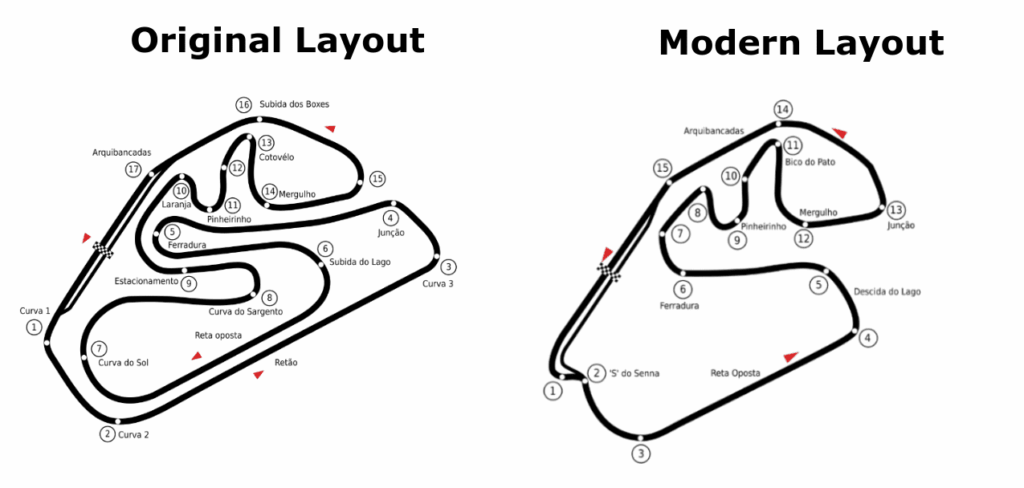
The track was once again renovated in 1970, as the popularity it had gained was causing major traffic issues in the area. Their sights were also now firmly set on hosting a Formula 1 race, and work began on improving the infrastructure. New fencing was added to the pit areas, a broadcasting building was added, along with another grandstand. Zebra crossings were put in place, and a tunnel was built to provide access to the inside of the circuit. Work was also carried out to add curbs, gutters, storm-water galleries and other general infrastructure improvements.
[adrotate banner=”10″]
Get 10% off all official F1 Merch at TheRaceWorks.com using code ‘EF1‘ at checkout.
1971 – 1989
In 1971, Interlagos hosted its first major test – an international non-championship Formula 2 race. Fittipaldi once again claimed victory, and the Fédération Internationale de l’Automobile (FIA) were able to test the track’s suitability. In 1972, Formula 1 arrived at Interlagos, albeit in the form of a non-championship race. As there were no points to be earned, not all teams took part. However there were 12 drivers that participated in the race. Four of them were Brazilian – Emerson Fittipaldi, Wilson Fittipaldi, Luiz Bueno and José Carlos Pace. The event was an unprecedented success, and Brazil officially joined the Formula 1 championship calendar the following year. The local crowds were delighted when Emerson Fittipaldi claimed victory at Interlagos in 1973. Formula 1 returned to the circuit each year until the end of 1977.
The following years saw some back-and-forth between venues. In 1978 the race was held in Jacarepaguá, Rio de Janeiro. However it returned to Interlagos for 1979 and 1980, before switching back to Jacarepaguá in 1981. This was due to the city of São Paulo not having the funds to maintain the conditions required by the FIA.
At the end of 1989, the funding situation in São Paulo had completely reversed. It was now Rio de Janeiro that couldn’t afford to host Formula 1 in their city. Determined to bring the Brazilian Grand Prix back to São Paulo, the circuit underwent more renovation works. New pits and a control tower were constructed. The track route was also shortened to approximately 4.3 km (2.67 miles) to fit in with the current trend of circuit lengths.
1990 – 2020
The circuit reopened on 23rd March 1990, after the $15 million renovation had been completed. Whilst the race was won by Alain Prost, it was São Paulo local Ayrton Senna who came second, much to the rapture of the Brazilian fans. It is without doubt that Senna’s legacy played a major part in the popularity of Formula 1 in Brazil. Senna’s legacy continues to live on at Interlaos. A karting track that is attached to the circuit was named in homage to the Formula 1 legend.

In 2007, work was carried out to repair the surface of the track. All of the asphalt was replaced to create a much smoother surface. A new grandstand was added at the same time, and the pit lane entrance was enhanced to improve safety. In 2011, further planned upgrades were announced by FIA race director Charlie Whiting. The plans included a brand new pit entrance, as well as expanded run-off areas at the final corner. By 2012, further details emerged. The plans were to move the start-finish straight and would also include the construction of a new pit building. However, it was decided that the start-finish straight would remain in its current location along with the new pit building.
The Autódromo José Carlos Pace now carries out improvement works every year. This ensures that it is kept up to date and in line with the FIA’s exacting standards.
Time For A New Name
The Autódromo de Interlagos was renamed in 1985 in homage to José Carlos Pace, who had sadly died in 1977. The circuit was now officially known as the Autódromo José Carlos Pace. Fans around the world, however, continue to refer to it simply as Interlagos.
Like many other races in 2020, the Covid-19 pandemic caused the Brazilian Grand Prix to be cancelled. It returned in 2021, but it had been given the new name of the São Paulo Grand Prix. The change partially came about after rumours began circulating that Rio de Janeiro was trying to bring the race back to their city. It also acknowledges the greater involvement of local authorities, and to promote the vibrant city of São Paulo itself.
[adrotate banner=”10″]
Get 10% off all official F1 Merch at TheRaceWorks.com using code ‘EF1‘ at checkout.
Iconic Moment
The Formula 1 driver’s championship has been won in the final race on 30 different occasions. But in 2008, the title fight between Felipe Massa and Lewis Hamilton proved to be one of the most nail-biting, edge-of-your-seat finales in Formula 1 history.
Hamilton was seven points ahead going into the final race. This was a healthy lead, considering this was the era where just 10 points were awarded for a race win, and only the top eight finishers got points at all. Fast forward to lap 66. Hamilton pitted for intermediate tyres, whilst Massa stayed out. One lap later, Massa also switched to intermediates, before filtering back out into the lead. Toyota’s Timo Glock boldly stayed out on dry tyres. This would prove to be an unexpected deciding factor in the title fight.
Hamilton dropped to sixth with just four laps of the race remaining. At this rate, Massa would have enough points to win the championship.
Massa crossed the finish line in first place. Both the driver and the team were in full belief that he had also won the championship. His rival was simply too far down the order to beat him…or so the world thought. On the final corner of the last lap, Hamilton squeezed past Glock to get himself into P5, claiming four points. Hamilton finally claimed his first-ever World Championship win. In doing so, he became the youngest driver to win the title in Formula 1 history.
Hearts broke across Brazil as Massa was delivered the news mid-celebration. The ultimate prize had been snatched away from him at the very last moment in what has to be one of the most thrilling ends to a Formula 1 season.
What’s your iconic São Paolo Grand Prix moment? Let us know in the comments!