

Silverstone is where it all began, and there’s an illustrious history behind the famous British circuit.
[adrotate banner=”10″]
Get 10% off all official F1 Merch at TheRaceWorks.com using code ‘EF1‘ at checkout.
Circuit Stats
| Track Length | 5.891km |
| Number of Laps | 52 |
| Race Lap Record | 1:27.097 (Max Verstappen – 2020) |
| Qualifying Lap Record | 1:19.509 (Sebastian Vettel – 2009) |
| First Grand Prix | 1950 |
| First Race Winner | Giuseppe Antonio “Nino” Farina |
| 2023 Race Winner | Max Verstappen |

Circuit History
Silverstone hosted the first ever Formula 1 World Championship Grand Prix in 1950. It was also the one and only time that a reigning monarch has attended a British motor race, with King George VI watching Nino Farina claim victory. Since then, it has held all but 17 of the British Grand Prix races. It has also cemented itself as one of the fastest, most challenging circuits on the calendar.
The circuit itself is built on the site of a second World War RAF bomber station. It was active between 1943 and 1946, and was the base for the No 17 Operational Training Unit. The classic triangle runway layout can still be seen within the outline of the present track to this day. The iconic Hangar and Wellington straights both earned their names from the site’s military past.
The circuit is situated close to several Formula 1 teams. Mercedes can be found just up the road in Brackley, and Red Bull are in nearby Milton Keynes. Aston Martin has the luxury of being situated right across the road from the circuit!
In 2023, the British Grand Prix had record attendance numbers. Across the weekend, approximately 480,000 race fans flocked to Silverstone, with 160,000 attending on Sunday alone.
1947 – 1990
Silverstone was first used as a race track by a group of friends who agreed to an impromptu race in September 1947. Maurice Geoghegan, a resident of the nearby Silverstone village, knew the airfield had been deserted. He gathered 11 other drivers and the race was held over a 2 mile (3.2km) stretch. Rather extraordinarily, a sheep wandered onto the airfield and was unfortunately struck by Geoghegan’s car. The sheep sadly died, and the car was written off, but the informal race became known as the “Mutton Grand Prix”.
In 1948, the Royal Automobile Club (RAC), leased the airfield and created a more recognised race track. The initial layout saw drivers racing on the long straights of the runways for the first two races. In 1949 the International Trophy meeting used the perimeter track instead. This layout would continue to be used for the 1950 and 1951 Grand Prix.
In 1952, the British Racing Drivers Club (BRDC) took over the lease of the circuit. The start line was relocated to the straight between Woodcote and Copse, having previously been located at Farm Straight. This layout would remain in place for almost four decades. In 1975, a chicane was added at Woodcote Corner to try and slow the cars down. In 1987, a right hand corner was introduced at Luffield.
[adrotate banner=”10″]
Get 10% off all official F1 Merch at TheRaceWorks.com using code ‘EF1‘ at checkout.
1991 – 2010
For the 1991 Grand Prix, two major overhauls took place. A new “stadium” area was added between Abbey and Woodcote. Becketts corner was replaced with sweeping curves for a greater challenge. A bridge was built across the Hangar Straight. Vale was installed between Stowe and Club corners to try and entice drivers to make daring overtakes. Further changes were made to Luffield corner and a new section was added to connect it to Abbey. This new section featured Bridge, Priory and Brooklands.
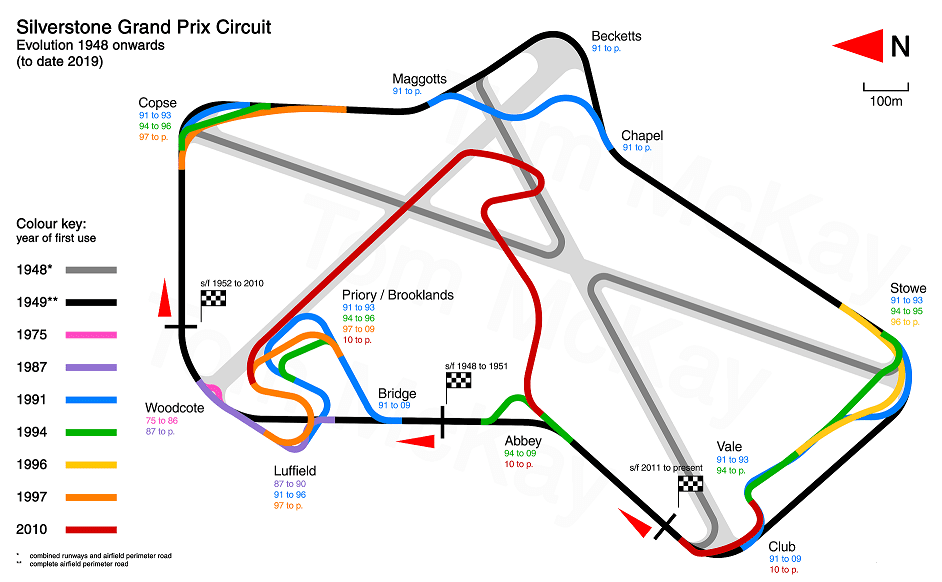
1994 saw many circuits making modifications to reduce speed and increase driver safety. This was as a result of the deaths of Ayrton Senna and Roland Ratzenberger. At Silverstone, work was undertaken to reprofile Copse, Stowe, Abbey and Priory, with greater run-off areas added and speeds slowed. A chicane was later added to Abbey in 1994. Further corners were modified in 1997. This time the changes helped to increase the speed and overall flow of the track.
An Uncertain Future
A £25m redevelopment was approved in 2007, with the inclusion of new pit facilities, grandstands and a development centre. However, in 2008 it was announced that Formula 1 would be moving to Donington Park from 2010. Roll on June 2009. Bernie Ecclestone announced that there was a chance that the British Grand Prix would be at Silverstone if Donington was not ready to host. Just four months later, it was confirmed that Donington had indeed failed to raise the £135m required. The rights to host the British Grand Prix for the next 17 years were awarded to Silverstone on 7th December 2009. Part of this new contract demanded that a new pit lane was to be built.
A £5m project took shape, with a new “Arena” area being built. It takes drivers right at the old Abbey Chicane, into the infield, before sweeping back towards Brooklands. It was one of the biggest changes to the track layout in the history of the Silverstone circuit.
2010 – Present Day
The Arena circuit configuration was used from 2010, subsequently increasing the track’s overall length by 759 metres. The new pit complex was completed in 2011, with the new pit lane now located between Club and Abbey. In 2020, the International Pit Straight was renamed to the Hamilton Straight. This was in honour of Lewis Hamilton winning his 7th world title. This would be the first time in the history of the Silverstone circuit where part of the track was named after an individual.
The Bridge section, no longer in use as part of the race track, has now become a Wall of Fame. In 2013, the Silverstone University Technical College opened at the circuit. The facility specialises in motorsports engineering, event management and hospitality.
2020 saw Silverstone host two back-to-back races due to the Covid-19 pandemic throwing the race calendar into disarray. The first of the two races was the British Grand Prix, where Lewis Hamilton took the win despite suffering a puncture. The second race was named the 70th Anniversary Grand Prix, in commemoration of 70 years of the Formula One World Championship. It would be Max Verstappen who claimed victory, also marking Red Bull’s first win at Silverstone since 2012.
In February 2024, the announcement came that Silverstone and Formula 1 had agreed a ten-year contract extension. As it stands, the circuit is currently set to host the British Grand Prix until 2034.
[adrotate banner=”10″]
Get 10% off all official F1 Merch at TheRaceWorks.com using code ‘EF1‘ at checkout.
Iconic Moment
In 1994, Ayrton Senna ran out of fuel as he crossed the finish line to claim 4th place. The legend found himself stranded on the track. However, help soon arrived in the form of home hero, Nigel Mansell.
Mansell stopped and allowed Senna to take a seat on the side-pod of his Williams, taking him back to the pits. Some believe that this was a crafty tactic that allowed Senna to gain some insight from the dashboard of the Williams. Others say it was simply an act of kindness from Mansell.
Whatever the true reason, it was a display of true sporting respect between two fierce rivals. Even now, it remains one of the most iconic images in Formula 1 history.
What’s your iconic British Grand Prix moment? Let us know in the comments!