

Image Courtesy of the FIA
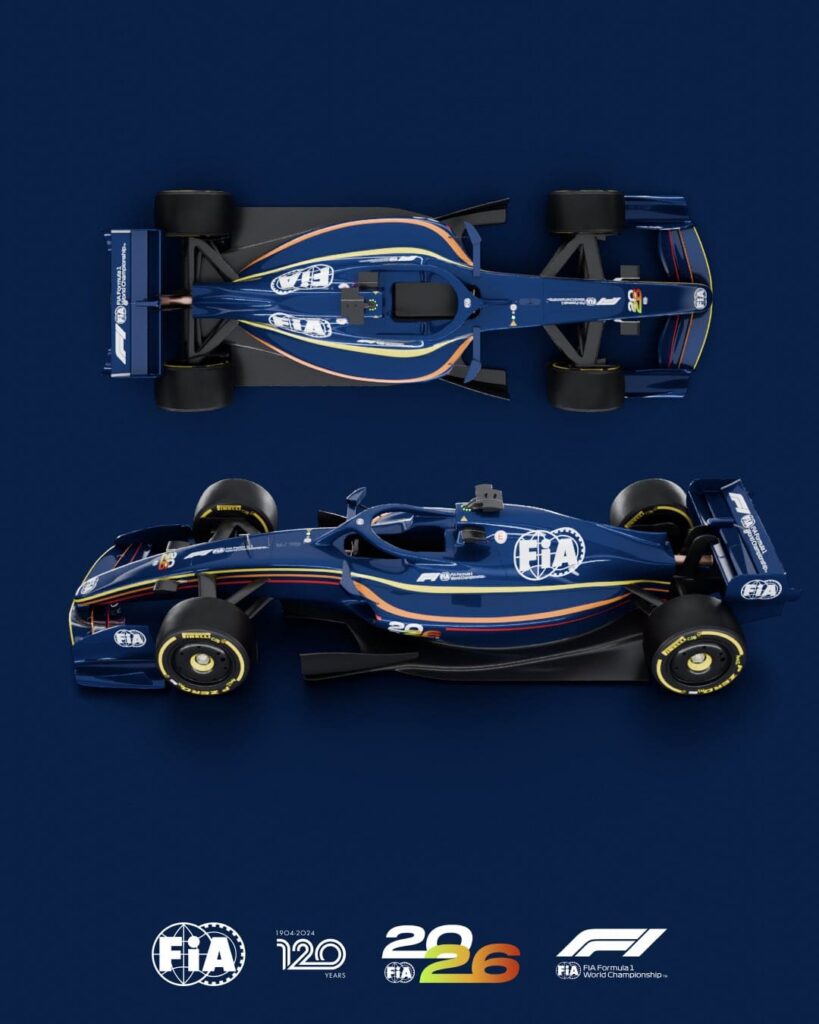
The FIA have released the F1 2026 car, which includes ditching DRS, having smaller and lighter cars and active aerodynamics.
The FIA are making a concerted effort to make the cars more nimble – reducing their weight by 30 kg after they have become so heavy over recent years.
[adrotate banner=”10″]
Get 10% off all official F1 Merch at TheRaceWorks.com using code ‘EF1‘ at checkout.
DRS will be replaced by a ‘manual override system’ which will aid cars behind to overtake by giving them an extra boost of electrical energy.
The active aero is aimed at improving the efficiency of the cars down the straights. The rear wing will have three moveable elements, while the front wing will have two.
At defined points on the circuit, the drivers will be able to flick between the high downforce Z mode to the low drag X mode for the straights.
There will also be changes to the dimensions of the car to make it easier to follow, including a reduction in downforce.
Chassis changes
- A ‘nimbler’ car by reducing the wheelbase from 3600mm to 3400mm and the width from 2000mm to 1900mm.
- Downforce has been reduced by 30% and drag by 55%.
- The 18-inch wheels have been retained but the width of the front tyres has been reduced by 25mm and the rears by 30mm.
Aero changes
- Active aerodynamics will have high downforce Z mode for corners and low downforce X mode for the straights, the rear wing will have three elements and the front wing two.
- The Front wing will be 100mm narrower than this years design.
- Wheel arches will be removed to reduce the amount of out washing wake and the cars will have in washing control boards that will sit on the front of the side pods to help assist wheel wake control.
- The cars will have a partially flat floor and a lower powered diffuser, reducing the ground effect and therefore reliance on stiff and low suspension setups.
Power unit changes
- Already known was the removal of the MGU-H with and increase in MGU-K output from 120kw to 350kw with the ICE dropping from 550-560kw to 400kw.
- The amount of energy that can be recuperated during braking is doubled, with the amount of recoverable set at 8.5 MJ per lap.
- The manual override system will aid in overtaking by allowing the following car to have 0.5 MJ worth of extra energy up to 337KPH. The leading cars energy will begin to taper off at 290KPH and reach zero at 355KPH.
The aim
FIA single-seater Technical Director Nokolas Tombasiz said that the F1 2026 regulations are directed at increasing the amount of skill needed and to allow closer racing.
“Lighter, more powerful and more focused on driver skill, the 2026 FIA Technical Regulations have been designed to provide closer racing among drivers, increase the competition between teams and improve the spectacle.”
Tombasiz explained
“These regulations mark a significant moment in the future of our sport, as we look forward to a new generation of car and power unit that aims to give fans closer and exciting racing.”
Formula One CEO Stefano Domenicali added
More details will be provided over the Canadian Grand Prix weekend, with the full regulations expected to be published later in June.
[adrotate banner=”3″]
Get 10% off all official F1 Merch at TheRaceWorks.com using code ‘EF1‘ at checkout.