

As Formula 1 heads Down Under, it’s time to dive into the history of Melbourne’s Albert Park circuit.
[adrotate banner=”10″]
Get 10% off all official F1 Merch at TheRaceWorks.com using code ‘EF1‘ at checkout.

Circuit Stats
| Track Length | 5.278km |
| Number of Laps | 58 |
| Race Lap Record | 1:20.235 (Sergio Perez – 2023) |
| Qualifying Lap Record | 1:16.732 (Max Verstappen – 2023) |
| First Grand Prix | 1996 |
| First Race Winner | Damon Hill |
| 2023 Race Winner | Max Verstappen |
Circuit History
Located just a short distance from the heart of Melbourne, you’ll find Albert Park – home of the Australian Grand Prix since 1996. Each year, the public park undergoes a spectacular transformation. Attracting around 450,000 spectators over the four-day race weekend, the event has been completely sold-out in recent years.
Whilst Albert Park has a long history of racing (dating back to 1953), the Australian Grand Prix was initially held in Adelaide between 1985-1995. Formula 1 returned to Melbourne in 1996 and the circuit was completely revamped in preparation. To this day, the only permanent facility is the pit land building. Grandstands, corporate facilities, pedestrian overpasses and most of the trackside fencing is constructed approximately two months before the Grand Prix weekend.
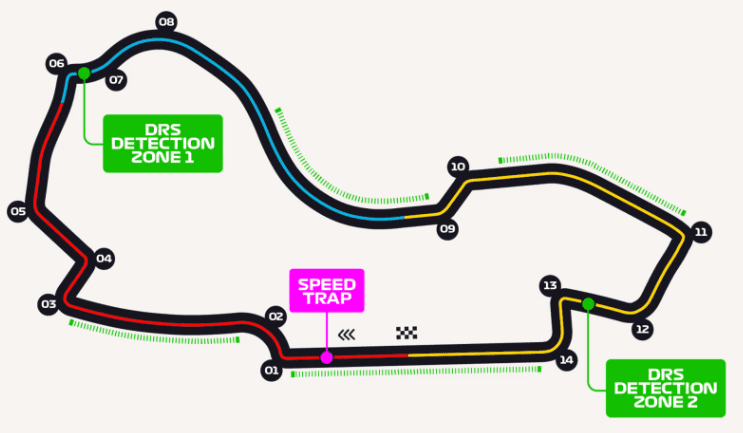
The circuit is considered to be fast, but generally easy to drive. Drivers have commented in the past that they are easily able to learn the circuit thanks to the consistent corner placement. In 2021, the circuit was revamped once more. Seven corners were modified, with two being removed entirely. The pit lane was widened by 2 meters and the track was resurfaced for the first time in 25 years. Overall, the circuit was reduced by 28 meters in length and lap times decreased by approximately 5 seconds.
Last Minute Cancellation
In 2020, the Covid-19 pandemic meant a drastic reshuffle of the F1 calendar. The Australian Grand Prix was still planned to go ahead despite concerns. A McLaren mechanic tested positive when he arrived into Australia, and the team withdrew from the race. A photographer was also later confirmed to have coronavirus. It was announced that the Grand Prix would still take place, but without spectators. However, just two hours before the first practice session was due to begin, the event was cancelled. Formula 1 returned to Albert Park in 2023, bringing the supporting F2 and F3 races with it for the first time.
Public Access & The Future
For the remaining 9 months of the year, Albert Park is not required for Grand Prix duties. During this time, the public can access and drive along most of the track in street-registered vehicles. There are some notable differences compared to the Grand Prix weekend however. Turn 4 is replaced by a car park access road, which runs directly between turns 3 and 5. The road between turns 5 and 6 is completely blocked (although it is possible to drive from turn 5 onto Albert Road, re-joining the track at turn 7. Turn 9 is also a car park, and the chicanes at turns 11 and 12 are much more open than those that F1 drivers have to navigate through.

Formula 1 at Albert Park remains popular in Melbourne and Australia. In June 2022, it was announced that the contract had been extended to 2035. In December 2022, it emerged that the deal had been extended by another two years, running until 2037. The new contract details include that between 2025 and 2037, the Australian Grand Prix will be one of the first three rounds of the season over the contract period. It also stipulates that the Australian Grand Prix will be the season-opener on at least four occasions.
Iconic Moment
In 1996, Martin Brundle went upside down in the land down under, whilst embarking on his first-ever Grand Prix lap for the Jordan GP team. On the opening lap of the race, the Norfolk-native hunted for a gap in the pack going into Turn 3. However, David Coulthard’s McLaren zipped suddenly to the left and clipped Johnny Herbert’s Sauber. Brundle had nowhere to go, slamming into the back of both cars at around 290km/h. The Jordan launched into the air, flipping over the top of Herbert before landing, rolling and eventually coming to a stop in the gravel.
When the dust settled, the damage was clearly visible, with half the engine snapped off and the gearbox missing. Brundle escaped unscathed, immediately trying to find a way to restart the race. Once he had made his way back to the pits, he made his intention to jump into the spare car clear. Only one hurdle stood in his way – medical clearance from F1 Medical Delegate, Sid Watkins. A quick conversation and one question later, he was given the all-clear.
Unaware that his entire mission had been caught on camera, Brundle headed back to the spare car. Reminiscing about what is now an iconic TV moment, Brundle said “a marshal happened to say ‘what did he (Watkins) say?’…I didn’t realise everybody in the world was watching, so when my thumb went up (in response) everyone went mad.”
Sadly, his restart didn’t last long. On lap 2, Brundle was once again involved in a collision…the irony being that it happened at Turn 3. This time, things were a little less dramatic. Brundle ran into Diniz, before slowly spinning and stalling the Jordan and retiring from the race.
What’s your iconic Australian Grand Prix moment? Let us know in the comments!