

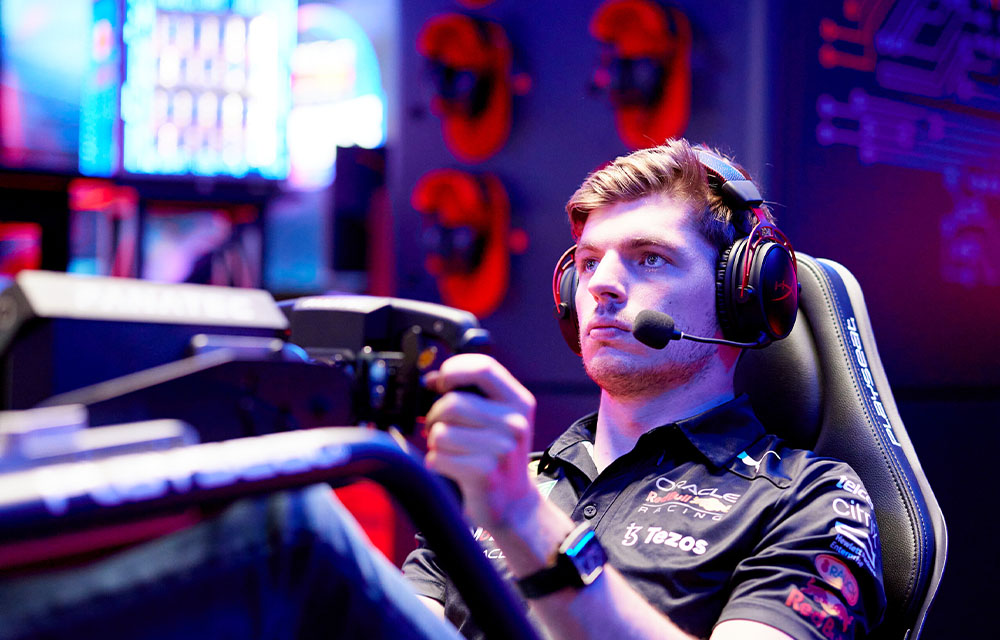
From the sofa to the simulator to the circuit: How the modern world of motorsport is being redefined by gaming.
A quick history lesson on sim racing success stories.
You’re probably familiar with a 2023 movie based on the true story of a boy who was pretty handy at a PlayStation game.
Gran Turismo follows the true story of Jann Mardenborough, gamer turned professional racing driver.

Darren Cox (played by Orlando Bloom in the Hollywood recreation) created the Nissan PlayStation GT Academy. This offered a shot at a professional racing contract for a gamer who could set rapid times on the Gran Turismo game. The Academy’s first winner came in the form of Spaniard, Lucas Ordóñez.
But the movie’s focus is on the series’ third winner, Briton Jann Mardenborough. In his victorious year, over 90,000 budding racers applied – and Jann was amongst the fastest.
The next step for Jann
Next was a test in a real racing car at Brands Hatch. ‘I was clued up on car set-up from games’, he said. This points to the accuracy of modern racing simulators.
It wouldn’t take long for Jann to get a taste for podium champagne. His first outing as a professional driver came in 2012 at the 24 Hours of Dubai, where he secured third place.
That’s a journey from playing games in his bedroom to the podium of an endurance race within one year.
Pretty remarkable stuff, right?
Modern gaming is blurring the lines between what’s on a computer screen and what’s behind a car windscreen. The age-old debate of motorsport being inaccessible to regular people without millions in the bank is easily debatable. Take it from Jann, a PlayStation was all he needed to showcase his raw talent.
There’s a reason why professional, real-life racing drivers swear by their at-home sim set-up. The modern world of motorsport is being redefined by gaming. Let’s get into it.
Building your Foundations (An Introduction to Sim Racing)
Before you ask, Mario Kart on the Nintendo Wii doesn’t count as sim racing. Although, I dare anyone to challenge me on Rainbow Road…
Allied Market Research valued the sim market at $4.86 billion in 2020. This is expected to rise to over $20 billion by 2030, growing 15% in nine years.
Sim racing has gone mainstream, to the point where a controller just doesn’t quite cut it anymore. If you want to mix with the top-calibre drivers in esports, a transition to a proper sim setup is crucial.
There’s a real FOMO if you don’t have your own sim rig. But don’t worry, getting kitted with the essentials is easier and more accessible than ever. Entry-level wheels from the likes of Logitech are plenty good enough to get acquainted with the world of sim racing.
When you’re shopping for your first setup, there are a few things to consider:
- What your budget is (buying equipment for sim racing can get pricey!)
- What platform you’re playing on, be that console or PC (we recommend the latter)
- Which games you’ll play will also be determined by your platform (games like iRacing are PC-only)
- What is your available space? Some of these rigs are beefy!
Once you’re comfortable answering these questions, you’re ready to get building.
The core elements of a sim rig are as follows, but not all elements are essential. You can find more detail in this sim racing guide:
- A rig/cockpit – this is where most of the following pieces of equipment are mounted
- A racing seat – you’re going to be sat in this for many hours at a time, so make sure you’re comfortable. Breathable fabric is a bonus too, especially if you get a wheel with heavy force feedback. These rigs can be a proper workout!
- Monitor and a sturdy monitor stand
- Pedal base
- Wheel mount
- Wheelbase
- Wheel (obviously)
- Pedals (this one too)
- PC or console (and these)
- Accessories like quick-release hubs, nuts, bolts and screws
Why the pros swear by sim racing to improve their skills
You might remember a certain global pandemic in 2020. F1 drivers jumped on their home simulators and raised $100,000 for charity. After all, they couldn’t go to the track, so they brought the track to themselves.
Alex Albon, Charles Leclerc, Lando Norris, George Russell, Antonio Giovinazzi and Nicholas Latifi got strapped into their sim rigs for the ‘Race For The World’ series. The all-star grid also featured notable F1 content creators, as well as F2 and F3 drivers.
What am I getting at here?
These pro drivers didn’t rush out to buy a racing simulator at a moment’s notice. They already had the equipment because of the value a simulator can bring to a professional driver.
Max Verstappen is the first Formula 1 world champion to attribute his success to a sim rig. Most of the F1 grid uses a simulator nowadays (except for a few outliers – more on this later), but Max is at the top of his game in both worlds. His esports team, Team Redline, are frequent front-runners, with Max as part of their main driver roster.
Even more ‘traditional’ racers, like Fernando Alonso, have adopted the sim racing practice to keep up to scratch with the younger talent on the grid.

A slight exception to this rule is Lewis Hamilton. Despite being a seven-time champion, the Brit isn’t convinced that sim racing is worthwhile. Back in his legendary title battle with Verstappen in 2021, Lewis claimed he does ‘only 20 laps on a simulator’ each season, also arguing that a track walk with the team is a waste of time. He attributes the distaste to a lack of true feel of the tyres, g-forces and downforce.
Take this comment from three-time F1 race winner, Johnny Herbert: ‘Hamilton is not among them, having previously shown a dislike to use even the official Mercedes simulator back at the team base, preferring to leave that side of development work to the squad’s reserve drivers’.
1996 F1 Champion, Damon Hill, says that Hamilton’s ‘natural, raw speed’ is starting to wane with the rise of the younger drivers’ involvement in sim racing for practice and track acclimatisation.
WRC’s stunt with former champion
A recent PR stunt with EA’s release of their annual WRC game. WRC2 driver Oliver Solberg took on his dad and 2003 WRC Champion Petter Solberg. Petter was immediately as quick as his son, who uses a sim set up daily.
Petter even asked for a ‘pointier front end’, indicating how realistic the game felt to a real car. Autosport’s Tom Howard touches on this point, suggesting sim racing can bring rise to the ‘stars of tomorrow’.
Oh, and in recent news, Max Verstappen and his sim racing organisation, Team Redline, just won the 24 Hours of Daytona… Enough said.
If the more experienced drivers are using sim rigs to practise, then there’s a clear translation of skills to real-life driving. The modern world of motorsport is being redefined by gaming.
Will sim racing make you a better driver in real life?
What if we approached sim racing from the opposite angle? Instead of being a real-life racer using simulators to sharpen their skills – what if you’re a sim racer who wants to race in the flesh? Can a sim setup help you? Let’s get into it.
I can’t believe I’m this far into an article about sim racing and I’ve not mentioned Jarno Opmeer. He’s the Formula 1 2020 and 2021 Esports world champion, and the biggest name in sim competitive sim racing. At the 2023 Race of Champions in Sweden, he and 2022 F1 Esports champ Lucas Blakeley took on Valtteri Bottas and Mika Hakkinen – and won…
Yes, that’s right. Two esports drivers beat an F1 world champion and a current F1 driver with 10 race wins.

YouTube stars are quick in real life, too.
Even YouTube star Jimmy Broadbent, who’s gained almost one million subscribers on the platform, has started to compete in real-life touring car racing, with great success.
So it’s clear that sim racing is beneficial to driving skills in general, whether that’s on a real track or in a game. Verstappen can mix with the very best esports drivers and Opmeer can beat a former F1 champion.
Sim racing is helping skilled racers be competitive, without the enormous overheads of real-life racing. But when they do get themselves to a track, the accuracy of simulators means they hit the ground running and can immediately mix with the best.
What if you’re not interested in racing?
But what if you’re not interested in racing and just want to sharpen up your daily driving skills? Sim racing’s got you covered with that, too.
A quick visit to the r/SimRacing Reddit thread shows how sim racing has helped day-to-day ability in a car. One user says he treats other road users ‘like he’s in an open Assetto Corsa lobby’. Online racing can be as unpredictable as general driving on public roads.
Another user says he was driving in icy conditions when he lost control of his car. They said their hands and feet just ‘did what needed to be done’ and prevented a crash. This leans heavily on how muscle memory (from either sim racing or real-life driving) can be transferable and useful in both circumstances.
A visit to Alpine Esports HQ
PCGamer, after they visited Alpine F1 HQ in 2023, said the all-French team are leading the way in using sim data in their real setups. Whereas a real F1 car gets limited in data collection by weight restrictions (more sensors = more weight) and bandwidth constraints, this isn’t an issue in sim racing.
Zouhayr Alami, an Alpine F1 data engineer, says the game’s representation of tyre degradation as a percentage change helps to understand the style of their drivers in real life. He even models the real-life data around what he collected from the game.
So if it’s good enough for F1 race winners Pierre Gasly and Esteban Ocon, then it’s probably good enough for your driving, too. Even more evidence that the modern world of motorsport is being redefined by gaming.
Is sim racing worth it? Can it change the world of motorsport?
The skills you learn from sim racing are invaluable and transferable to the real world of racing. Professional racers will use simulators to sharpen their skills. Professional sim racers can jump in the cockpit of a real car and be as quick (if not quicker) as someone who’s raced for years.
You don’t need to be spending £1000s on a setup – having a comparable rig to Max Verstappen might be a little overkill. A budget wheel and cockpit are all you need to start mixing with the best in the esports world. F1 are even branching out into their own sim centres and F1 Arcades are popular tourist attractions.
Find a guide on building your ideal sim rig here, or check out more articles on the world of sim racing at SIMRACINGCOCKPIT.COM